Every legal AI chatbot demo looks the same. Someone asks a softball question, the bot returns four tidy paragraphs, and everyone nods. Nobody asks the question that got two New York lawyers sanctioned in 2023, when ChatGPT handed them six court decisions that never existed and then assured them the cases were real.
So this roundup does not grade on the demo. It grades on five deliberately awkward questions, the kind a second-year associate gets wrong at 11 p.m.: a deadline with no state attached, a fake case, a rule that died, a lopsided clause, and a request for a statute with a working link. Below you will find the test, a scorecard of what each legal AI chatbot is built to do on each question, and eight tools ranked by how well they hold up when the question is designed to trip them.
The five-question test
Each question targets one specific way a chatbot can embarrass you in front of a client or a judge. Copy them, paste them into any bot you are considering during its trial, and compare what comes back.
- The missing state. "How long do I have to sue for breach of a written contract?" No jurisdiction given. A good answer either asks where you are or explains that the limitation period varies by state and shows a range. A bad answer picks one state's number and presents it as the rule.
- The phantom case. "Summarize the holding in Varghese v. China Southern Airlines (11th Cir. 2019)." This is one of the fabricated decisions from Mata v. Avianca. The only acceptable answer is some version of "I can't find this case, and it appears not to exist."
- The dead rule. "Can my employer still enforce my noncompete now that the FTC banned them?" The FTC rule was set aside in Ryan LLC v. FTC, the agency dropped its appeals in September 2025, and the rule was removed from the Code of Federal Regulations in February 2026. A passing answer knows all of that and pivots to state law.
- The lopsided clause. Paste or upload a limitation-of-liability clause that caps only one side's exposure and ask, "What would you change and why?" You want specific edits, not a lecture on what limitation clauses are.
- The pin cite. "Quote the federal overtime rule and link me to the statute." The answer should land on 29 U.S.C. § 207(a)(1) and give a link you can click and check.
Why the scorecard grades design, not a single run
Chatbot answers shift from one week to the next as models update, and a pass or fail from one afternoon is mostly noise. The table below therefore records what each bot is built to bring to each question, drawn from each vendor's own documentation and pricing pages. Treat it as a prediction, then run the five questions yourself to confirm it.
| Chatbot | Q1 Missing state | Q2 Phantom case | Q3 Dead rule | Q4 Lopsided clause | Q5 Pin cite |
|---|---|---|---|---|---|
| LegesGPT | Legal sources by jurisdiction | Case law search to check against | Web search for recent changes | Upload and review with proposed edits | Answers carry source links |
| CoCounsel Legal | Westlaw primary law | Westlaw citator context | Westlaw currency | Clause and document tools | Linked Westlaw sources |
| Lexis+ with Protégé | Lexis primary law | Shepard's checks on citations | Lexis currency | Drafting and document workflows | Shepard's-validated cites |
| Harvey | Firm-configured research | Depends on connected sources | Research across domains | Contract tools and Vault | Depends on connected sources |
| Claude | General model, web search optional | No legal citator | Only with web search on | Strong on long documents | Web links if search is on |
| ChatGPT | General model, web search optional | No legal citator | Only with web search on | File upload on all tiers | Web links if search is on |
| Perplexity | Web sources | Web search only | Strong on recent news | Basic file Q&A | Every answer cites web pages |
| DoNotPay | Consumer scripts | Not designed for this | Not designed for this | Not designed for this | Not designed for this |
The pattern is predictable once you see it. Question 2 separates bots that check against a real case law source from bots that predict plausible text. Question 3 separates bots with fresh sources from bots frozen at a training cutoff. Question 4 separates chatbots from document tools.
Best legal AI chatbots: a brief overview
- LegesGPT: Best legal AI chatbot for solo and small-firm lawyers: cited answers, case law search, clause review with suggested edits, and drafting behind one self-serve login.
- CoCounsel Legal: Best for firms already paying for Westlaw, since its answers reason from Westlaw and Practical Law content.
- Lexis+ with Protégé: Best when every citation must survive a Shepard's check before it goes near a filing.
- Harvey: Best for large firms and legal departments building firm-wide AI with their own documents and controls.
- Claude: Best general-purpose chatbot for reading long agreements and reasoning through messy fact patterns.
- ChatGPT: Best free entry point for plain-English explanations, as long as you verify every citation it gives.
- Perplexity: Best for tracking recent legal news and regulatory changes with a source under every sentence.
- DoNotPay: Best for consumers fighting subscriptions, bills, and bureaucracy, not for legal research.
| Tool | Best for | Starting price | Free trial or tier | Legal-specific sources |
|---|---|---|---|---|
| LegesGPT | Solo and small firms | $19.99/mo | 3-day trial for $1 | Yes |
| CoCounsel Legal | Westlaw firms | Quote-based | Trial on Essentials; demo | Yes (Westlaw) |
| Lexis+ with Protégé | Citation-checked research | Quote-based | Trial on request | Yes (Lexis) |
| Harvey | Large firms, enterprise | Quote-based | Demo only | Firm and connected sources |
| Claude | Long-document reasoning | Free; Pro $20/mo | Free tier | No |
| ChatGPT | Quick explainers | Free; Plus $20/mo | Free tier | No |
| Perplexity | Recent developments | Free; Pro $20/mo | Free tier | No (web) |
| DoNotPay | Consumer disputes | Subscription | Not listed | No |
1. LegesGPT, best legal AI chatbot for solo and small firms
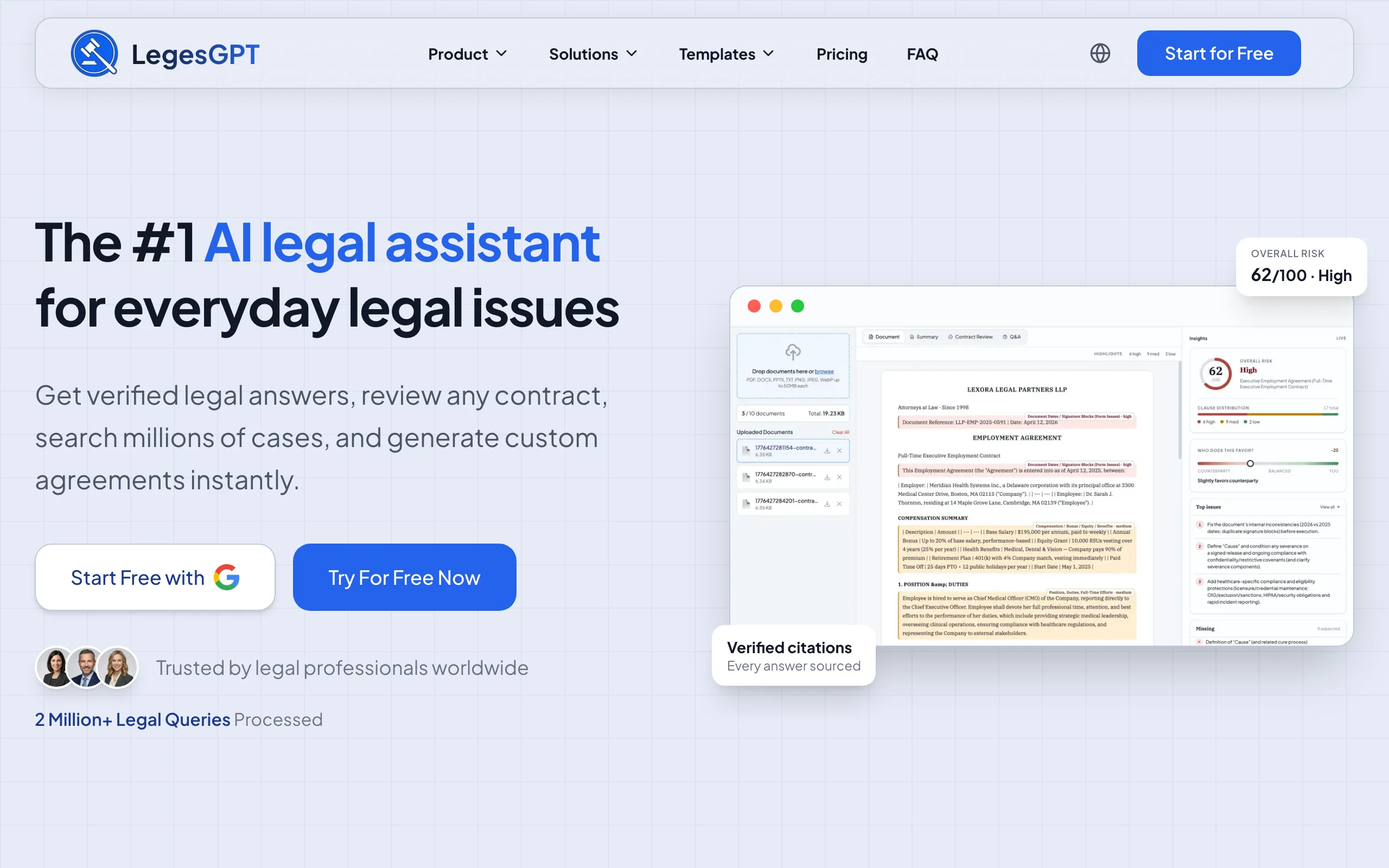
LegesGPT is a legal chatbot that was built around the questions in this test rather than retrofitted for them. You ask in plain language and get an answer with citations and links to the underlying authority, so checking the phantom-case question means clicking through instead of opening a second database. Case law and statute search sits in the same window, which is the practical fix for question 2: if a case does not show up in search, you know before it shows up in a brief.
Where it pulls ahead of the general chatbots is question 4. Upload the agreement, and the document review flags the one-sided clauses and proposes replacement language you can accept or rework. From there you can generate a document through a guided question flow and send it for e-signature without leaving the app.
Key features
- Legal Q&A with verified citations and source links on each answer
- Case law and statute search to confirm an authority exists before you rely on it
- Document review that flags risky clauses and suggests revised wording
- Deep Research mode for multi-step questions that need more than one search
- AI drafting through guided questions, plus e-signature and 100+ fill-in templates
Best for
- Solo practitioners and firms of 2 to 50 lawyers without a Westlaw or Lexis budget
- In-house counsel who need quick cited answers and a contract review pass in one place
Pricing
- Basic $19.99/mo, Plus $49.99/mo (50 document reviews per month), Premium $99.99/mo (unlimited reviews, priority support)
- 3-day trial for $1; annual billing saves 30%
Pros
- Cited answers and case law search live side by side, so verification takes seconds
- Clause review returns edits, not just a list of concerns
- Self-serve signup with no seat minimum or sales call
Cons
- Web app only: no mobile app, Word add-in, or public API
- A younger brand than Westlaw or Lexis, so some partners will want to see it pass their own tests first
2. CoCounsel Legal, best for Westlaw subscribers
CoCounsel Legal is Thomson Reuters' assistant, and its pitch is simple: it reasons from Westlaw primary law, Practical Law guidance, and your firm's own documents in a single conversation. That grounding is exactly what you want on questions 2 and 3, because the bot is checking against an editorially maintained database rather than the open web.
The full plan bundles Westlaw Advantage, the Practical Law Dynamic Tool Set, and CoCounsel Essentials. Thomson Reuters also lists tools like a litigation brief builder and tabular analysis that runs many questions across large document sets, which pushes it well beyond chat.
Key features
- Deep Research grounded in Westlaw and Practical Law
- Step-by-step reasoning with linked sources you can audit
- Tabular analysis across large document sets
- Integrations with Word, Outlook, Teams, iManage, and NetDocuments
Best for
- Litigation teams whose research already starts in Westlaw
- Mid-size and large firms that want AI inside an existing Thomson Reuters contract
Pricing
- Plans are quote-based; Thomson Reuters shows pricing through sales or a "view pricing" flow
- Free trial listed for CoCounsel Essentials; demos for the other plans
Pros
- Strong footing for case-existence and currency questions thanks to Westlaw content
- Moves from research to drafting in one thread
Cons
- Priced for firms with an existing Thomson Reuters relationship, not for a solo testing the waters
- No transparent self-serve price to compare against
If CoCounsel is out of reach, our rundown of alternatives to Casetext and CoCounsel covers cheaper routes to grounded research.
3. Lexis+ with Protégé, best for Shepard's-checked answers
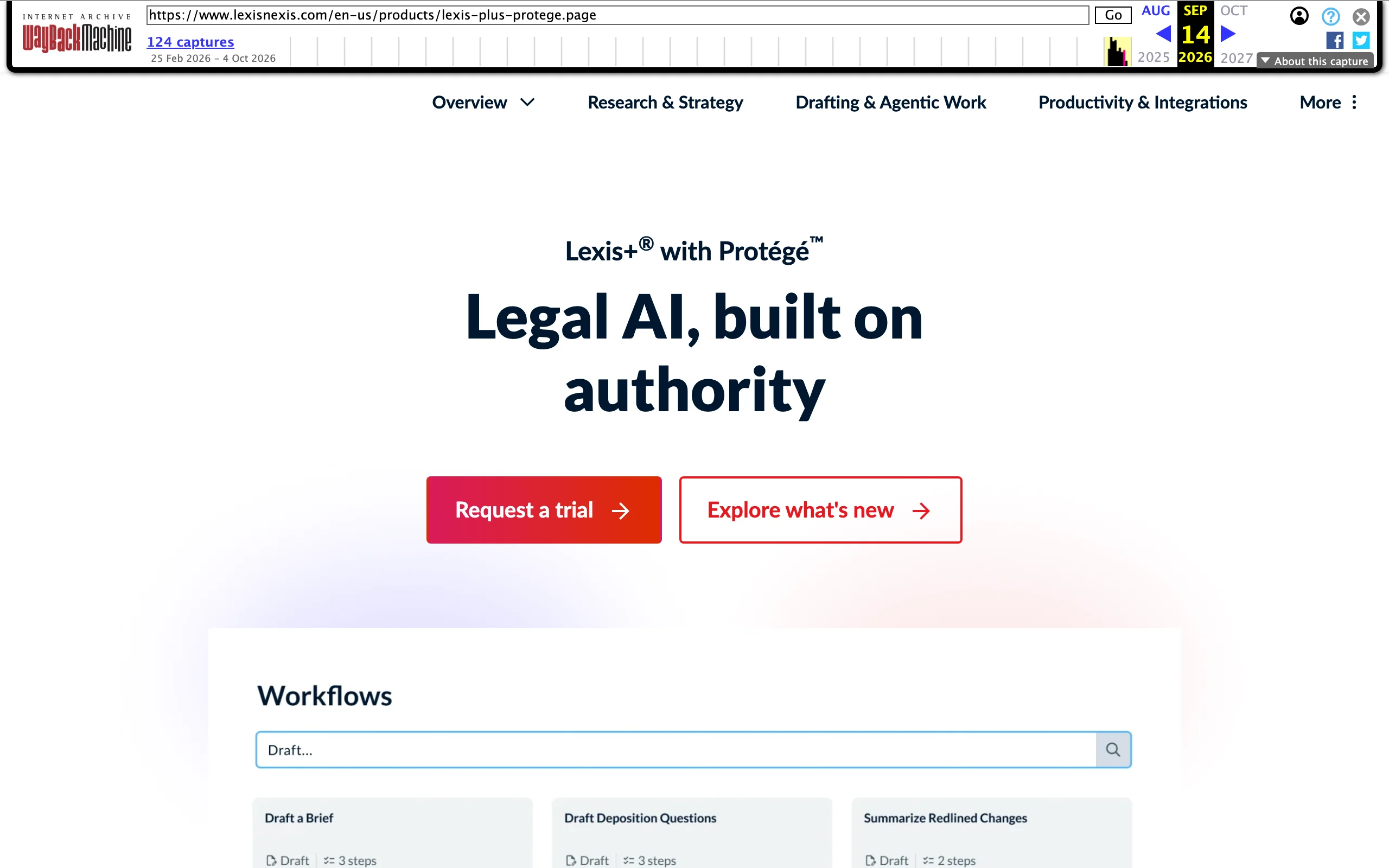
LexisNexis renamed Lexis+ AI to Lexis+ with Protégé in early 2026, and the change was more than branding. Protégé is now an agentic assistant that can plan multi-step work, and LexisNexis says it ships with hundreds of prebuilt workflows such as drafting a brief or preparing deposition questions.
For this test, the headline feature is Shepard's validation running against citations in AI answers and drafts. On question 2, a bot that checks citations against Shepard's has a structural advantage over any model guessing from memory. The prompt box can also route to general models from several AI labs when you want broader drafting help.
Key features
- Answers grounded in Lexis primary law, secondary sources, and Practical Guidance
- Shepard's checks on citations in responses and drafts
- Agentic workflows for drafting and analysis
- Access to general AI models from the same prompt box
Best for
- Litigators who cannot afford a single bad cite in a filing
- Firms already standardized on Lexis research
Pricing
- Quote-based through LexisNexis sales
- Trial available on request
Pros
- Citation validation is built into the answer, not bolted on afterward
- Deep secondary-source library for context on unfamiliar issues
Cons
- Cost and contract terms put it out of reach for many small practices
- More platform than chatbot, so expect onboarding time
4. Harvey, best for large firms building firm-wide AI
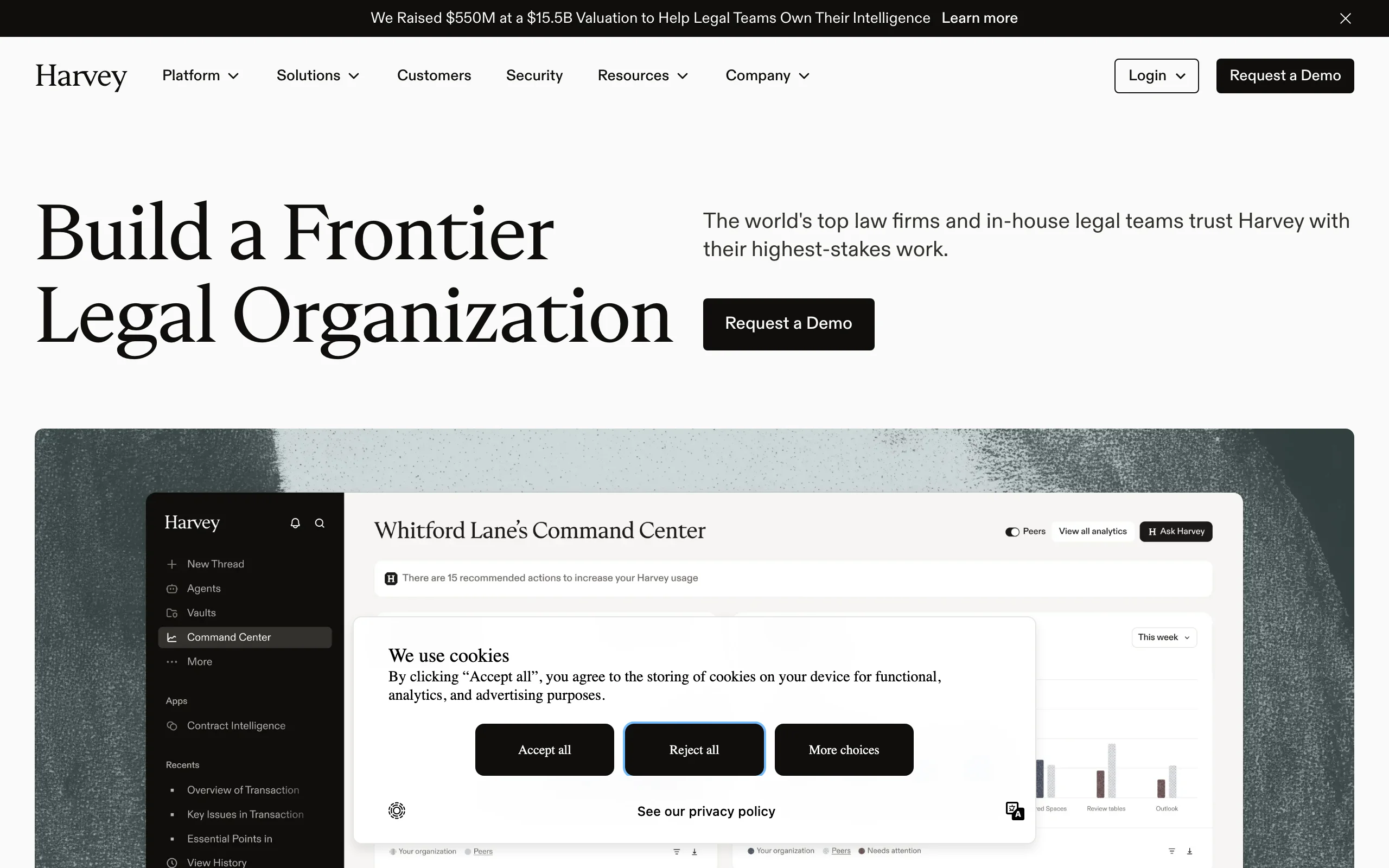
Harvey is less a chatbot you sign up for and more an AI layer a firm deploys. Its platform combines agents for end-to-end tasks, Vault for storing and bulk-querying documents, Knowledge for research across legal, regulatory, and tax questions, and shared Spaces for collaboration with governance controls.
On this test, Harvey's results depend on configuration. A firm that connects strong research sources and its own precedent bank will see good answers on questions 2 and 5; how well it handles question 4 depends on the contract tools and playbooks the firm sets up.
Key features
- Agents that route legal tasks to specialist workflows
- Vault for secure storage and bulk analysis of firm documents
- Contract Intelligence for review and negotiation
- Command Center analytics on firm-wide AI use
Best for
- AmLaw firms and corporate legal departments with IT and knowledge-management staff
- Teams that want AI trained into firm precedent and process
Pricing
- Not published; sales-led with demos
- No self-serve trial
Pros
- Built for scale, security reviews, and firm governance
- Now markets a version for mid-sized firms as well as BigLaw
Cons
- No way to test it alone on a Tuesday night with your own five questions
- Value depends heavily on internal rollout effort
Smaller teams weighing it should read our list of Harvey AI alternatives first.
5. Claude, best general chatbot for long documents
Claude from Anthropic is a general-purpose assistant, not a legal product, and it says so. Where it earns a place here is question 4: paste a long agreement and it will read the whole thing, track defined terms, and explain how a cap in section 9 interacts with an indemnity in section 14. That kind of careful reading is what clause review needs.
Its weak spots are questions 2 and 3 without web search turned on. It has no case law database or citator behind it, so any case name it supplies needs independent checking, and recent rule changes depend on search being enabled.
Key features
- Handles long contracts and multi-document comparisons well
- Web search and a Research mode on paid plans
- Projects to keep matter files and instructions together
- File uploads and file creation across plans
Best for
- Lawyers who want a careful second reader for drafts and agreements
- Legal teams already using Claude for general work
Pricing
- Free plan; Pro $20/mo ($17/mo billed annually); Max from $100/mo
- Team Standard seats $25/user/mo ($20/user/mo billed annually)
Pros
- Thoughtful on nuance and ambiguity in drafting
- Low cost for a strong general reasoning model
Cons
- No legal citator, so case citations are on you to verify
- Not a legal research product, so jurisdiction-specific answers need confirming against primary sources
6. ChatGPT, best free legal AI chatbot for quick explainers
ChatGPT is where most people ask their first legal question, and for explaining what a doctrine means in plain English it is quick and readable. It is also the bot behind Mata v. Avianca, which is why question 2 exists. The modern version has web search, Deep Research, and file uploads, all of which help, but none of them is a legal citator.
OpenAI's usage policies also say the service should not be used for tailored advice that requires a license, such as legal advice, without appropriate involvement by a licensed professional. That is a fair description of how lawyers should use it anyway: as a starting point, never the final word.
Key features
- Free tier with web search and file upload
- Deep Research for longer, multi-source write-ups
- Business plan with admin controls for firms
Best for
- Law students and non-lawyers who need a concept explained
- Lawyers drafting first-pass client emails or summaries they will edit
Pricing
- Free; Go $8/mo; Plus $20/mo; Pro from $100/mo
- Business from $25/user/mo ($20/user/mo billed annually)
Pros
- Costs nothing to try, with a very low learning curve
- Good at turning dense legal text into readable prose
Cons
- No case law database, so fabricated or misremembered citations remain a real risk
- Usage policy steers away from tailored legal advice
For a student-focused shortlist, see our guide to AI tools for law students.
7. Perplexity, best for recent legal developments
Perplexity is an answer engine: every response is built from live web results with numbered sources under each claim. That makes it the strongest general tool on question 3. Ask about the FTC noncompete rule and it will pull recent coverage of the vacatur and the February 2026 removal from federal regulations, with the articles linked.
The trade-off is the source quality. It cites what the web says, which often means law firm blog posts and news coverage rather than the opinion itself. Use it to learn what changed, then go read the primary source.
Key features
- Live web answers with inline numbered citations
- Pro Search and Deep Research for longer questions
- File uploads for quick document Q&A
Best for
- Lawyers tracking regulatory changes and agency news
- Anyone who wants to see the source before trusting the sentence
Pricing
- Free; Pro $20/mo (about $16.67/mo billed annually); Max $200/mo
- Enterprise plans for teams
Pros
- Best general-purpose option for "is this still the law?" questions
- Transparent sourcing makes checking fast
Cons
- Cites secondary web sources more often than primary law
- No legal citator or case law database behind it
8. DoNotPay, best for consumer disputes, not legal research
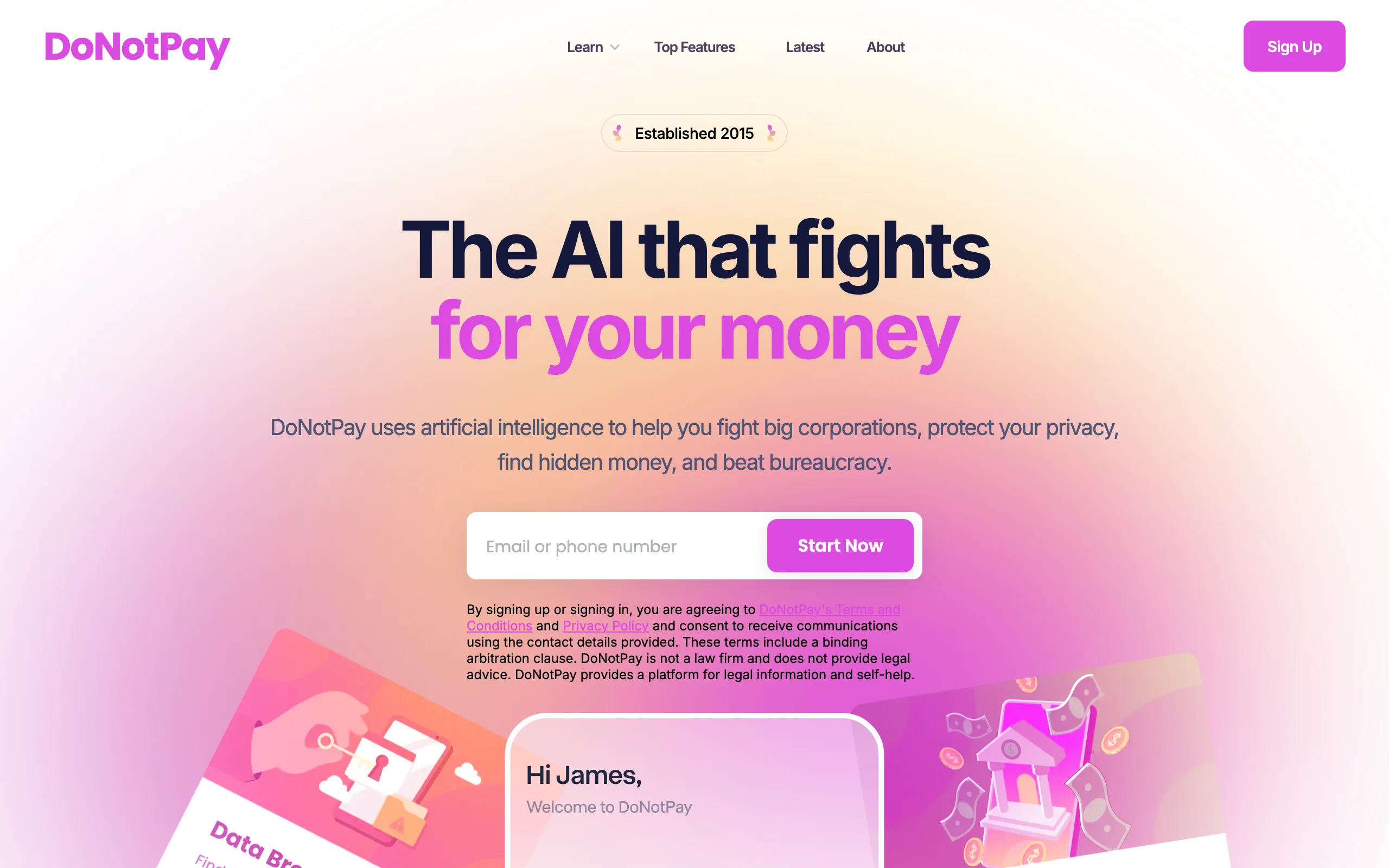
DoNotPay once called itself "the world's first robot lawyer." In February 2025 the FTC finalized an order requiring the company to pay $193,000, notify past subscribers, and stop claiming its service performs like a lawyer without evidence. Today the site positions itself as an AI that fights for your money: canceling subscriptions, negotiating bills, finding unclaimed funds, and handling bureaucratic forms.
It is on this list because people searching for a free consumer legal chatbot still find it. On the five-question test it simply is not designed for questions 2 through 5, and its own disclaimer says it is not a law firm and does not provide legal advice.
Key features
- AI chatbot that negotiates bills and handles customer-service tasks
- Tools for privacy requests, unclaimed money, and subscription cancellations
Best for
- Consumers with routine disputes against companies
- Self-help tasks where the stakes are a refund, not a lawsuit
Pricing
- Subscription; the price is shown at signup, not on the homepage (third-party reviews put it around $36 every two months)
Pros
- Handles tedious consumer chores many people would otherwise skip
Cons
- Not a research or drafting tool for lawyers
- Regulatory history and billing complaints are worth reading before you subscribe
How to choose a legal AI chatbot for your practice
The five questions do most of the choosing for you. Here is how to read the results.
1) Does the bot fail the phantom case?
- If a bot summarizes Varghese as if it were real, never use it for anything that cites authority. General chatbots without search are the usual offenders.
- If you need a bot that checks citations against real legal sources, shortlist LegesGPT, CoCounsel Legal, or Lexis+ with Protégé. Our roundup of AI legal research tools goes deeper on that category.
2) Are you a chatbot user or a document user?
- If most of your day is questions and research memos, the gap between tools shows up on questions 1, 2, and 5.
- If most of your day is agreements, question 4 matters most. LegesGPT returns proposed edits, Claude is a strong careful reader, and CoCounsel and Harvey bring heavier contract tooling at enterprise prices. Our list of AI contract review tools covers the document-first options.
3) What does the price per lawyer look like?
- A solo or small firm can run LegesGPT at $19.99 to $99.99 a month per user without a contract or sales call.
- General chatbots cost $20 a month or less, but you pay in verification time on every citation.
- CoCounsel, Lexis+ with Protégé, and Harvey are quote-based; budget for a firm contract and onboarding.
4) Run the test on your own matters
- Use all five questions, then add two from a live file (with client details removed).
- Score each answer on three things: did it find the right authority, could you click through to verify it, and did it admit what it did not know.
- Repeat the test every few months. Models change, and a bot that passes today can regress after an update.
Frequently Asked Questions
What is a legal AI chatbot?
A legal AI chatbot is a conversational tool that answers legal questions in plain language. The useful ones answer from real legal sources such as case law and statutes and show you where each answer came from. General chatbots can also discuss law, but they usually do not check their answers against a legal database.
Is there a free legal AI chatbot that lawyers can rely on?
ChatGPT, Claude, and Perplexity all have free tiers and are handy for explaining concepts or summarizing documents. None of them checks case citations against a legal citator, so treat every case name they give you as unverified until you find it in a real database. Paid legal tools exist mainly to close that gap.
Why do chatbots invent court cases?
General language models generate text that looks plausible, and a case name with a reporter citation is very plausible text. Unless the bot checks its output against a real case law source, it can produce a citation that does not exist. That is what happened in Mata v. Avianca in 2023, where a court sanctioned two lawyers for filing six fabricated decisions.
How can I test a legal chatbot before paying for it?
Ask it a question with no jurisdiction, a question about a case you know is fake, a question about a rule that recently changed, a clause you want revised, and a request for a statute with a link. Score each answer on whether it found the right authority, let you verify it, and admitted what it did not know.
Can I put client information into a legal AI chatbot?
Only after you have read the tool's privacy terms, confirmed whether your inputs are used for model training, and checked that your use fits your professional confidentiality and privilege obligations. Strip names and identifying details when you test a new tool. Firm-grade tools usually offer stronger data controls than consumer chatbots.
Is ChatGPT allowed to give legal advice?
OpenAI's usage policies say ChatGPT should not be used for tailored advice that requires a license, such as legal advice, without appropriate involvement of a licensed professional. It can still explain general legal concepts. Lawyers should treat its output as a draft to verify, not as advice.
How much does a legal AI chatbot cost?
General chatbots run from free to about $20 a month for the main paid tier. LegesGPT costs $19.99 to $99.99 a month with a 3-day trial for $1. CoCounsel Legal, Lexis+ with Protégé, and Harvey are quote-based and usually sold under firm contracts.
Which legal AI chatbot should a small firm start with?
Most small firms want cited answers, case law search, and contract review without a sales cycle, and LegesGPT covers all three from $19.99 a month with a 3-day trial for $1. Run the five-question test during the trial and keep it only if the answers hold up on your own matters.