A single missed clause in a contract can cost a client a lawsuit, a renewal, or a right they did not know they were giving up. Manual review catches most of it, but it is slow and it does not scale when a deal lands 40 agreements on your desk at once. AI contract review tools change the math: they read an agreement in minutes, flag risky or missing terms, extract key obligations, and compare language against your standards or the market.
The category runs from self-serve apps a solo lawyer can start today to six-figure enterprise platforms with a procurement cycle. This guide compares the 7 best AI contract review tools in 2026, covering what each one reviews, who it fits, real pricing, and the honest trade-offs, so you can match a tool to your contract volume and budget.
Best AI contract review tools: a brief overview
Here is a quick snapshot of the 7 tools and what each does best:
- LegesGPT: Best overall and best value: reviews documents to flag risks and propose changes, then drafts and signs, in one affordable platform.
- Spellbook: Best for review inside Microsoft Word: redlines and clause suggestions where lawyers already draft.
- Robin AI: Best for high-volume review: fast review, redlining, and obligation extraction at scale.
- Luminance: Best for enterprise due diligence: anomaly detection across thousands of contracts at once.
- Kira (Litera): Best for M&A due diligence: machine-learning provision extraction trusted across large firms.
- Ironclad: Best for review inside a CLM: AI review built into a full contract lifecycle workflow.
- Juro: Best for in-house mid-market teams: AI review and contract management in one collaborative platform.
| Tool | Best for | Starting price | Free trial | Platform |
|---|---|---|---|---|
| LegesGPT | All-in-one review and drafting | From $19.99/mo | 3-day for $1 | Web app |
| Spellbook | Review inside Word | Quote-based (~$99+/user/mo est.) | Demo only | Word add-in |
| Robin AI | High-volume review | Pro $100/user/mo (free tier) | Free tier | Web app |
| Luminance | Enterprise due diligence | Custom enterprise | Demo only | Web / on-prem |
| Kira (Litera) | M&A due diligence | Custom enterprise | Demo only | Web app |
| Ironclad | Review inside a CLM | Custom enterprise | Demo only | CLM platform |
| Juro | In-house mid-market | Quote-based | Demo only | CLM platform |
Pricing note: LegesGPT and Robin (Pro) publish standard prices. Spellbook, Luminance, Kira, Ironclad, and Juro quote per organization, so those figures are public estimates or "custom," not list prices. Confirm before budgeting.
1. LegesGPT, best overall AI contract review tool
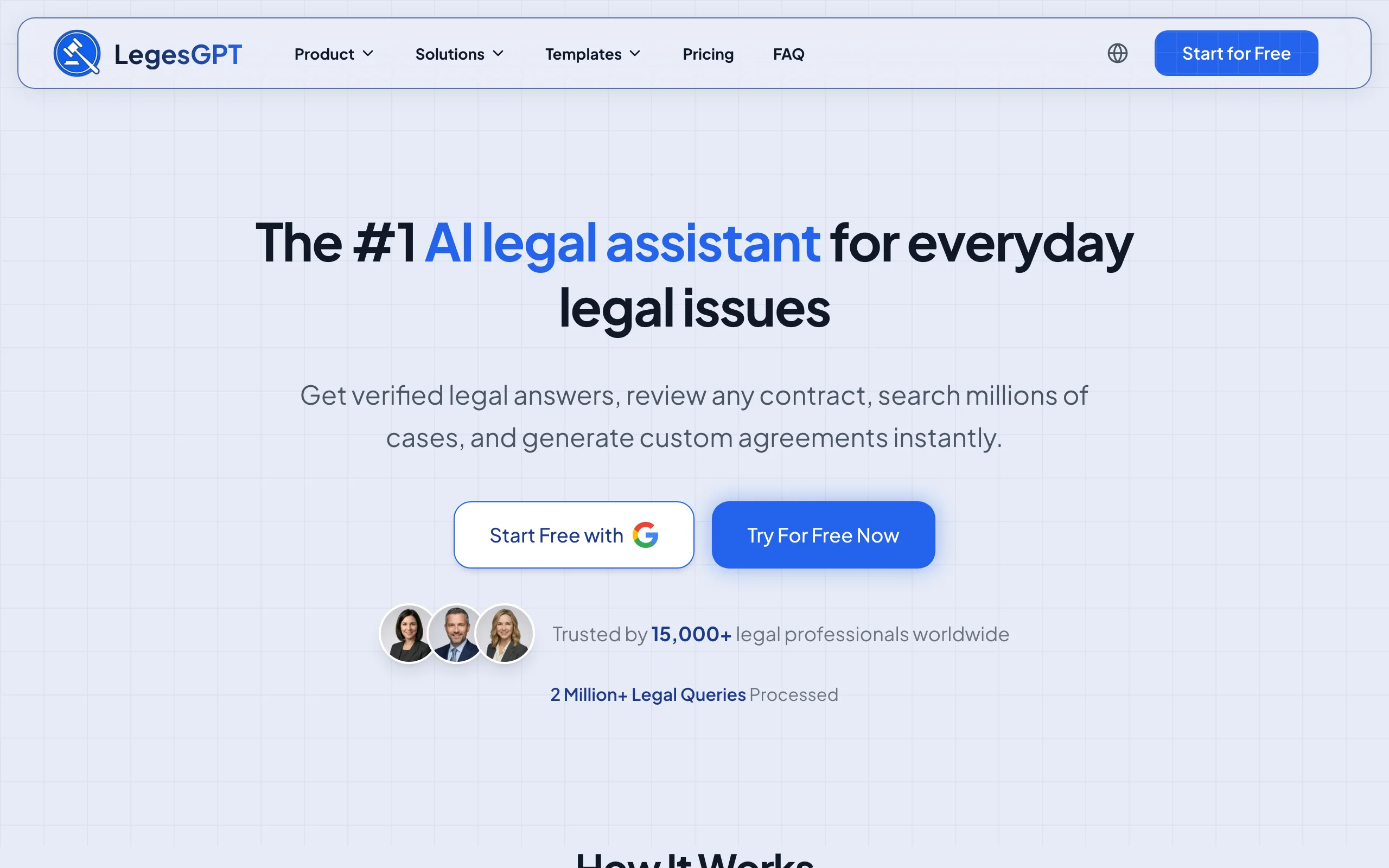
LegesGPT reviews a contract the way a careful associate would: upload the document and it flags the risks, surfaces problematic or non-standard clauses, explains them in plain language, and proposes changes you can accept or refine. It handles PDFs, Word files, and more, and because review sits in the same app as AI drafting and e-signature, you can mark up an agreement, revise it, and send it for signature without switching tools.
What makes it the top pick for most lawyers is the combination of capability and price. There is no enterprise contract, no procurement cycle, and no per-seat minimum. You sign up, start a 3-day trial for $1, and review your first contract in minutes. For solo and small-firm lawyers who want real contract review without enterprise pricing, it is the most complete starting point at the lowest cost.
Key features
- Document review that flags risks and proposes specific changes
- Surfaces problematic or non-standard clauses with plain-language explanations
- Reviews PDF, DOCX, PPTX, TXT, and image files
- AI drafting and e-signature in the same platform, so review flows into finished work
- Attorney-drafted templates to compare or start from
- Verified-citation answers and case law search for the legal questions a contract raises
Best for
- Solo practitioners and small firms that want affordable, capable review
- Lawyers who want review, drafting, and signing in one subscription
- General practices reviewing varied agreements rather than one contract type at scale
Pricing
- 3-day trial for $1 on all plans (no permanently free tier)
- Basic at $19.99/month, Plus at $49.99/month (50 document reviews/month), Premium at $99.99/month (unlimited reviews)
- Roughly 30% off with annual billing; no per-seat minimums
Pros
- Flags risks and proposes fixes, not just a summary
- By far the lowest entry price on this list
- Review connects directly to drafting and e-signature
- Self-serve signup with a $1 trial, no procurement
Cons
- Newer brand with a smaller footprint than legacy enterprise platforms
- Web-only: no native Microsoft Word add-in for in-document redlining
2. Spellbook, best for review inside Microsoft Word
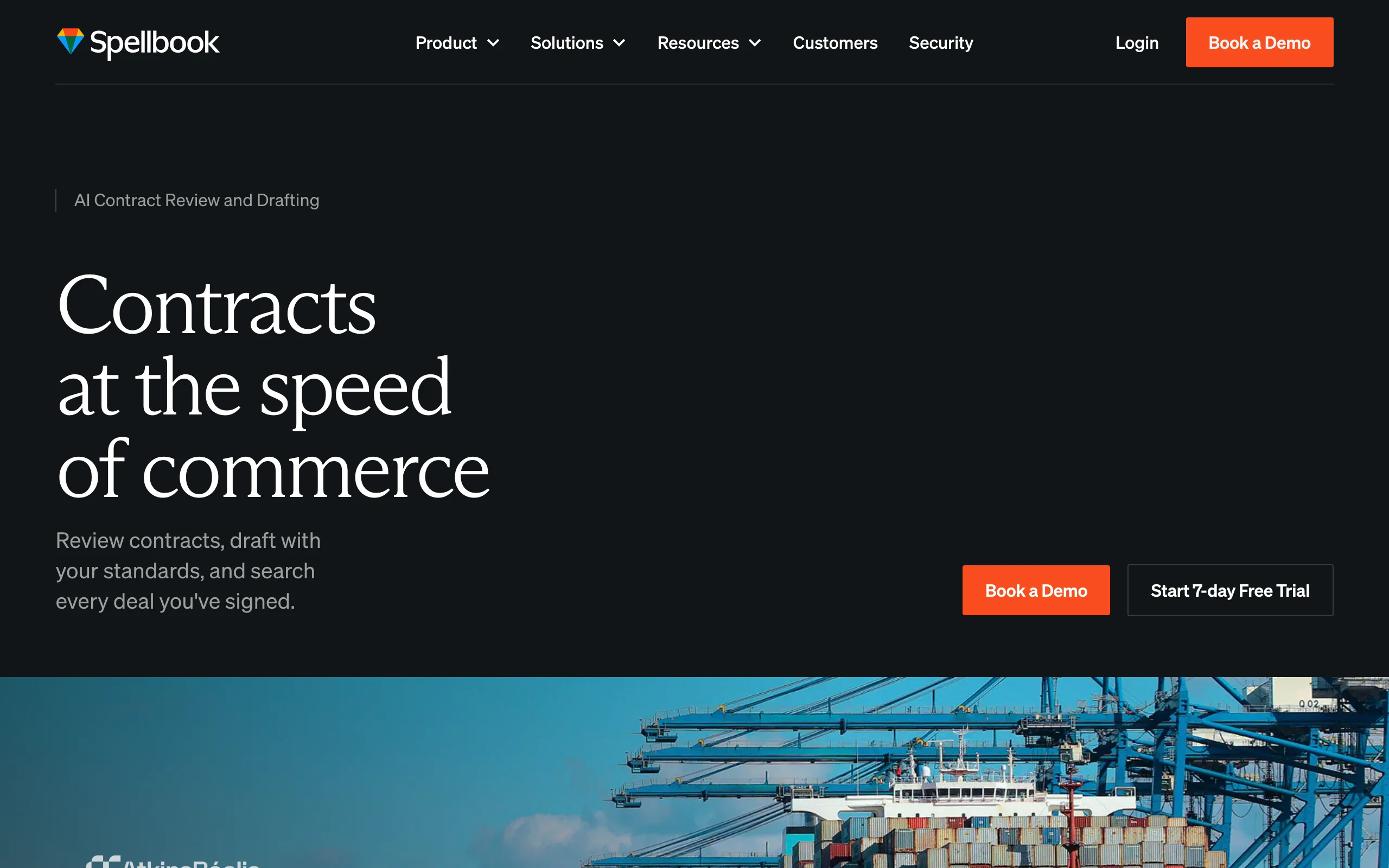
Spellbook works as a Microsoft Word add-in, so it reviews and redlines contracts where transactional lawyers already draft them. It flags missing or aggressive terms, suggests language, and benchmarks clauses against common market positions without making you move text into a separate app. For a contracts practice that lives in Word, removing that context-switch is the entire appeal.
It is purpose-built for drafting and review rather than legal research, so it pairs well with a separate research tool. The main friction is pricing: Spellbook moved to quote-based pricing and raised rates in recent cycles, so the entry cost is higher than it once was and no longer fully transparent.
Key features
- Microsoft Word add-in that reviews and redlines in the document
- Clause and language suggestions based on the contract in front of you
- Risk flagging for missing or non-standard terms
- Benchmarking of terms against common market positions
- Playbooks to enforce a firm's preferred clause standards
Best for
- Transactional and contracts lawyers who work primarily in Word
- In-house teams standardizing clause language across many agreements
- Firms that want AI review without changing their core tooling
Pricing
- Quote-based; Spellbook no longer publishes standard list pricing
- Third-party estimates put entry plans around $99/user/month and up
- Demos and custom quotes only; confirm current pricing before budgeting
Pros
- Reviews and redlines inside Word, with no new interface to learn
- Strong at clause-level suggestions and benchmarking
- Playbooks enforce consistent language across a team
Cons
- Pricing is opaque and has risen
- Focused on contracts, with no legal research or case law
- Tied to Microsoft Word rather than a broader workflow
3. Robin AI, best for high-volume contract review
Robin AI is built for teams that review and negotiate contracts at scale. It analyzes agreements, extracts key obligations, redlines against your standards, and increasingly runs multi-step review through an agent mode. Where a generalist tool reviews one document well, Robin is designed for the legal team processing hundreds of NDAs, vendor agreements, or commercial contracts a month.
It also offers rare pricing transparency for the enterprise contract space: a free tier for light use and a flat-rate Pro plan, with Enterprise reserved for advanced features like centralized obligation management and bespoke playbooks. That makes it easier to trial than most tools at its level.
Key features
- Contract review with redlining and risk flagging against your standards
- Obligation and key-term extraction across large contract volumes
- Reports for contract analysis and data extraction at scale
- Agent mode for multi-step, autonomous review workflows
- Centralized obligation management on enterprise tiers
Best for
- In-house legal and operations teams reviewing high contract volumes
- Companies standardizing NDA and vendor agreement review
- Mid-market teams that want predictable per-user pricing
Pricing
- Free tier for light single-user use (limited daily messages)
- Pro at $100/user/month with unlimited review for small teams
- Enterprise is custom, adding clause comparison, SSO, and bespoke playbooks
Pros
- Genuinely transparent entry pricing, including a usable free tier
- Purpose-built for high-volume review and obligation tracking
- Agent mode handles multi-step review generalist tools struggle with
Cons
- Focused on contracts, so it is not a research or all-in-one tool
- Advanced features and unlimited users require an Enterprise quote
- Less useful for litigation or case law work
4. Luminance, best for enterprise due diligence
Luminance applies AI to large-scale document analysis, the work that defines due diligence and compliance review at big organizations. Point it at thousands of contracts and it surfaces anomalies, clusters similar documents, and highlights what deviates from the norm, compressing review cycles that would otherwise take a team weeks. Its positioning is squarely enterprise, with deployments across large law firms and corporate legal departments.
The depth comes at enterprise cost and complexity. There is no self-serve trial, pricing is quote-only and often modular, and evaluation typically involves a proof-of-concept phase. For a small practice it is overkill, but for a team drowning in contract volume, it is built for exactly that problem.
Key features
- AI document analysis across thousands of contracts at once
- Anomaly detection that flags clauses deviating from the norm
- Automatic document clustering for faster due diligence
- Contract negotiation and review with risk highlighting
- Modular deployment across legal, compliance, and corporate teams
Best for
- Large firms and corporate legal departments running due diligence at scale
- Teams reviewing very high volumes of contracts or M&A document sets
- Organizations that need anomaly detection across large repositories
Pricing
- Custom enterprise pricing only; Luminance does not publish rates
- No advertised free trial; evaluation runs through a demo and proof-of-concept
- Pricing often scales by module and document volume, with implementation costs
Pros
- Excellent at high-volume document analysis and anomaly detection
- Proven in demanding enterprise due diligence and M&A work
- Modular, so large teams deploy only what they need
Cons
- Enterprise-only pricing and onboarding, inaccessible to small practices
- No self-serve trial; evaluation takes weeks
- Specialized for document analysis rather than everyday drafting
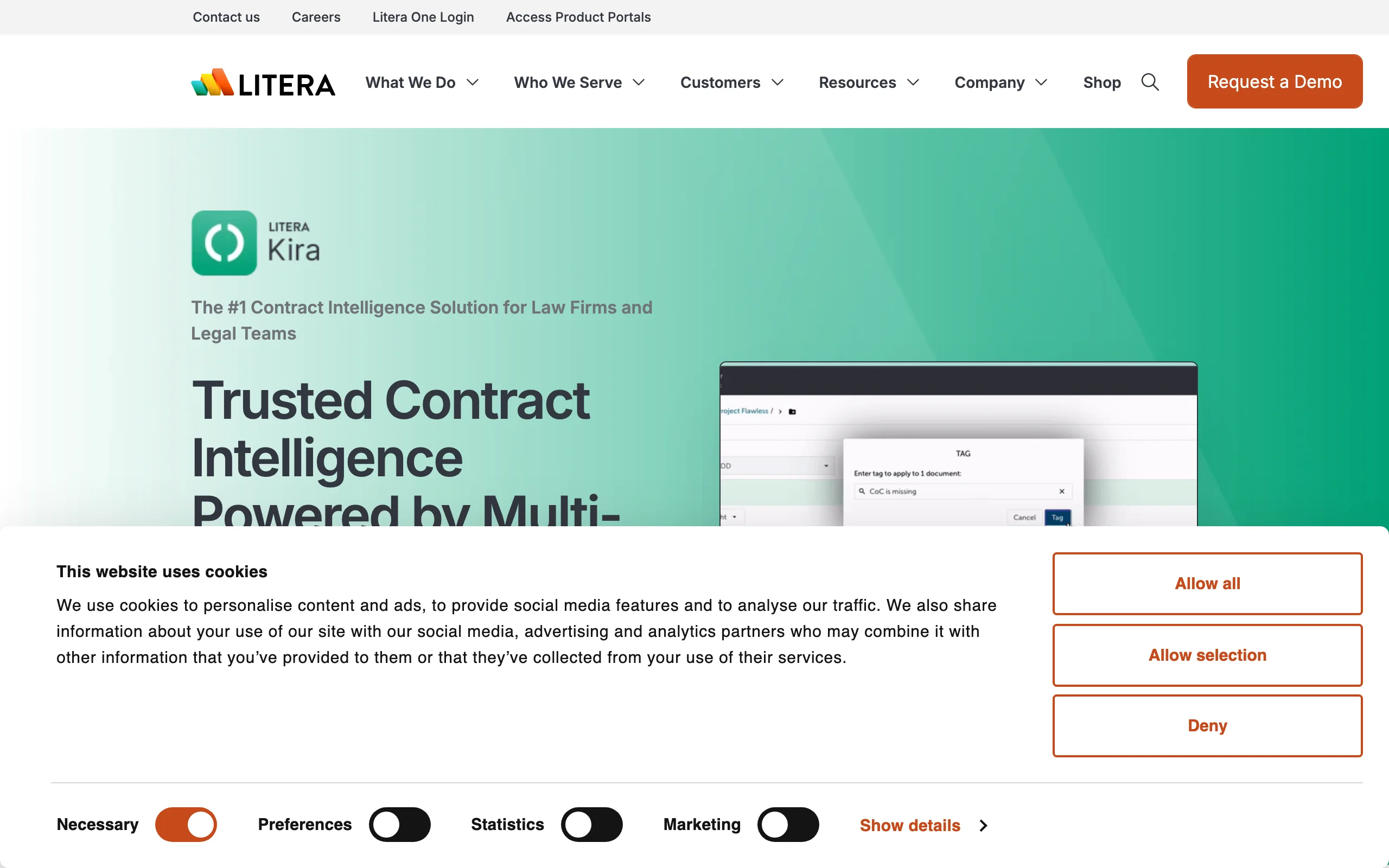
5. Kira (Litera), best for M&A due diligence
Kira, now part of Litera, is a machine-learning platform built to identify, extract, and analyze provisions across large contract sets. It is a fixture in M&A due diligence, where teams need to pull specific clauses, such as change-of-control or assignment provisions, from hundreds or thousands of agreements quickly and consistently. A large share of the biggest firms rely on it for diligence, and Litera has layered generative AI on top of Kira's trained extraction models.
Its strength is depth in provision extraction rather than conversational review. Kira shines when the task is structured analysis across a big repository, not a quick redline of a single NDA. Like other enterprise tools here, it is quote-based and aimed at firms and departments with serious diligence volume.
Key features
- Machine-learning extraction across a large library of trained provision types
- Generative AI layered on top of the proprietary extraction engine
- Built for structured analysis across large contract repositories
- Smart fields spanning many practice areas
- Part of the broader Litera legal-tech suite
Best for
- Large firms running M&A and high-volume due diligence
- Corporate legal teams analyzing big contract repositories
- Practices that need consistent provision extraction at scale
Pricing
- Custom enterprise pricing; Litera does not publish standard rates
- Public estimates range widely, from low five figures to six- or seven-figure firm-wide deals
- Quote-based, scaled to firm size and document volume
Pros
- Proven, deep provision extraction trusted across large firms
- Generative AI now augments the established ML engine
- Strong fit for structured M&A diligence
Cons
- Enterprise pricing and onboarding, not for solo or small firms
- Built for extraction and diligence rather than quick single-contract review
- Strongest within the Litera ecosystem
6. Ironclad, best for review inside a CLM
Ironclad is a contract lifecycle management platform with AI review built into the workflow. Rather than reviewing contracts in isolation, it sits across the full lifecycle, from request and drafting to negotiation, approval, signature, and storage, with AI that redlines, flags risk, and surfaces key terms as part of that flow. For organizations that want contract review to live inside their operational process, not a separate app, that integration is the draw.
The trade-off is that you are buying a CLM, not a standalone reviewer. Ironclad is priced and scoped for mid-market and enterprise teams, with AI capabilities often layered on top of the core platform. For a legal team that already needs CLM, the AI review is a strong bonus; for a solo lawyer who just wants to mark up a contract, it is far more than necessary.
Key features
- AI review and redlining inside a full contract lifecycle workflow
- Risk flagging and key-term extraction during negotiation and approval
- Request, drafting, approval, signature, and repository in one platform
- Integrations across common business and CRM systems
- AI assist and analytics as add-on capabilities
Best for
- Mid-market and enterprise teams that need full CLM, not just review
- Operations-heavy legal teams managing contracts end to end
- Companies standardizing the entire contract process
Pricing
- Custom enterprise pricing; Ironclad does not publish list rates
- Public estimates commonly start in the tens of thousands per year and climb with scale
- AI assist and advanced analytics are typically add-on costs
Pros
- Review lives inside an end-to-end contract workflow
- Strong integrations and process automation
- Scales across legal and business teams
Cons
- You are buying a CLM platform, with review as one part
- Enterprise pricing and implementation, not for small practices
- Overkill if you only need to review individual contracts
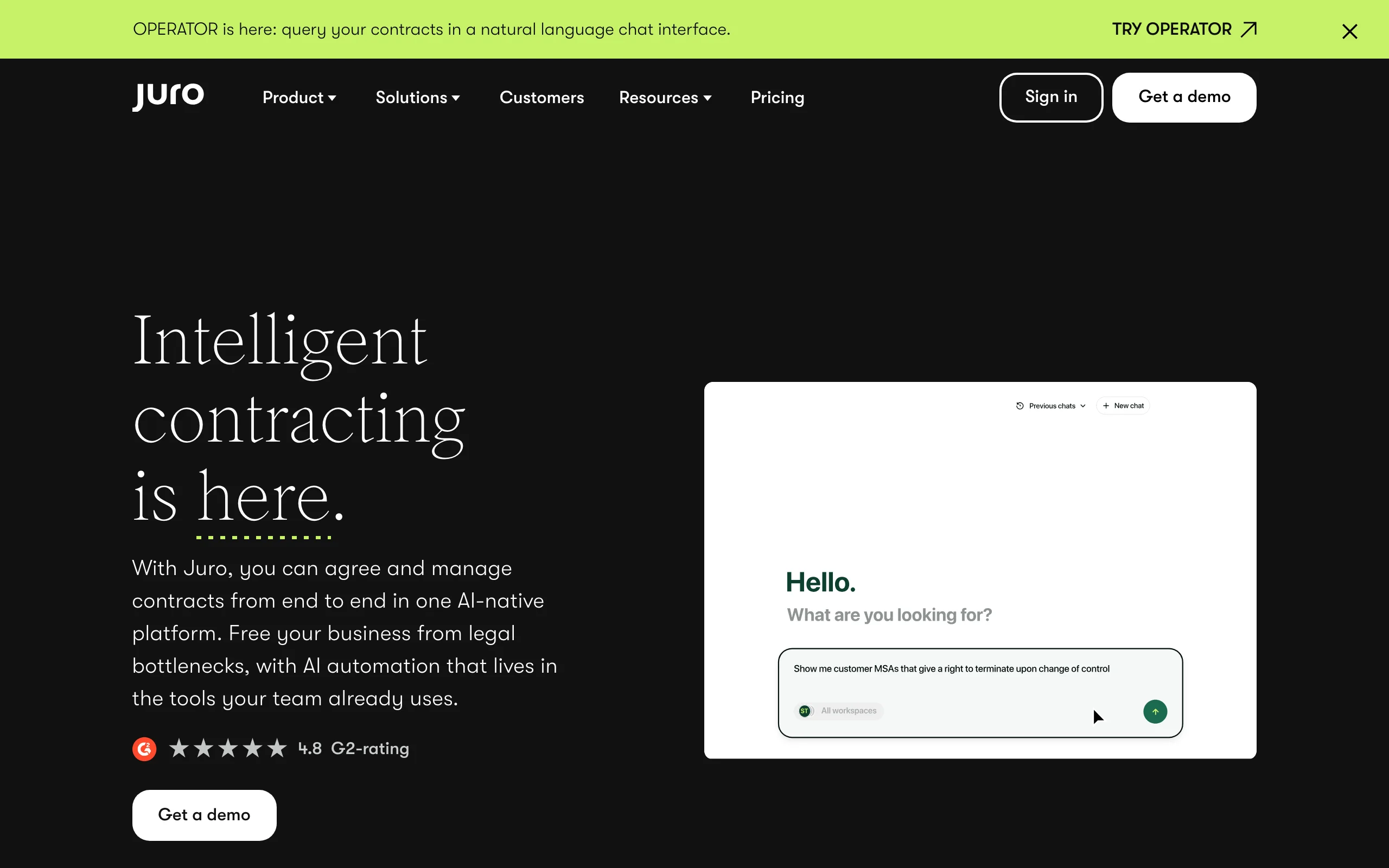
7. Juro, best for in-house mid-market teams
Juro is an AI-native contract platform aimed at in-house and mid-market teams that want review and management in one collaborative tool. It combines AI review, redlining, and data extraction with a browser-based editor where legal and business stakeholders can negotiate and approve contracts together. The pitch is a single place to create, review, and manage agreements without bolting an AI tool onto a separate document workflow.
It sits between a pure reviewer and a heavyweight enterprise CLM: lighter and faster to adopt than the largest platforms, but more structured than a standalone add-in. For a growing in-house team that wants AI review plus a manageable contract process, Juro is a practical middle ground.
Key features
- AI review, redlining, and data extraction in a collaborative editor
- Browser-based negotiation and approval for legal and business users
- Contract creation, management, and repository in one platform
- Templates and automated workflows for routine agreements
- Integrations with common business systems
Best for
- In-house and mid-market legal teams wanting review plus management
- Growing companies that need a manageable contract process
- Teams that want business stakeholders to collaborate in the tool
Pricing
- Quote-based; Juro does not publish standard list pricing
- Tiered by team size and feature needs, with demos on request
- Positioned below heavyweight enterprise CLM platforms
Pros
- AI review combined with a usable, collaborative contract workflow
- Faster to adopt than the largest enterprise CLMs
- Good fit for in-house teams that want one tool
Cons
- Pricing is not transparent; a quote is required
- More than a solo lawyer needs for occasional review
- A platform commitment, not a lightweight add-on
How to choose the best AI contract review tool for your practice
1) How many contracts do you review, and of what kind?
Volume and variety point to different tools. If you review a steady stream of varied agreements, an all-in-one like LegesGPT covers it affordably. If you process hundreds of similar contracts a month, Robin AI is built for that throughput, and Luminance and Kira handle large due-diligence sets. If you mostly draft and mark up in Word, Spellbook fits your existing workflow.
- Varied agreements, general practice: LegesGPT
- High volume of similar contracts: Robin AI
- Large M&A or diligence sets: Luminance or Kira
2) Standalone review or a full contract workflow?
Some tools just review; others manage the whole contract lifecycle. If you want review only, LegesGPT, Spellbook, or Robin AI keep it simple. If you need request-to-signature management with AI review built in, Ironclad and Juro are CLM platforms first. Buying a CLM for occasional review is overkill, but if you already need the workflow, the integrated AI is a real bonus.
3) What is your budget and team size?
Budget separates this list sharply. Enterprise platforms like Luminance, Kira, and Ironclad run into five and six figures and assume a procurement process. Juro and Spellbook are mid-market and quote-based. LegesGPT starts at $19.99/month with a 3-day trial for $1, and Robin AI offers a free tier, so solo and small teams have accessible entry points the enterprise tools do not.
- Solo or small firm: LegesGPT, or Robin AI's free tier
- Mid-market in-house: Juro, Spellbook, or Robin AI Pro
- Large firm or enterprise: Luminance, Kira, or Ironclad
4) Test on your own contracts before committing
Run a real agreement you know well through your top pick and check whether it catches the issues you would. Then try a messier, non-standard contract. LegesGPT offers a 3-day trial for $1 and Robin AI a free tier, so you can test the accessible options at little cost, while the enterprise tools require a demo and proof-of-concept. Reviewing a contract you already understand is the fastest way to judge accuracy.
Finally, "review" is a broad label, and if your need is more specific we have dedicated comparisons for each slice of the category: contract analysis software for in-depth extraction from individual agreements, AI contract risk analysis software for pre-signature risk scoring and triage, contract intelligence software for portfolio-wide contract data, and contract reading software for plain-language comprehension of agreements before you sign.