Contract intelligence software turns a drive full of signed PDFs into data you can actually query: who your counterparties are, when renewals hit, which agreements carry uncapped liability, and what your side promised to deliver. Instead of assigning someone to reread agreements every time finance or procurement asks a question, the AI extracts key terms, tracks obligations, and summarizes risk in language the business understands.
One definitional line separates this category from its neighbors: contract intelligence is the portfolio discipline. Analysis tools dig into one agreement at a time, review tools redline a draft in negotiation, but intelligence platforms treat the whole contract estate as a dataset to be extracted, tracked, and reported on. If your actual bottleneck is understanding the single contract that arrived this morning, our contract analysis software comparison is the more useful list; for negotiation-stage markup, start with the best AI contract review tools.
The market splits sharply by scale. At one end sit enterprise platforms that index repositories of 20,000 contracts and take months to deploy. At the other, per-document tools a solo GC can start using before lunch. Prices span three orders of magnitude, and most vendors will not publish a number.
This guide compares 6 contract intelligence platforms across that entire range, with real pricing where it exists, honest trade-offs, and a short framework for matching a tool to the way your team actually works.
Contract intelligence software: a brief overview
- LegesGPT: Best overall for solo and small legal teams: risk flags, key-term extraction, and plain-language contract answers from $19.99/month with no CLM deployment.
- Luminance: Best for AI agents across a full contract portfolio: the Lumi assistant answers cited questions from first draft through repository-wide analysis.
- LinkSquares: Best mid-market CLM with intelligence built in: the LinkAI engine surfaces key terms, obligations, and risk across every executed agreement.
- Icertis: Best for regulated global enterprises: contract intelligence woven into SAP, Microsoft, and Salesforce workflows with governance at the core.
- Kira (Litera): Best for M&A due diligence at law firms: extraction models trained on legal documents for over a decade, built for data-room-scale review.
- Zuva Analyze: Best pay-as-you-go extraction: $10 per document with 1,400+ pre-built AI fields and no subscription required.
| Tool | Best for | Starting price | Free trial | Jurisdictions |
|---|---|---|---|---|
| LegesGPT | Solo and small legal teams | From $19.99/mo | 3-day for $1 | 38+ countries |
| Luminance | Portfolio-wide AI agents | Custom (contact sales) | Demo only | Global |
| LinkSquares | Mid-market in-house teams | Custom (contact sales) | Demo only | Global (US focus) |
| Icertis | Regulated global enterprises | Custom (contact sales) | Demo only | Global |
| Kira (Litera) | M&A due diligence at firms | Custom (contact sales) | Demo only | Global |
| Zuva Analyze | Pay-as-you-go extraction projects | $10/document ($5K min) | 5 documents free | Global |
1. LegesGPT, best contract intelligence overall for solo and small legal teams
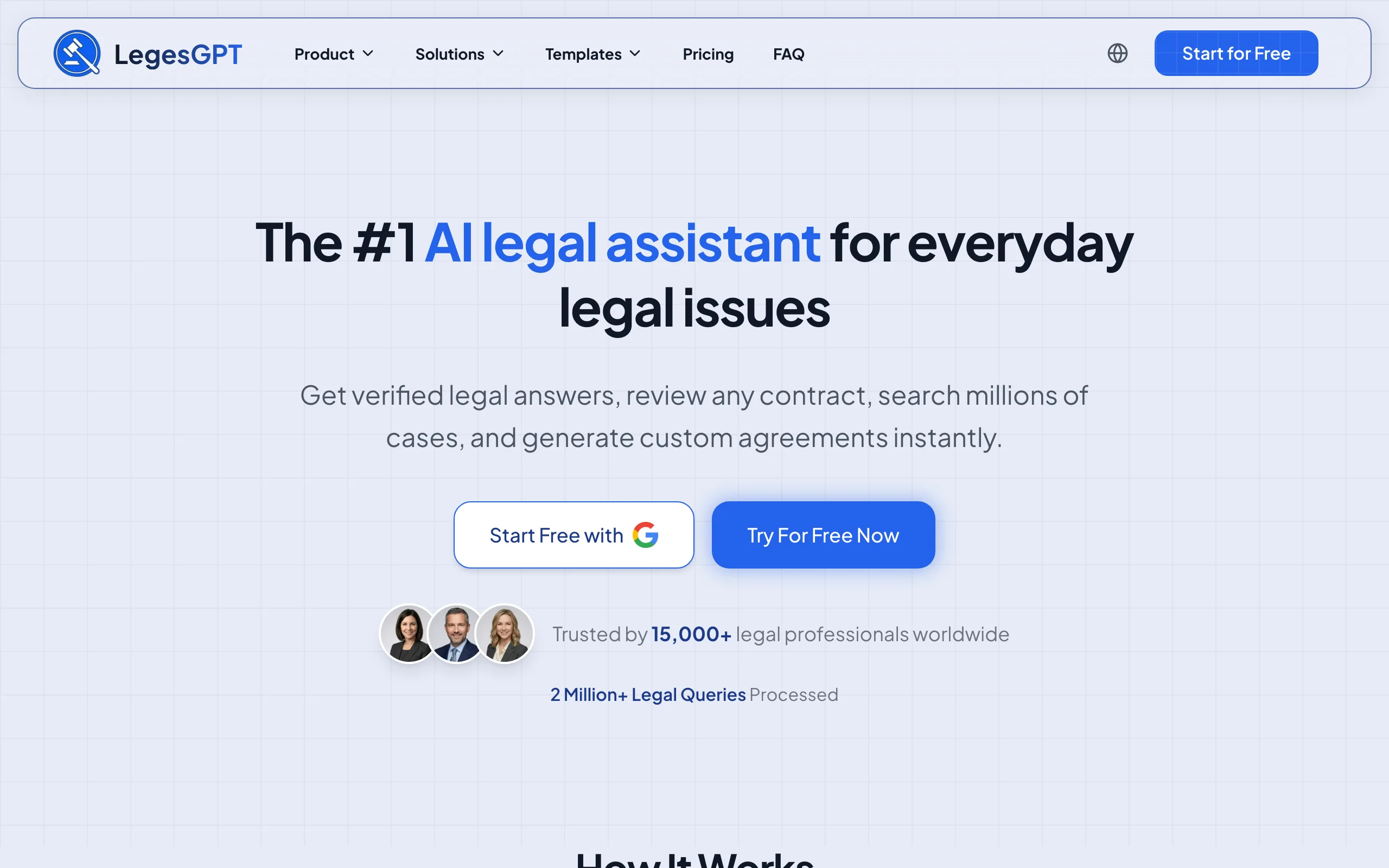
Most contract intelligence platforms assume you have a repository problem. LegesGPT assumes you have a Tuesday problem: a vendor MSA just landed, and someone needs to know what it says, where it bites, and whether to push back. Upload the file (PDF, DOCX, PPTX, TXT, even an image) and LegesGPT pulls out the key terms, flags risky or non-standard clauses with proposed replacement language, and writes a plain-language summary you can forward to the business side without translation.
Because it sits on top of a legal AI assistant that answers questions with verified citations, the intelligence does not stop at the document's edge. When a flagged clause raises a legal question, you research the answer with sources in the same tab, then draft the fix and route it for e-signature.
Key features
- Key-term extraction on demand: parties, dates, renewal windows, payment terms, termination and indemnity provisions
- Risk flagging with concrete suggested edits, not just highlighted text
- Plain-language summaries of dense agreements for stakeholders outside legal
- Legal Q&A with verified citations, plus case law and statute search, for the questions a clause raises
- Deep Research mode and web search for questions that span a contract and current law
- AI drafting, e-signature, and 100+ attorney-drafted templates to act on what the analysis finds
Best for
- Solo GCs and in-house teams of one to five who handle contracts one at a time
- Founders, HR, and procurement leads who sign agreements without a legal department
- Small firms that want contract intelligence without an IT project or sales cycle
Pricing
- Basic at $19.99/month covers AI legal Q&A with citation-verified research; Plus at $49.99/month adds document upload with 50 reviews per month
- Premium at $99.99/month brings unlimited document review, Deep Research mode, and web search
- 3-day trial for $1, and roughly 30% off with annual billing
Pros
- Runs entirely in the browser: no deployment, no seat minimums, no procurement process
- Contract answers arrive paired with cited legal research, not just extracted fields
- An order of magnitude cheaper than every enterprise platform on this list
Cons
- Works document by document; it will not build analytics dashboards across thousands of legacy agreements
- Web-only, with no Word add-in, API, or native mobile app
- A newer brand than the enterprise incumbents below
2. Luminance, best for AI agents working across the whole contract portfolio
Luminance began life in due diligence and now positions itself as an end-to-end AI platform for contracts, with agents that handle drafting, negotiation, compliance monitoring, and investigation. Its conversational assistant, Lumi, is the thread that ties it together: ask a question about a single draft or about obligations buried across the entire estate, and it answers with citations back to the underlying documents.
The distinctive part is continuity. The same AI layer that watched a contract get negotiated also serves repository queries later, so portfolio-level answers carry the context of how each deal was actually papered.
Key features
- Lumi assistant with cited answers across contracts, amendments, and obligations
- AI agents that trigger follow-on tasks automatically based on contract status
- Portfolio-wide natural-language querying of the contract estate
- One AI layer spanning negotiation, workflow, and repository intelligence
Best for
- Legal departments that want AI doing work across the lifecycle, not only extracting data
- Organizations with large, messy contract estates that need answers rather than keyword search
Pricing
- Custom, quote-based; no public pricing, demo required
- Deployments typically scale with team size and contract volume
Pros
- One of the most complete AI-native visions of contract work currently shipping
- Citations behind every answer address the trust gap that dogs generative AI in legal
Cons
- Enterprise pricing and rollout put it beyond small-team budgets
- Its breadth makes evaluation a project in itself; scoping which agents you need takes real effort
3. LinkSquares, best CLM-plus-intelligence for mid-market in-house teams
LinkSquares is the pragmatic middle of this market: a full contract lifecycle platform with the LinkAI engine underneath, reading every executed agreement and turning it into searchable, reportable data. Post-signature intelligence is where it built its reputation, surfacing key terms, obligations, and risk across the whole book of contracts so legal can answer business questions from a dashboard instead of a filing cabinet.
It covers pre-signature work too, including an AI assistant for drafting and redlining with a Microsoft Word add-in, plus playbooks and clause libraries that standardize how deals get papered.
Key features
- LinkAI extraction of key terms, obligations, and risk across the repository
- Analytics and reporting that turn contract data into business answers
- AI drafting and redlining assistant, including a Word add-in
- Automated approvals, task routing, and workflow
- Playbooks, templates, clause libraries, and an API for integrations
Best for
- In-house teams of roughly 2 to 20 legal professionals consolidating CLM and intelligence with one vendor
- Teams that live in Microsoft Word and want the AI to meet them there
Pricing
- Custom, quote-based, driven by contract volume, users, and modules; no public price points
- Third-party procurement data suggests mid-market deals commonly land in the tens of thousands per year (figure as verified in LegesGPT editorial research, July 2026)
Pros
- Serious post-signature intelligence without Fortune 500 pricing
- Modular: start with insights on executed contracts, add workflow later
Cons
- No free trial or self-serve tier, so you cannot test it without entering a sales process
- Costs climb as modules, seats, and integrations stack up
4. Icertis, best for global enterprises in regulated industries
Icertis Contract Intelligence (ICI) is the heavyweight option here, designed for enterprises managing tens of thousands of agreements across jurisdictions and regulatory regimes. Its operating philosophy is that agents execute while humans govern: AI drafts, redlines, monitors obligations, and surfaces risk, and the platform wraps all of it in auditability and control.
The Vera copilot handles natural-language search, summaries, and actions, and deep integrations with SAP, Microsoft, Salesforce, and Workday push contract data into the systems where enterprise work actually happens, so a payment term extracted by legal shows up where finance can act on it.
Key features
- Vera copilot for natural-language search, summaries, and actions across the repository
- Obligation tracking and fulfillment monitoring at portfolio scale
- Agent-driven drafting, redlining, and playbook enforcement
- Enterprise integrations with SAP, Microsoft, Salesforce, and Workday
- Interoperability with external AI ecosystems, including Claude and ChatGPT
Best for
- Fortune 500 and large global companies in regulated sectors such as pharma, financial services, and manufacturing
- Organizations where missed contract obligations carry compliance and audit consequences
Pricing
- Custom, quote-based; no public pricing
- Third-party reporting places typical enterprise subscriptions in the six figures annually, with implementations measured in months (figure as verified in LegesGPT editorial research, July 2026)
Pros
- Genuine enterprise depth: governance, audit trails, and industry-specific configurations
- Contract data flows into ERP and CRM systems instead of staying siloed in legal
Cons
- Not a realistic option for small or mid-sized teams, on cost or on complexity
- Long implementation timelines before the platform delivers value
5. Kira (Litera), best for M&A due diligence at law firms
Kira, now part of Litera, is the platform many transactional lawyers picture when they hear machine learning for contracts. Its extraction models have been trained on legal documents for over a decade, with accuracy Litera puts at 90% or better on trained provisions, and its Generative Smart Fields let reviewers ask natural-language questions across thousands of documents without building a training set first. Litera says 70% of the top 50 global law firms use it.
Its natural habitat is high-volume, high-stakes review: M&A, finance, real estate, and restructuring diligence, where a deal team needs every change-of-control clause in a data room by Friday.
Key features
- Generative Smart Fields for natural-language extraction with no labeled training data
- Concept Search across every document in a project
- Chat with cited, contextual answers and Smart Summaries for reporting
- Bulk import, deduplication, and data-room integrations with HighQ and Intralinks
- Exports to Word, Excel, and PDF for client deliverables
Best for
- Law firm transactional teams running diligence at data-room scale
- Corporate development teams reviewing a target company's contract set
Pricing
- Custom, quote-based; no public pricing, demo required
- The most attractive economics reportedly come bundled with broader Litera commitments (figure as verified in LegesGPT editorial research, July 2026)
Pros
- Battle-tested extraction accuracy on transactional documents, refined over a decade
- Project workflow (dedupe, assign, review, export) built specifically for deal teams
Cons
- Priced and packaged for firms and deal work, not everyday in-house questions
- Standalone deployments reportedly cost more per unit than Litera bundles
6. Zuva Analyze, best pay-as-you-go contract data extraction
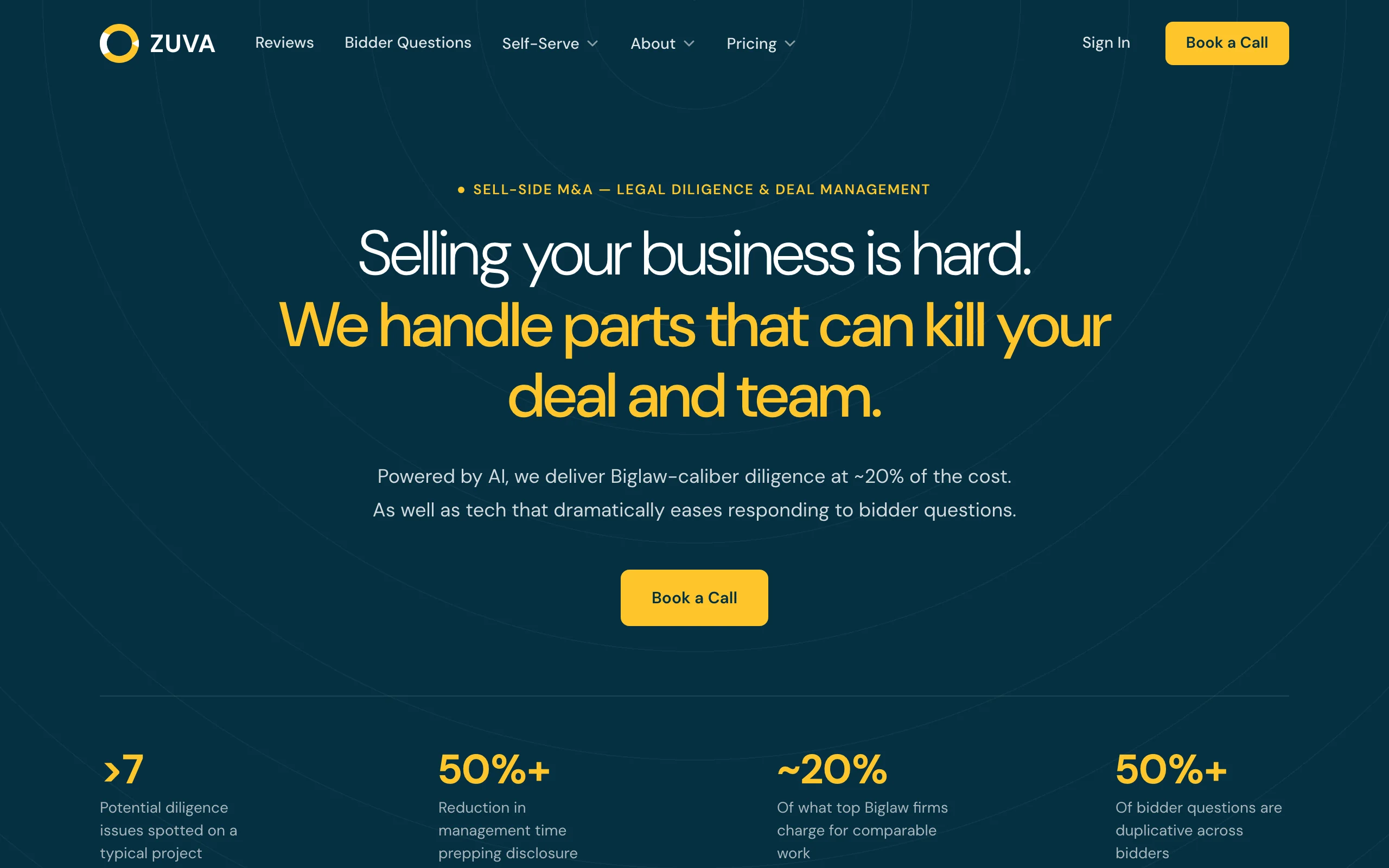
Zuva spun out of Kira Systems and productized its extraction technology for self-serve use. Zuva Analyze charges $10 per document with 1,400+ pre-built AI fields and automatic classification across 225+ document types: upload a batch, run a pre-built or custom workflow, and export structured results to Excel or Word. No subscription, no seats.
The company now leads with fixed-fee M&A diligence services, but Analyze remains one of the only contract intelligence tools with published, usage-based pricing. That makes it a strong fit for defined projects with a known document count, such as a compliance sweep or a repository migration.
Key features
- 1,400+ pre-built AI extraction fields with 225+ document types classified automatically
- Custom workflows to tailor extraction to a specific project
- Exports to Excel, Word, or in-app review
- SOC 2 Type II certified, with an API for embedding extraction into your own systems
Best for
- Defined projects: entity restructurings, compliance sweeps, or migrating a legacy repository into a CLM
- Teams that want to validate AI extraction on 5 free documents before spending anything
Pricing
- Pay-as-you-go at $10 per document, with a $5,000 minimum commitment
- Free trial on 5 documents with no credit card; custom enterprise volume pricing
Pros
- Transparent published pricing in a category that mostly hides it
- Extraction pedigree inherited directly from Kira's legal machine-learning lineage
Cons
- The $5,000 minimum makes it a project tool rather than an everyday one
- Extraction only: drafting, negotiation, and legal Q&A have to live somewhere else
How to choose the best contract intelligence software for your practice
Four questions will narrow this list faster than any feature matrix.
What is the unit of work: one contract, a batch, or the whole repository?
- If contracts reach you one at a time and the job is to understand and de-risk each one: use LegesGPT, which delivers extraction, risk flags, and summaries per document from $19.99/month. Our roundup of the best contract analysis software goes deeper on document-level tooling.
- If the question is "what is inside our 20,000 executed agreements": use Luminance, LinkSquares, or Icertis, which are built for repository scale.
- If it is a defined batch with a known document count, like a diligence set or a migration: use Kira for firm-led deals or Zuva Analyze for self-serve extraction at $10 per document.
How much budget and sales-cycle patience do you have?
- If you need something working this week: LegesGPT ($1 trial) and Zuva Analyze (5 free documents) are the only two you can try without talking to sales.
- If you can run a mid-market procurement: LinkSquares deals reportedly land in the tens of thousands per year.
- If you are budgeting six figures and months of implementation: Luminance and Icertis compete at that tier. Do the price-to-value math honestly: a $100,000 platform has to save vastly more attorney hours than a $1,200-a-year tool before it wins.
Where does the extracted intelligence need to end up?
- If contract data must flow into ERP, CRM, or HR systems: Icertis pushes structured terms into SAP, Salesforce, and Workday.
- If your team works in Microsoft Word: LinkSquares ships a Word add-in for drafting and redlining.
- If you flag risks and then need to fix them: LegesGPT pairs its analysis with drafting and e-signature, a workflow we compare against dedicated reviewers in our guide to the best AI contract review tools.
- If a browser tab with zero IT involvement is the goal: LegesGPT and Zuva both run fully self-serve on the web.
Who will actually open the tool?
Enterprise platforms assume trained legal ops admins. If the real users are one GC, a paralegal, and a procurement lead, pick something they will use without a training program. Whatever you shortlist, test with 3 to 5 of your own contracts (an NDA, an MSA, and your most heavily negotiated vendor agreement) and grade the output against what your team would have caught manually. Small departments weighing a broader stack should also see our guide to the best AI tools for in-house legal teams.