Contracts hide their most important information in the least readable places: an uncapped indemnity in clause 14, a renewal deadline buried in a schedule, an obligation that only bites two years in. Contract analysis software surfaces all of it. You feed the tool an agreement and it extracts the key terms, flags risky or non-standard clauses, and explains what you actually agreed to, in minutes instead of a billable afternoon.
The category splits into two camps. Self-serve tools charge a monthly subscription and go deep on the contract in front of you, one agreement at a time — the job this guide is organized around. Enterprise platforms extract data across thousands of agreements at once, but expect five-figure annual pricing and a procurement cycle. This guide covers six tools across both camps, with verified pricing and honest limitations for each.
A quick map of adjacent terms before the list, because vendors use them loosely. Analysis, as we use it here, means in-depth review of individual contracts: extracting the risks, obligations, and data from the agreement on your desk. Review is the narrower pre-signature task of redlining a draft, covered in our roundup of the best AI contract review tools. Risk analysis is the scoring-and-flagging subset of this work, compared separately in our AI contract risk analysis software guide. And when the question is what sits inside thousands of signed agreements rather than one, you are shopping for contract intelligence, not analysis.
Contract analysis software: a brief overview
- LegesGPT: Best overall contract analysis software: flags risky and non-standard clauses, explains them in plain language, and proposes replacement wording, with drafting and e-signature in the same app.
- Spellbook: Best for analyzing contracts inside Microsoft Word: risk flags, benchmarking, and cited answers appear directly in the open document.
- Kira (Litera): Best for large-scale due diligence: extracts clauses and data points from thousands of documents for law firm deal teams.
- Workday Contract Intelligence: Best for pushing contract data into business systems: the former Evisort, with repository-wide extraction and Salesforce, SharePoint, and Box syncing.
- Luminance: Best for enterprise legal departments: portfolio analysis, negotiation support, and compliance monitoring on a single platform.
- ThoughtRiver: Best for triaging inbound contracts: pre-signature risk scoring with published pricing and a 28-day free trial.
| Tool | Best for | Starting price | Free trial | Platform |
|---|---|---|---|---|
| LegesGPT | Self-serve risk and clause analysis | From $19.99/mo | 3-day for $1 | Web app, 38+ countries |
| Spellbook | Analysis inside Microsoft Word | Custom | 7-day | Word add-in |
| Kira (Litera) | Bulk due diligence extraction | Custom | Demo only | Web |
| Workday Contract Intelligence | Contract data in business systems | Custom | Demo only | Web |
| Luminance | Enterprise legal departments | Custom | Demo only | Web |
| ThoughtRiver | Pre-signature risk triage | From £15,000/yr | 28-day | Word add-in + web |
1. LegesGPT, best overall contract analysis software
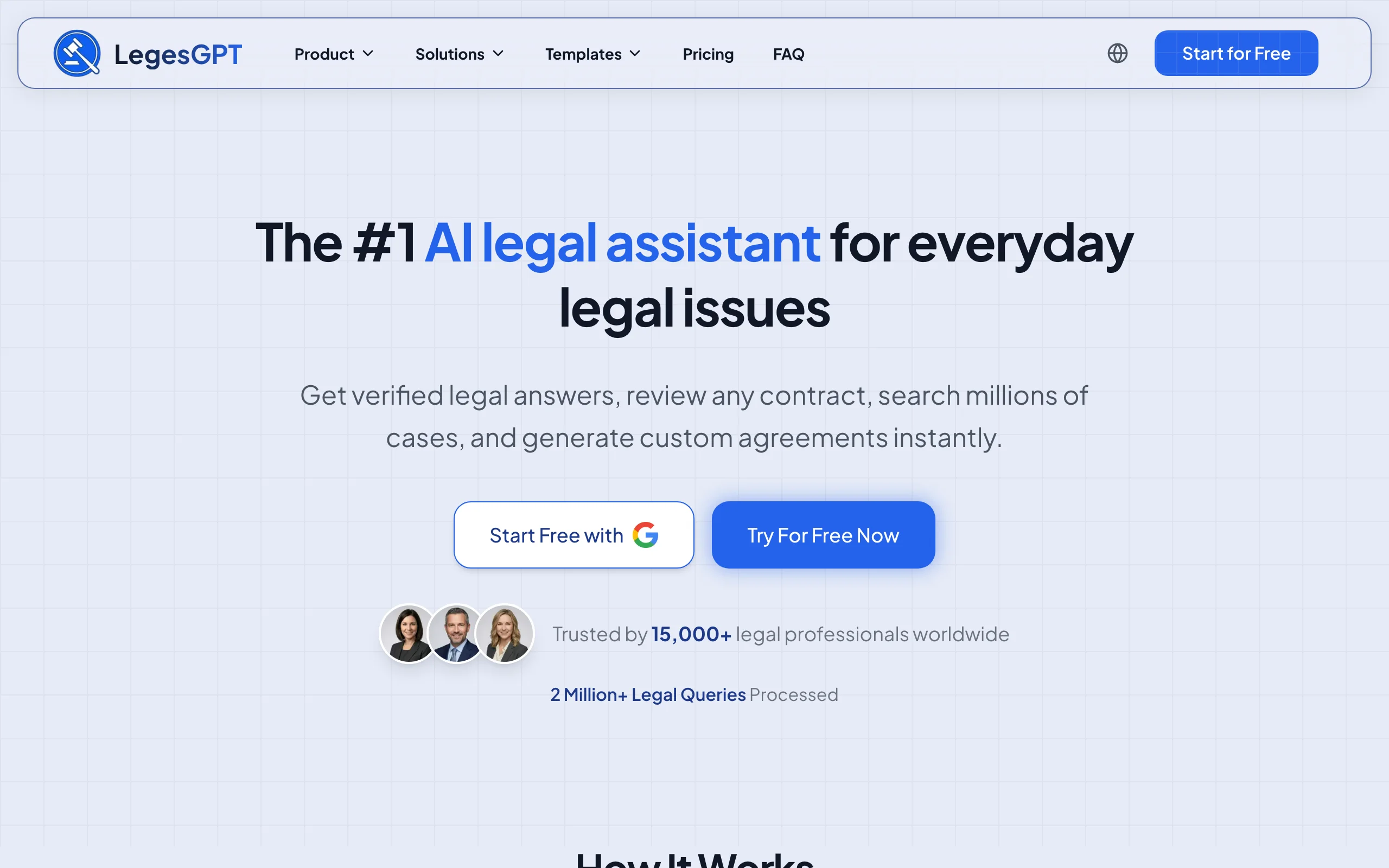
LegesGPT treats a contract as something you can interrogate. Upload an agreement (PDF, DOCX, PPTX, TXT, or even a photographed page) and the AI review flags risky and non-standard clauses, explains in plain language why each one matters for your position, and proposes specific replacement wording you can drop into your next markup. When you need the key terms, you ask for them directly: who carries the indemnity, when the renewal window closes, which obligations survive termination. Answers come from the document itself, with the relevant language identified.
What sets it apart in this category is that the analysis feeds a complete workflow. The same subscription drafts new contracts with AI, includes 100+ attorney-drafted templates, sends documents for e-signature, and runs legal research with verified citations. It all works in the browser with no IT setup, so a flagged clause can become a corrected, signed agreement without switching tools.
Key features
- Flags risky and non-standard clauses and proposes concrete changes, not just highlights
- Plain-language explanations of what each flagged clause means in practice
- Extracts obligations, deadlines, and key terms through direct questions about the document
- Accepts PDF, DOCX, PPTX, TXT, and image uploads
- Deep Research mode and web search for questions that reach beyond the document
- AI contract drafting, e-signature, and attorney-drafted templates in the same app
Best for
- Solo lawyers and firms of 2 to 50 attorneys who need contract analysis without an enterprise budget
- In-house counsel who want a risk read on an incoming agreement the same day it arrives
- Teams that prefer one tool for analysis, drafting, and signature over three separate subscriptions
Pricing
- Basic at $19.99/mo (AI legal questions and case law search, no document upload); Plus at $49.99/mo adds document upload with 50 reviews per month; Premium at $99.99/mo adds unlimited reviews, Deep Research, and web search
- 3-day trial for $1 on every plan, with roughly 30% off annual billing
Pros
- Actionable output: each flag comes with an explanation and proposed replacement language
- Lowest published entry price of any tool on this list
- Covers the steps after analysis (drafting, templates, e-signature), so findings turn into finished documents
- Self-serve signup; you can be analyzing your first contract within minutes
Cons
- Newer brand than legacy legal tech vendors, with a smaller track record
- Web-only: no Word add-in, public API, or native mobile app, and analysis runs document by document rather than across a portfolio of thousands
2. Spellbook, best for contract analysis in Microsoft Word
Spellbook takes the position that the analysis should happen where the contract already is: inside Microsoft Word. Its Review capability marks up risks in the open document, Compare benchmarks your terms against industry standards, and Ask answers questions about the agreement with citations back to the text. Playbooks let a firm or legal team encode standard positions so every analysis checks against house rules, and the Associate feature extends the add-in to multi-document workflows.
For transactional lawyers who rarely leave Word, that zero-switching design is the main draw. The trade-off is the inverse: Spellbook is built around single open documents, not repository-scale analytics.
Key features
- Word add-in that flags risks and suggests redlines without leaving the document
- Compare benchmarks contract terms against industry standards
- Ask returns cited answers about the agreement in front of you
- Playbooks encode firm standards; Associate handles multi-document workflows
Best for
- Transactional lawyers and in-house counsel who draft and mark up in Word all day
- Teams that want drafting and analysis inside one add-in rather than a separate platform
Pricing
- Custom seat-based quotes; Spellbook publishes no price list
- 7-day free trial with self-serve signup
Pros
- No workflow change: analysis happens in the document you are already editing
- Self-serve trial is uncommon among legal AI vendors at this level
Cons
- Quote-only pricing makes budgeting harder for small teams
- Word-centric design suits single documents, not bulk portfolio analysis
If Word integration appeals but the quote-based pricing does not, see our comparison of the best Spellbook alternatives.
3. Kira (Litera), best for large-scale due diligence extraction
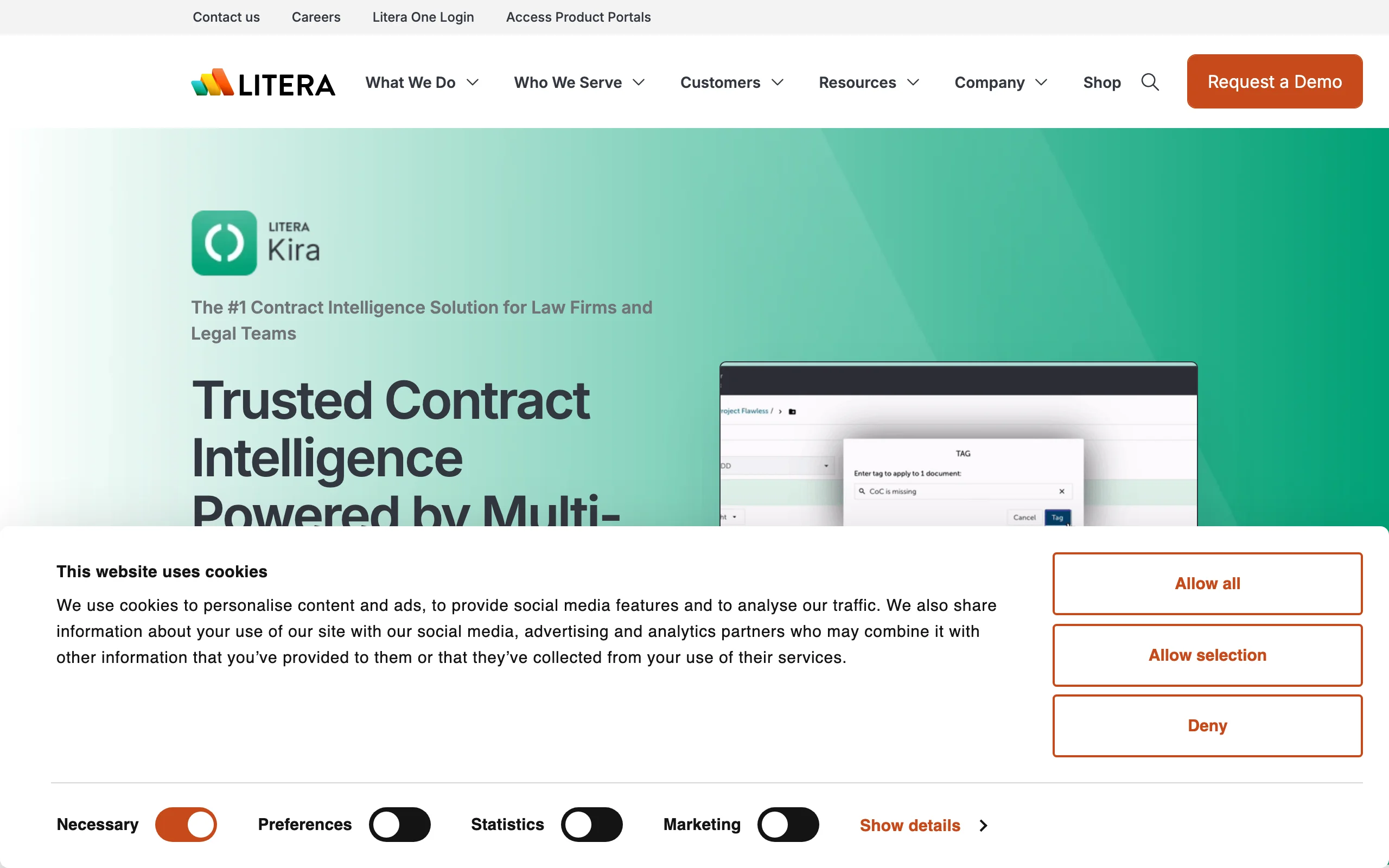
Kira is the extraction engine behind due diligence at many large law firms. Point it at a data room and it pulls specific clauses and data points (change-of-control triggers, assignment restrictions, termination rights) out of thousands of contracts and arranges them into a reviewable grid. Litera, which owns the product, claims 90%+ extraction accuracy, and the platform carries SOC 2 Type II certification with a per-project toggle for generative AI.
Recent versions strengthened the AI layer. Generative Smart Fields let reviewers define new extraction targets by describing them in natural language rather than training on sample documents, and Grid Chat answers questions across an entire project's document set.
Key features
- Clause and data-point extraction across thousands of documents at once
- Generative Smart Fields for defining custom extractions in natural language
- Grid Chat for questions across a whole project
- Bulk import with deduplication, document comparison, and exports to Word, Excel, and PDF
- SOC 2 Type II certification and per-project generative AI controls
Best for
- M&A and corporate teams at law firms running due diligence on large document sets
- Firms with knowledge management or innovation staff to configure and run projects
Pricing
- Custom pricing scaled to users and document volume; no figures published
- No self-serve trial; evaluation starts with a demo and sales process
Pros
- Purpose-built for high-volume extraction that lighter tools cannot match
- Widely adopted in large firms, with mature export and workflow tooling
Cons
- Opaque pricing and an enterprise sales cycle put it out of reach for small practices
- Scoped to extraction and analysis; drafting and signature happen elsewhere
4. Workday Contract Intelligence, best for contract data in business systems
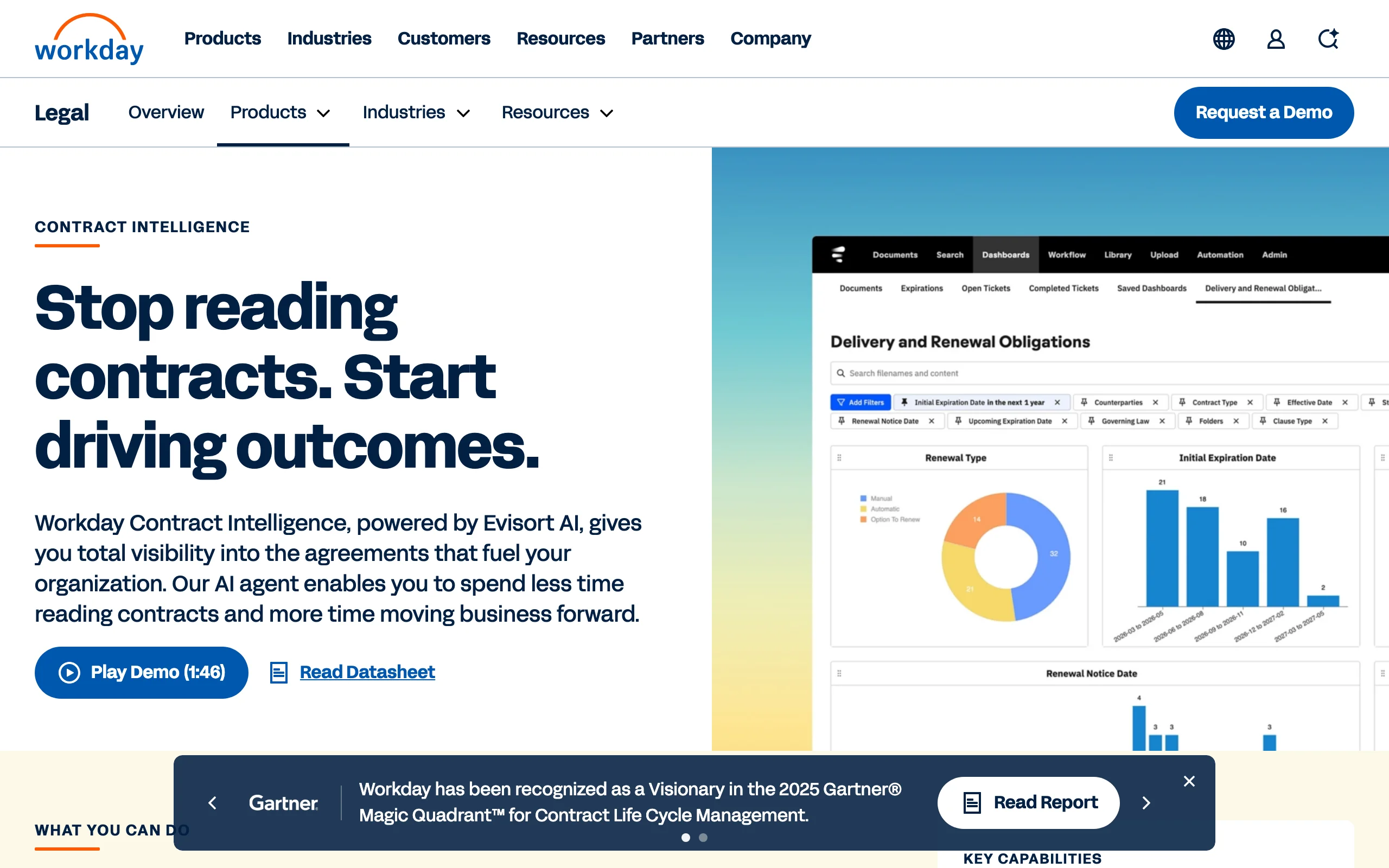
Workday Contract Intelligence is the current name for Evisort, one of the most established contract analysis vendors before Workday acquired it in September 2024. The product combines AI with OCR to extract terms from an entire contract repository, tracks obligations and risks in dashboards, and pushes that data to the systems the wider business runs on, with syncing for Box, SharePoint, and Salesforce.
The Ask AI capability turns the repository into something you can query in plain English, and custom AI models can be trained to track company-specific terms. The natural buyers are enterprises, particularly existing Workday customers connecting contract data to finance and procurement.
Key features
- AI and OCR extraction of terms across a full contract repository
- Ask AI natural-language search over every stored contract
- Custom AI models for company-specific terms
- Obligation tracking, risk identification, and live dashboards
- Syncs with Box, SharePoint, and Salesforce
Best for
- Enterprises, especially Workday customers, wiring contract data into finance and procurement
- Legal ops teams building reporting on obligations and renewals at scale
Pricing
- Custom pricing through Workday sales; nothing is published
- No self-serve trial; evaluation runs through demos
Pros
- Repository-wide intelligence with strong integrations into business systems
- Years of Evisort extraction development behind the product
Cons
- Enterprise sales process with no pricing transparency
- Increasingly oriented around the Workday ecosystem since the acquisition
5. Luminance, best for enterprise legal departments
Luminance builds outward from analysis into a full contract platform for corporate legal teams. The Analyze module reads every contract a business holds and tracks renewal dates, obligations, and risk in real time, while the Negotiate module flags non-standard clauses during markup and suggests compliant alternatives. Compliance monitoring checks the portfolio against regulatory requirements on an ongoing basis rather than as a one-off exercise.
The pitch is consolidation: analysis, drafting, negotiation, and monitoring from a single vendor, which appeals to legal departments tired of stitching point solutions together. The corresponding cost is enterprise procurement, with module-based quotes and proof-of-concept evaluations measured in weeks.
Key features
- Portfolio-wide analysis of obligations, renewal dates, and risk
- Flags non-standard clauses and proposes compliant alternatives during negotiation
- Continuous compliance monitoring against regulatory requirements
- Drafting, workflow routing, and collaboration modules on the same platform
Best for
- Corporate legal departments standardizing the contract lifecycle on one vendor
- Compliance-heavy industries that need continuous monitoring, not point-in-time analysis
Pricing
- Custom, module-based pricing; quotes scale with team size and nothing is published
- No advertised free trial; evaluation via demos and proof-of-concept phases
Pros
- End-to-end coverage for a legal department consolidating vendors
- Real-time visibility across the entire contract estate, not single documents
Cons
- Undisclosed enterprise pricing and a long evaluation process
- More platform than most teams need for on-demand analysis of individual contracts
6. ThoughtRiver, best for pre-signature risk triage
ThoughtRiver concentrates on the intake moment: a third-party contract arrives, and someone has to decide how risky it is and what needs fixing before signature. The platform scores the incoming document, generates a detailed issue list, and tracks each issue through to resolution, with a Microsoft Word add-in for working the changes in the document. For in-house teams measured on turnaround time, that triage layer is often the difference between legal being an enabler and a bottleneck.
Two things distinguish it commercially: published starting prices, which are rare in this category, and a 28-day free trial, the longest on this list and long enough to test against a real month of contract flow.
Key features
- Pre-signature analysis with risk scoring on incoming contracts
- Detailed issue lists tracked through to resolution
- Microsoft Word add-in for resolving issues inside the document
- Unlimited users on enterprise plans
Best for
- In-house teams triaging 20 or more inbound contracts per month
- Legal teams accountable for turnaround time on sales and procurement paper
Pricing
- Professional from £15,000/year for teams reviewing 20 to 50 contracts monthly; Enterprise from £30,000/year for higher volumes
- 28-day free trial
Pros
- Published pricing, unusual among enterprise legal AI vendors
- Four-week trial allows testing on genuine contract volume
Cons
- Five-figure annual entry point is steep for small firms and solo lawyers
- Built for triage; less useful for portfolio analytics or drafting
How to choose the best contract analysis software for your practice
Four questions will narrow this list quickly.
1) Single contracts or a whole portfolio?
- If your work arrives one document at a time (a vendor agreement today, an employment contract tomorrow): LegesGPT or Spellbook, both of which you can start using this week.
- If you need to extract data from thousands of agreements for due diligence or repository reporting: Kira, Workday Contract Intelligence, or Luminance. For that portfolio-scale end of the market, our guide to the best contract intelligence software goes deeper.
2) Browser or Microsoft Word?
- If markup must happen in Word: Spellbook and ThoughtRiver ship Word add-ins.
- If a browser is fine or preferable (nothing to install, no IT approval): LegesGPT, Kira, Workday Contract Intelligence, and Luminance are web platforms.
3) What happens after the analysis?
- If a flagged clause should become a revised, signed contract in the same tool: LegesGPT pairs analysis with AI drafting, templates, and e-signature.
- If analysis feeds an existing CLM or deal workflow: Kira and Workday Contract Intelligence slot in as the intelligence layer.
4) What does the price actually buy?
Do the price-to-value math honestly. A £15,000 or five-figure platform needs a steady contract volume to pay for itself; at 10 contracts a month, a $49.99/mo subscription covering 50 reviews is hard to argue with. And whatever you shortlist, run the same test: upload 3 to 5 of your own contracts, including at least one messy scanned document, and compare what each tool catches. Vendor demos use clean contracts; your files are the real benchmark.