
AI legal assistants now handle the research, first drafts, and document review that used to eat a junior associate's week. For lawyers, that means faster turnaround, fewer missed clauses, and lower overhead, which matters most in solo and small-firm practices that run without a large support team.
But the category splits sharply. Some tools are enterprise platforms priced in five or six figures with a sales cycle to match. Others are self-serve apps you can start using today for the cost of a working lunch. This guide compares the 7 best AI legal assistants for lawyers in 2026, covering what each one does, who it fits, real pricing, and the honest trade-offs, so you can match a tool to your practice area, firm size, and budget instead of paying for capability you will never touch.
Best AI legal assistants for lawyers: a brief overview
Here is a quick snapshot of the 7 tools and what each does best:
- LegesGPT: Best overall AI legal assistant: answers legal questions with verified sources, reviews contracts, and drafts documents in one affordable platform.
- CoCounsel (Casetext): Best for Westlaw-integrated firms: agentic research and deposition prep backed by Thomson Reuters.
- Harvey AI: Best for BigLaw and enterprise legal teams: sophisticated reasoning and custom agents for complex, high-stakes matters.
- Lexis+ with Protégé: Best for deep US primary law research: an agentic assistant on the LexisNexis database.
- vLex Vincent AI: Best for international litigation research: AI across 100+ jurisdictions with judge and lawyer profiling, now part of Clio.
- Paxton AI: Best for citation-focused research: benchmarked accuracy and strong citation verification for brief writing.
- Clio Duo: Best for practice-management automation: AI built into Clio for drafting, tasks, and matter summaries.
| Tool | Best for | Starting price | Free trial | Jurisdictions |
|---|---|---|---|---|
| LegesGPT | All-in-one for solo and small firms | From $19.99/mo | 3-day for $1 | 38+ countries |
| CoCounsel (Casetext) | Westlaw-integrated firms | ~$225/user/mo (est.) | Demo only | Primarily US |
| Harvey AI | BigLaw and enterprise legal teams | Custom enterprise | Pilots only | US and multi |
| Lexis+ with Protégé | Deep US primary law research | Five figures/yr (est.) | Demo only | Primarily US |
| vLex Vincent AI | International litigation research | Quote-based (via Clio) | Free trial | 100+ jurisdictions |
| Paxton AI | Citation-focused research | $499/user/mo | 7-day | Primarily US |
| Clio Duo | Practice-management automation | $39/user/mo add-on | Via Clio trial | Primarily US |
Pricing note: LegesGPT, Paxton, and Clio Duo publish standard prices. Harvey, Lexis, CoCounsel, and Vincent AI quote per firm, so those figures are public estimates, not list prices. Confirm before budgeting.
1. LegesGPT, best overall AI legal assistant
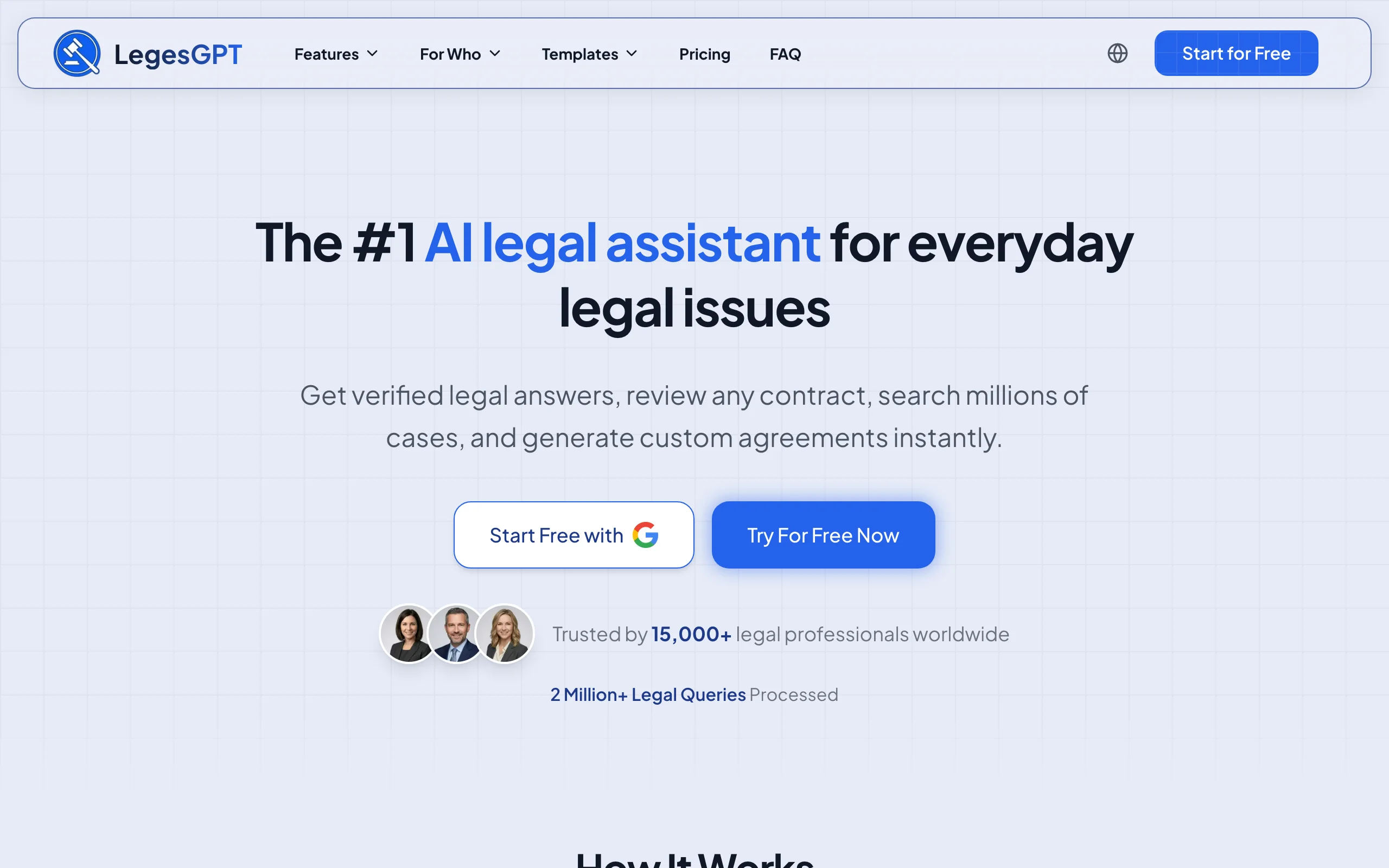
LegesGPT works like a junior associate who is on call around the clock. Ask a legal question and it answers with verified sources you can click through, hand it a contract and it flags the risks and proposes fixes, or describe a document and it drafts it, then lets you send it for e-signature. Research, review, drafting, and signing live in one place, so a solo lawyer covering several practice areas is not stitching together three subscriptions to get through the day.
What makes it the top pick for lawyers is accessibility. There is no enterprise sales cycle, no annual contract, and no per-seat minimum. You sign up, start a 3-day trial for $1, and begin working within minutes. For practices that need capable AI across the full workflow without enterprise pricing, LegesGPT is the most complete starting point at the lowest entry cost.
Key features
- Answers legal questions with verified sources and direct citations you can check
- Document review that flags risks, surfaces problematic clauses, and proposes fixes
- AI drafting of legal documents and contracts, plus attorney-drafted document templates
- E-signature to sign and send finished documents without leaving the platform
- Case law and statute search across 38+ countries
- Deep Research mode for complex, multi-step legal questions, plus free tools like a contract generator and citation generator
Best for
- Solo practitioners and small law firms that want one affordable, full-featured assistant
- Lawyers handling diverse practice areas who need multi-jurisdictional coverage
- Professionals who want research, review, drafting, and signing in a single subscription
Pricing
- 3-day trial for $1 on all plans (no permanently free tier)
- Basic at $19.99/month, Plus at $49.99/month (50 document reviews/month), Premium at $99.99/month (unlimited reviews)
- Roughly 30% off with annual billing; no annual contracts or per-seat minimums required
Pros
- Covers the full daily workflow (answers, research, drafting, review, signing) without switching tools
- Verified sources and direct citations make outputs easy to check before you rely on them
- Self-serve signup with a $1 trial, no sales calls or onboarding cycle
- Multi-jurisdiction coverage, unlike most US-only competitors
Cons
- Newer brand with a smaller footprint than legacy providers like Westlaw or LexisNexis
- Web-only: no native mobile app, public API, or Microsoft Word add-in
2. CoCounsel (Casetext), best for Westlaw-integrated firms
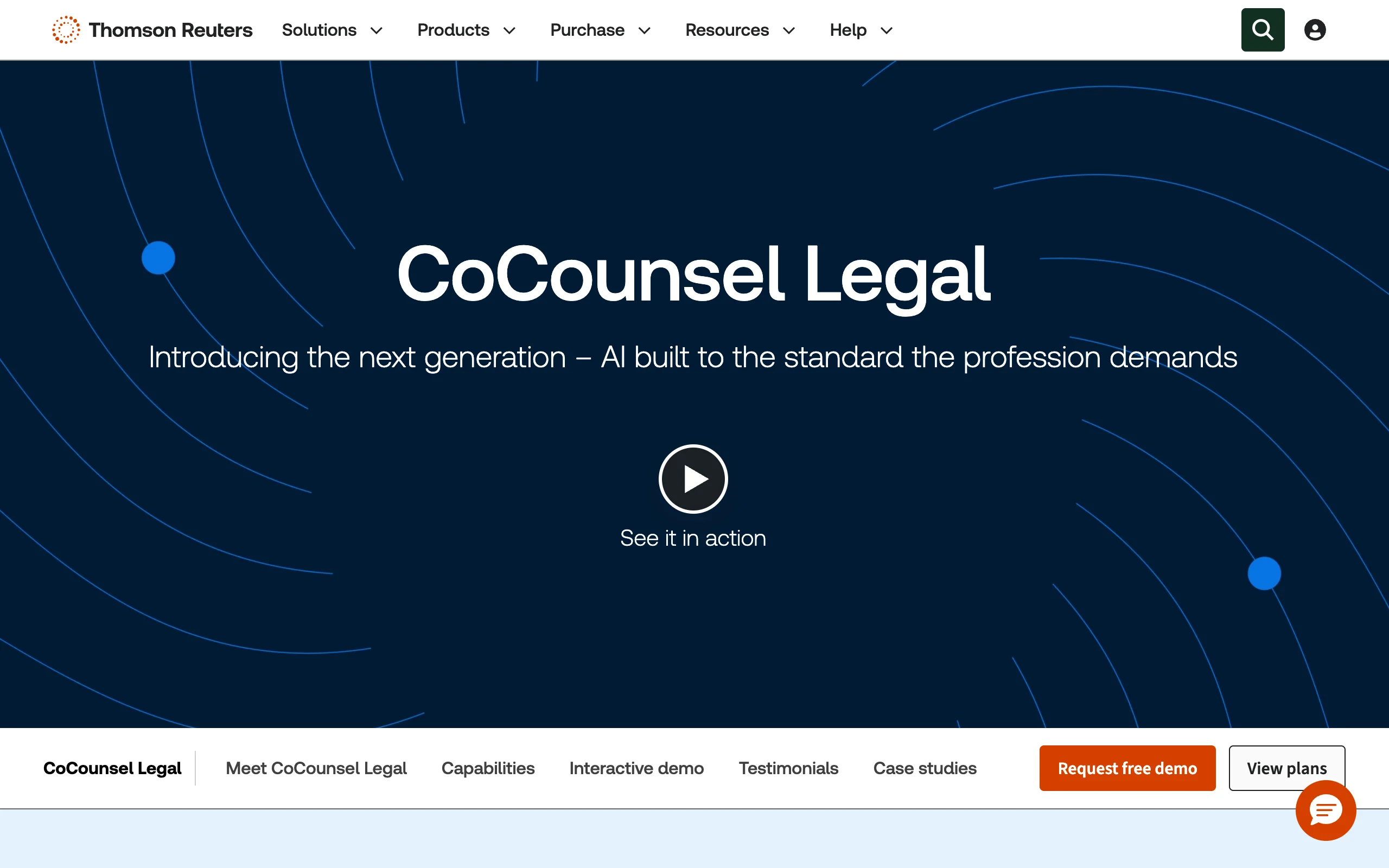
CoCounsel is Thomson Reuters' AI legal assistant, built on the Westlaw database. Formerly sold as Casetext, it was folded into Thomson Reuters after a $650 million acquisition and now carries the CoCounsel name across tiers. It handles research queries, reviews documents, and assists with deposition preparation for tens of thousands of firms and legal departments.
If your firm already pays for Westlaw, CoCounsel adds AI without switching platforms, and its recent updates leaned hard into agentic workflows: a Deep Research agent, a custom workflow builder, and a 2026 rebuild on Anthropic's Claude. For teams already inside the Thomson Reuters ecosystem, it is the natural upgrade.
Key features
- Agentic legal research grounded in Westlaw's primary law database
- Deep Research mode and a custom workflow builder for multi-step tasks
- Document review and bulk analysis across large document sets
- Deposition preparation with automated question generation
- Integration across the Thomson Reuters suite of legal products
Best for
- Firms already subscribing to Westlaw or other Thomson Reuters products
- Litigation teams that need deposition prep alongside case law research
- Mid-size to large firms with existing Thomson Reuters infrastructure
Pricing
- CoCounsel Core is commonly cited around $225/user/month, but Thomson Reuters does not publish standalone pricing
- Real cost varies with your existing Westlaw subscription level
- CoCounsel Legal is quote-only, with enterprise agreements for larger deployments
Pros
- Deep Westlaw integration gives the AI one of the most comprehensive legal databases
- Rebuilt on Claude in 2026, with deposition prep that few competitors match
- Backed by Thomson Reuters, signaling long-term investment
Cons
- Per-user pricing adds up quickly for firms with multiple seats
- Best value requires an existing Westlaw subscription, limiting appeal to non-TR users
- Solo practitioners may find the cost prohibitive without a firm-level Westlaw deal
3. Harvey AI, best for BigLaw and enterprise legal teams
Harvey AI is built for the largest law firms and corporate legal departments. It delivers sophisticated legal reasoning across contract analysis, regulatory research, and due diligence, and it now ships a library of pre-built agents plus an Agent Builder for firm-specific workflows. Harvey reports more than 1,500 customers and 142,000+ lawyers on the platform.
Investors have backed that growth aggressively: Harvey raised a $200M round in early 2026 at an $11 billion valuation, up from $5 billion in mid-2025. The platform excels at complex, multi-step matters, but enterprise-only pricing and sales-driven onboarding put it out of reach for most solo practitioners and small firms.
Key features
- Advanced legal reasoning for complex contract analysis and regulatory questions
- Pre-built agents and an Agent Builder for firm-specific, multi-step workflows
- Memory personalization and a model selector spanning frontier models
- Due diligence acceleration across large document sets
- Enterprise-grade security and document management integrations
Best for
- Am Law 100 firms and large corporate legal departments handling high-stakes matters
- Enterprise teams running large-scale due diligence or M&A transactions
- Firms willing to invest in custom AI deployment for firm-wide adoption
Pricing
- Enterprise and custom contracts only; Harvey does not publish public pricing
- Third-party estimates vary widely by firm size, so treat any quoted figure with caution
- No self-serve option or free trial; access starts with a structured pilot
Pros
- Extremely sophisticated reasoning, purpose-built for complex enterprise matters
- Agent Builder adapts the AI to your firm's specific practice areas and workflows
- Strong top-tier adoption and deep funding behind continued development
Cons
- Enterprise-only pricing makes it inaccessible for solo and small firm lawyers
- Long sales cycle with no easy way to test the product before committing
- Overkill for the everyday research and drafting most small practices need
4. Lexis+ with Protégé, best for deep US primary law research
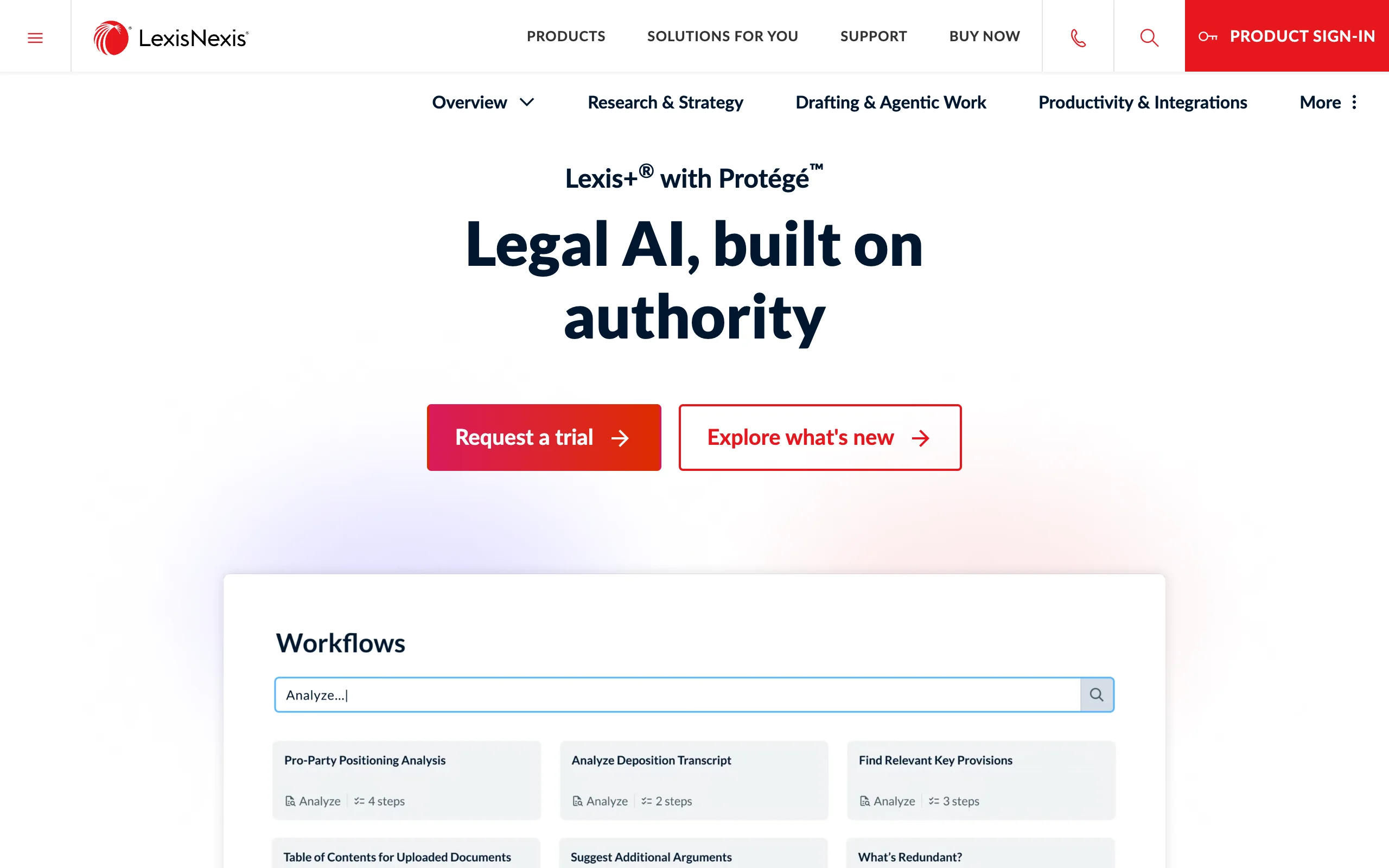
Lexis+ with Protégé is LexisNexis' agentic AI assistant, the successor to Lexis+ AI, which reached general availability in early 2026. It lets lawyers ask natural language questions and receive answers grounded in Lexis' primary law, case law, statutes, and secondary sources, then chains those answers into drafting and review. For firms that need the deepest possible US legal database, this is that database with an agent on top.
The strength here is the underlying data. LexisNexis has decades of indexed legal content that few competitors can match in depth, now paired with agentic drafting, a Vault for large document sets, and Shepard's Verify for citation validation. The trade-off is cost: it requires a Lexis subscription, and pricing runs well into five figures annually.
Key features
- Natural language search across the LexisNexis primary law database
- Protégé agentic assistant with model selection and specialized agents
- Agentic drafting and a Vault that handles large document sets
- Shepard's Citations and Shepard's Verify for case validation
- Integration with Microsoft 365 and the broader Lexis product suite
Best for
- Large firms that already subscribe to LexisNexis and want agentic AI added
- Practitioners requiring the deepest primary law coverage for US jurisdictions
- Research-intensive practices like appellate litigation or academic legal work
Pricing
- Roughly five figures per year, varying significantly by package and firm size
- Best value requires an existing LexisNexis subscription
- Custom enterprise pricing; LexisNexis does not publish a standalone rate
Pros
- Access to one of the largest and most established legal databases in the industry
- Shepard's Verify provides trusted citation validation inside the AI workflow
- Agentic drafting and Microsoft 365 integration extend it beyond simple search
Cons
- Five-figure annual pricing puts it beyond the budget of most solo and small firms
- Complex, opaque pricing makes costs hard to estimate upfront
- Strongest only when paired with a full Lexis subscription
5. vLex Vincent AI, best for international litigation research
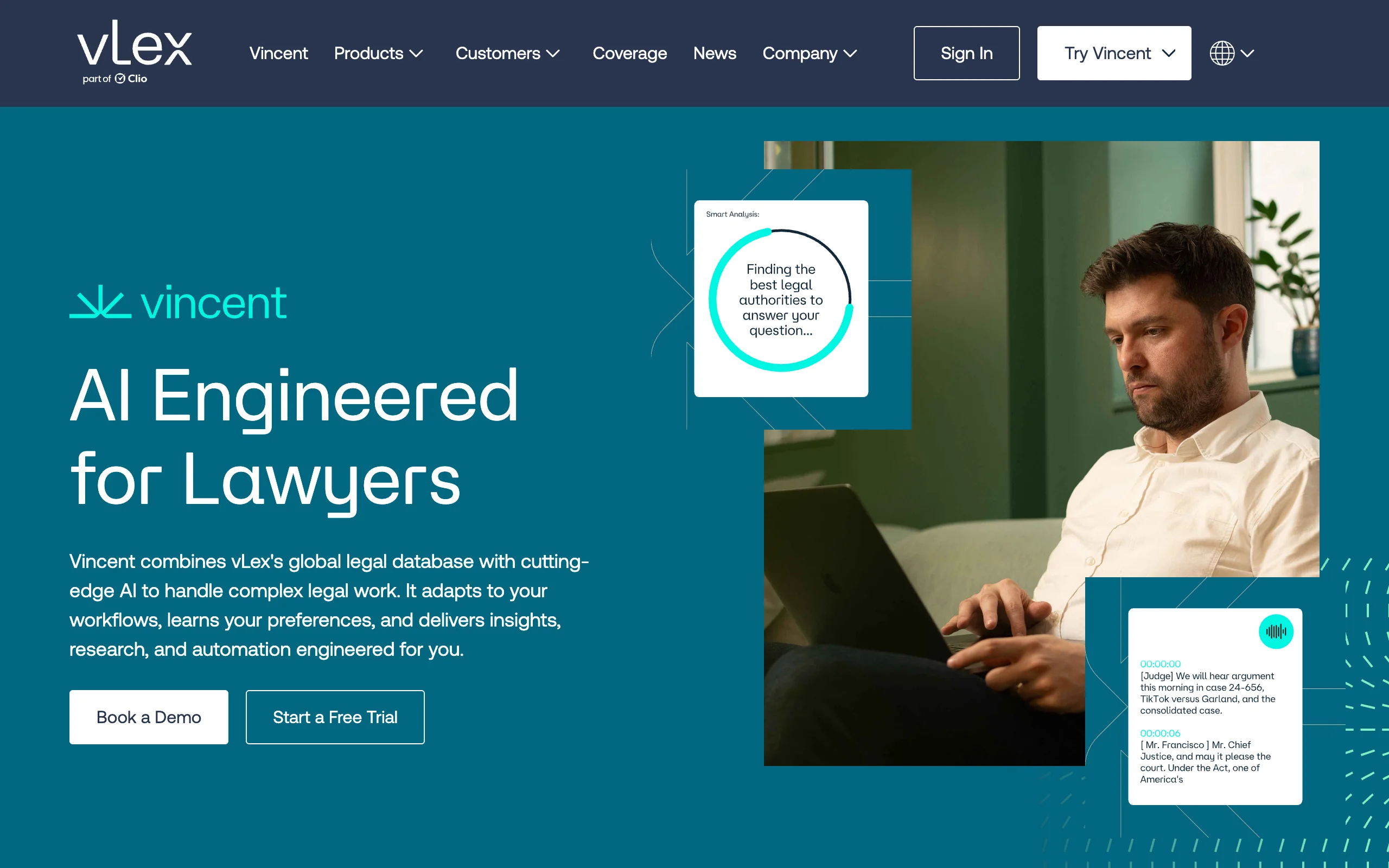
vLex Vincent AI is a legal research platform with AI capabilities spanning 100+ jurisdictions and over 1 billion editorially enriched legal documents. It goes beyond basic research with litigation-specific workflows including judge profiling, lawyer profiling, and complaint analysis, and Vincent Studio lets firms build custom AI workflows without coding. In late 2025, Clio completed its $1 billion acquisition of vLex, so Vincent AI can now be subscribed to directly inside Clio.
For lawyers handling cross-border matters or international litigation, Vincent AI offers the broadest jurisdictional coverage on this list. It is also strong for domestic litigation teams that want AI-powered insight into judicial behavior and opposing counsel strategy.
Key features
- AI legal research across 100+ jurisdictions with 1 billion+ legal documents
- Judge and lawyer profiling with ruling patterns and motion-success rates
- 50-State Survey and complaint analysis for multi-jurisdictional US work
- Contract review with legal risk flagging and redline analysis
- Vincent Studio for building custom no-code AI workflows
Best for
- Litigation practices that want AI-powered judge and opposing counsel profiling
- Firms handling international or cross-border matters across multiple jurisdictions
- Mid-size to large firms, especially Clio users, investing in a premium research platform
Pricing
- Quote-based as of 2026; vLex and Clio direct buyers to sales, with a free trial available
- Now bundled or sold through Clio following the acquisition
- Previously cited single-user rates are no longer the published price
Pros
- Broadest jurisdictional coverage on this list (100+ jurisdictions, 1B+ documents)
- Litigation intelligence (judge and lawyer profiling) is a genuine differentiator
- Vincent Studio lets firms build custom AI workflows without developer resources
Cons
- Pricing is no longer transparent; a quote is required to budget
- Breadth of features means a steeper learning curve
- Premium positioning is hard to justify for a US-only solo practice
6. Paxton AI, best for citation-focused legal research
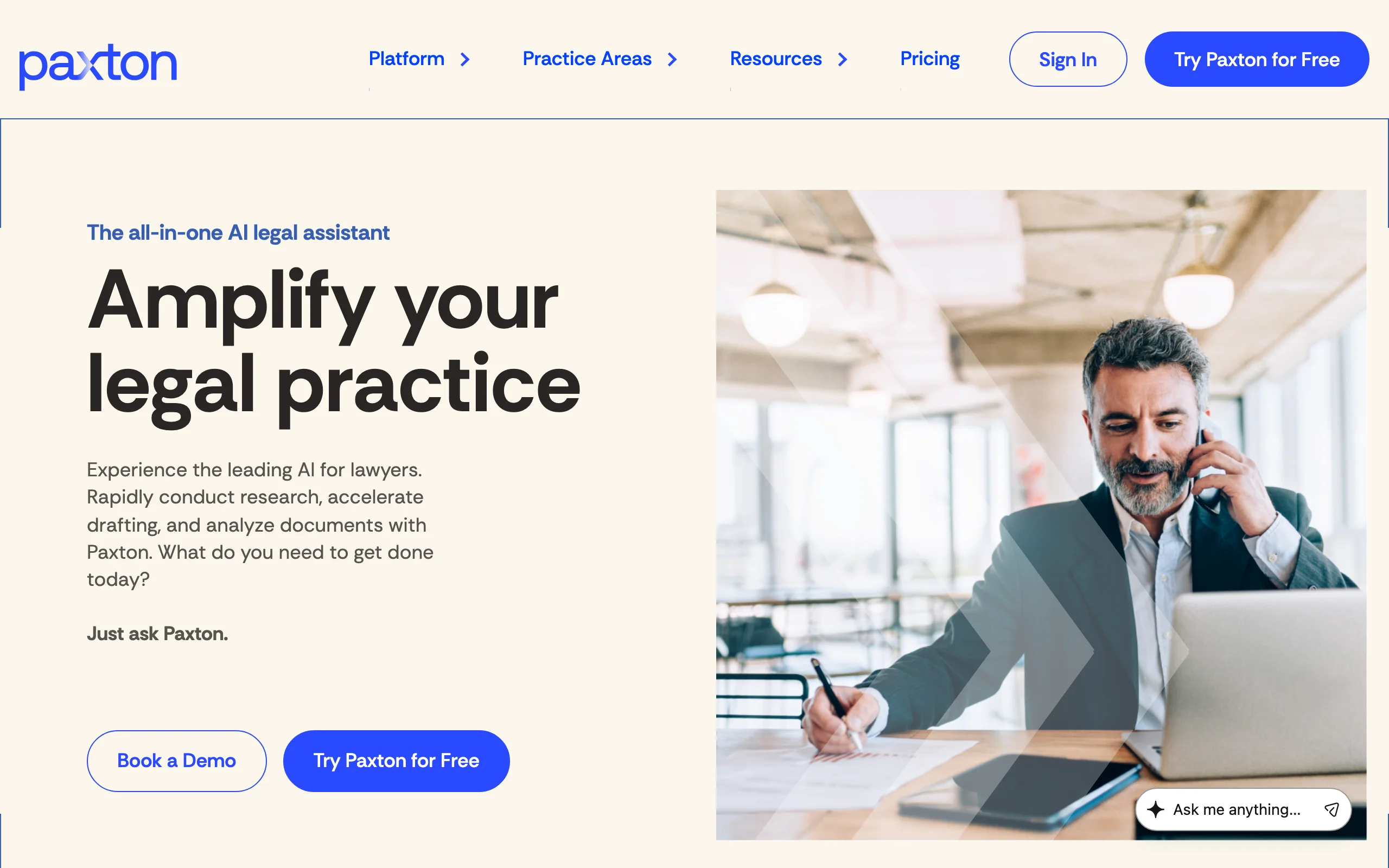
Paxton AI is a legal research platform built around citation accuracy. It focuses on well-sourced answers and puts a strong emphasis on verifying that every citation is real and correctly linked. In a Stanford-built benchmark, Paxton reported 93.82% accuracy and a 94.7% non-hallucination rate, which is why it positions itself as the reliable choice for lawyers who have been burned by AI hallucinations elsewhere.
The platform covers US federal and state case law and statutes with a clean interface focused on research and contract analysis. It does not try to be an all-in-one tool. Its strength is doing research well and making sure the citations check out.
Key features
- AI legal research with high, benchmarked citation accuracy and source verification
- Direct links to cited cases and statutes for quick validation
- Contract analysis alongside case law and statutory research
- Clean, focused interface designed specifically for legal research queries
- Research history and saved queries for ongoing matters
Best for
- Lawyers who prioritize citation accuracy above all other features
- Appellate practitioners and brief writers who need every citation verified
- Solo and mid-size firm attorneys focused primarily on US legal research
Pricing
- Individual plan at $499/user/month, or $2,999/user/year
- 7-day free trial; enterprise pricing available on request
- Priced above mid-range research tools but below enterprise platforms
Pros
- Strong, benchmarked emphasis on citation verification reduces the risk of citing non-existent cases
- Focused research interface keeps the experience simple and fast
- Transparent public pricing, unlike most enterprise legal AI tools
Cons
- Narrower feature set than all-in-one platforms (limited drafting, no eDiscovery)
- Primarily focused on US jurisdictions, limiting use for international practitioners
- At $499/user/month, considerably more expensive than LegesGPT while covering less ground
7. Clio Duo, best for practice-management automation
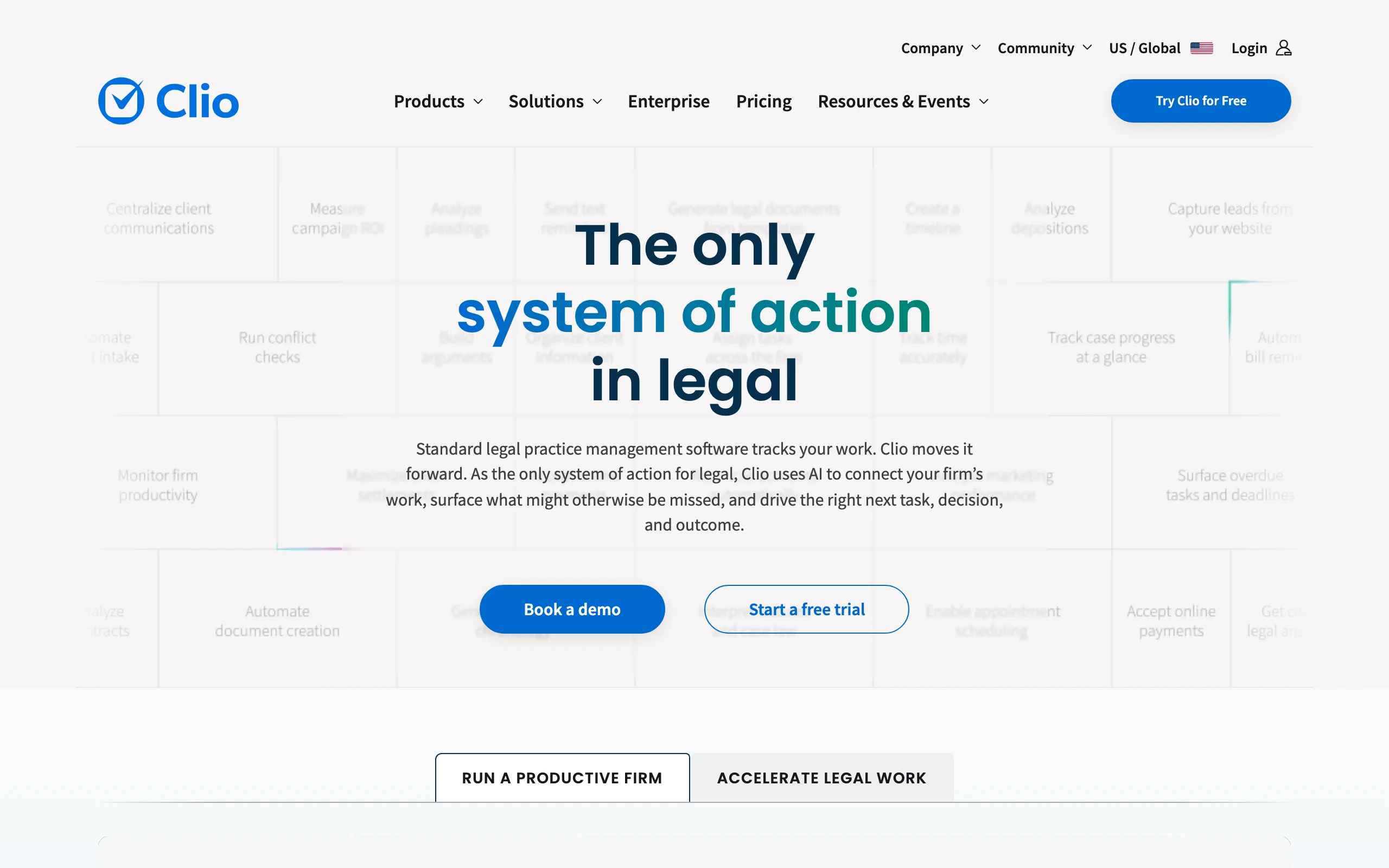
Clio Duo is the AI assistant built directly into Clio's legal practice management software. Unlike standalone research tools, Clio Duo works within your existing case data to draft emails, summarize matter histories, create tasks, and analyze uploaded documents. For lawyers who already run their practice on Clio, it adds an AI layer without introducing another tool to learn.
After Clio's $1 billion acquisition of vLex, Clio now pairs this practice-management AI with Vincent AI's legal research, positioning itself as a single intelligent legal work platform. The trade-off for Duo on its own is scope: it does not search external legal databases or perform case law research.
Key features
- AI document summaries and issue spotting from uploaded files
- Email and letter drafting based on matter context and case data
- Task creation and deadline extraction through natural language commands
- Matter history summarization across notes, calls, and communications
- Built directly into Clio Manage with no additional setup
Best for
- Solo practitioners and small firms already using Clio for practice management
- Lawyers who want AI help with administrative tasks like email and task tracking
- Firms looking to recover billable hours by automating operational work
Pricing
- $39/user/month as an add-on to a Clio Manage subscription
- Available across Clio Manage plan tiers
- Per-user licensing, so small firms can start with one seat and expand
Pros
- Integrated into Clio Manage, with no separate tool or login needed
- Drafts communications and tasks using your actual case data for relevant context
- Now part of a broader platform that also offers Vincent AI legal research
Cons
- On its own, does not perform legal research or search external case law databases
- Only works within Clio Manage, with no standalone or cross-platform option
- Requires a base Clio subscription, adding to the total monthly cost
How to choose the best AI legal assistant for your practice
1) What tasks do you need AI to handle?
AI legal assistants fall into three buckets: research-first tools, practice-management tools, and all-in-one platforms. If your priority is case law research and brief prep, Paxton AI and Lexis+ with Protégé focus there. If you want AI for operational tasks like email drafting and task management, Clio Duo is built for that workflow. If you need research, document review, drafting, and signing in one subscription, LegesGPT covers all of it.
- If you need research, review, drafting, and signing: start with LegesGPT
- If you need practice-management AI: evaluate Clio Duo
- If you need litigation-specific intelligence: look at vLex Vincent AI
2) What is your budget?
Budget is the sharpest dividing line in this space. Enterprise tools like Harvey AI (custom, four figures per seat) and Lexis+ with Protégé (five figures per year) deliver deep capabilities but price out most solo and small firm lawyers. LegesGPT starts at $19.99/month with a 3-day trial for $1, the most accessible full-featured option. Paxton AI sits in the middle at $499/user/month for citation-heavy research.
- Solo practitioners: LegesGPT ($19.99/mo)
- Small to mid-size firms: LegesGPT ($19.99 to $99.99/mo) or CoCounsel (~$225/user/mo with Westlaw)
- Enterprise and BigLaw: Harvey AI or Lexis+ with Protégé
3) Do you need multi-jurisdictional coverage?
Most AI legal assistants focus primarily on US law. If you handle international or cross-border matters, your options narrow fast. vLex Vincent AI covers 100+ jurisdictions with 1B+ documents. LegesGPT covers 38+ countries with case law and statutes. CoCounsel, Lexis+, and Paxton are US-centric.
- For US-only practice: any tool on this list works
- For cross-border or international work: vLex Vincent AI or LegesGPT
4) Test before you commit
Run your top pick through a real workflow before subscribing long-term. Draft three to five research queries you already know the answers to and check the AI's accuracy. Upload a real contract or brief and evaluate the analysis. LegesGPT offers a 3-day trial for $1 on all plans, and Paxton offers a 7-day trial. Thirty minutes of hands-on testing with your actual work is worth more than any comparison article.