
Harvey AI set the template for enterprise legal AI: research, drafting, and multi-document analysis built for large firms. But that power comes with enterprise friction. There is no published price, no self-serve signup, and no free trial, and access runs through a sales team on annual contracts sized for BigLaw. If you are a solo lawyer, a small or midsize firm, or an in-house team without a six-figure software budget, that model does not fit.
The good news: you no longer need Harvey to get Harvey-style capability. In this guide we compare the best Harvey AI alternatives, with verified pricing, the features that matter for legal work, and how each tool is actually sold, so you can find the one that fits your practice and your budget.
Best Harvey AI alternatives: a quick overview
- LegesGPT: Best overall alternative for solos, small firms, and in-house counsel. An all-in-one workspace for verified-citation answers, case law search, document review, drafting, and e-signature, self-serve from $13.99/month.
- Thomson Reuters CoCounsel: Best for firms that want AI grounded in Westlaw's authoritative content and are comfortable with a quote-based, sales-led purchase.
- Legora: Best for mid-to-large firms doing high-volume due diligence and M&A that need mass document review across many files at once.
- Paxton AI: Best transparent, self-serve alternative for firms that want a published price and an enterprise-grade research feature set.
- Spellbook: Best for transactional lawyers who live in Microsoft Word and mainly need contract drafting and review.
- Lexis+ with Protégé: Best for research- and litigation-heavy work that demands citation-validated, authoritative sourcing.
| Tool | Best for | Starting price | Free trial | Access |
|---|---|---|---|---|
| LegesGPT | All-in-one for solo & small firms | From $13.99/mo | 3-day, $1 | Self-serve |
| CoCounsel | Westlaw-grounded research | Quote-based | Demo only | Sales-led |
| Legora | High-volume diligence & M&A | Quote-based | Demo only | Sales-led |
| Paxton AI | Transparent, self-serve research | $499/user/mo | 7-day free | Self-serve |
| Spellbook | Contract drafting in Word | Per-seat quote | 7-day free | Self-serve |
| Lexis+ with Protégé | Citation-validated research | Quote-based | 2-day free | Sales-led |
1. LegesGPT, best overall Harvey alternative for solo and small firms
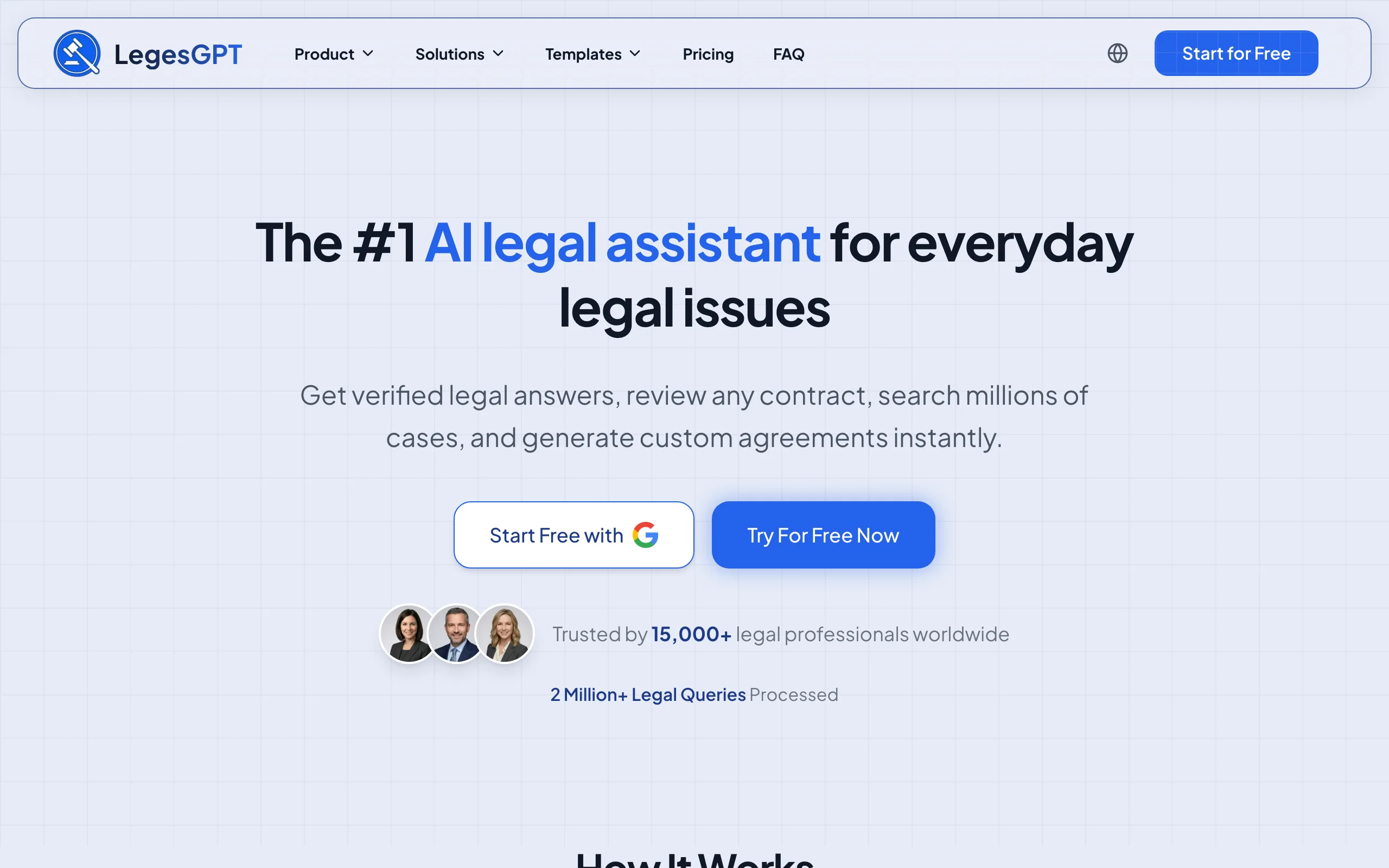
LegesGPT delivers the core of what firms hire Harvey for, answering legal questions, analyzing documents, and drafting, without the enterprise contract. It answers legal questions with verified citations and direct source links, searches case law and statutes, reviews uploaded documents to flag risky clauses and propose fixes, drafts contracts and legal documents, and lets you e-sign and send them. All of it lives in one browser-based subscription you can start today.
The difference from Harvey is access. Where Harvey is sales-gated and priced for large firms, LegesGPT is self-serve, published, and affordable, so a solo practitioner or a five-attorney firm gets a comparable end-to-end workflow for the price of a few billable minutes a month.
Key features:
- Verified-citation answers to legal questions, with links to the underlying source
- Case law and statute search across 38+ jurisdictions
- AI document review for PDF, DOCX, PPTX, TXT, and images that flags risks and proposes changes
- AI drafting of contracts and legal documents from a short guided brief
- Built-in e-signature to sign and send finished documents
- Deep Research mode and web search for multi-step questions and recent developments
Best for:
- Solo practitioners and 2-50 attorney firms that want broad capability without a sales cycle
- In-house counsel and legal ops teams that need research plus review plus drafting in one tool
- Cost-conscious teams priced out of Harvey, CoCounsel, or Lexis+
Pricing:
- Basic $13.99/month: unlimited AI queries, case law and statute search, citation verification
- Plus $34.99/month: adds document upload and 50 document reviews per month
- Premium $69.99/month: adds unlimited document review, Deep Research, and web search
- 3-day trial for $1; about 30% off on annual billing
Pros:
- Broadest workflow at the lowest entry price, research, review, drafting, and signing in one subscription
- Self-serve with a real trial, so you can test your own documents before committing
- Verified citations with source links make answers easy to check
Cons:
- A newer brand with a smaller footprint than Westlaw or LexisNexis
- Web-only, with no native mobile app, public API, or Microsoft Word add-in
- Lower tiers cap document reviews, so heavy review workloads need the Premium plan
For a closer look at how it stacks up against the wider market, see our roundup of the best legal AI tools and our guide to the best AI legal research tools.
2. Thomson Reuters CoCounsel, best for Westlaw-grounded research
CoCounsel is Thomson Reuters' AI legal assistant, built from the Casetext product TR acquired in 2023 for $650 million. Its defining strength is that its research, drafting, and review are grounded in Westlaw's proprietary content, so answers come tied to authoritative primary law rather than the open web. For firms that already trust and pay for the Thomson Reuters ecosystem, that grounding is the main reason to choose it.
CoCounsel now spans document review, deposition preparation, legal research, drafting, and agentic Deep Research workflows, and Thomson Reuters reported it passed one million users across 107 countries in early 2026.
Key features:
- Legal research grounded in Westlaw's authoritative content
- Document review and analysis across large sets of files
- Drafting of correspondence, contracts, and litigation documents
- Deep Research and agentic multi-step workflows
- Deposition and hearing preparation support
Best for:
- Firms already subscribed to Westlaw that want AI layered on the same content
- Litigation and research-heavy practices that value authoritative sourcing
- Small firms with 10 or fewer attorneys can self-configure online; larger firms buy through sales
Pricing:
- Not published. Sold through a configurator by sector, attorney count, and jurisdiction, in one-, two-, or three-year terms, and commonly bundled with Westlaw tiers
- No self-serve free trial; access is via demo and sales contact
Pros:
- Answers grounded in Westlaw's respected primary-law database
- Deep, mature feature set for research and litigation
- Backed by Thomson Reuters' scale and support
Cons:
- Quote-based pricing with annual terms and no transparent entry price
- Best value is tied to an existing Westlaw subscription
- Heavier and pricier than a solo or small firm usually needs
3. Legora, best for high-volume due diligence and M&A
Legora, formerly Leya, is a fast-rising European legal AI platform aimed at mid-to-large firms and in-house teams. Its signature feature is Tabular Review, which analyzes large batches of documents in a spreadsheet-style grid, ideal for due diligence, M&A, and any workflow where you need consistent answers pulled from hundreds of files at once. It pairs that with agentic legal research across jurisdictions and native Microsoft Word and Outlook add-ins.
Legora has scaled quickly, raising a $550 million Series D at a $5.55 billion valuation in early 2026, followed by an extension backed by Nvidia's venture arm. It competes directly with Harvey for large-firm transactional and litigation work.
Key features:
- Tabular Review for mass, side-by-side document analysis
- Agentic legal research across multiple jurisdictions
- Microsoft Word and Outlook add-ins
- Regulatory monitors and repeatable workflows
- Collaboration features for deal and diligence teams
Best for:
- Mid-to-large firms handling M&A, diligence, and multi-jurisdiction matters
- In-house teams reviewing large document volumes on a deadline
- Firms wanting a Harvey-class platform with a strong European footprint
Pricing:
- Not published. Quote-based, with third-party reports of a multi-seat minimum, so it carries a meaningful annual floor
- Demo only, with no free trial
Pros:
- Best-in-class bulk document review for diligence workflows
- Modern, agentic research and strong Word and Outlook integration
- Heavily funded and iterating quickly
Cons:
- Enterprise pricing and seat minimums put it out of reach for solos and small firms
- No transparent price or self-serve trial
- Overkill if you do not routinely review large document sets
4. Paxton AI, best transparent self-serve alternative
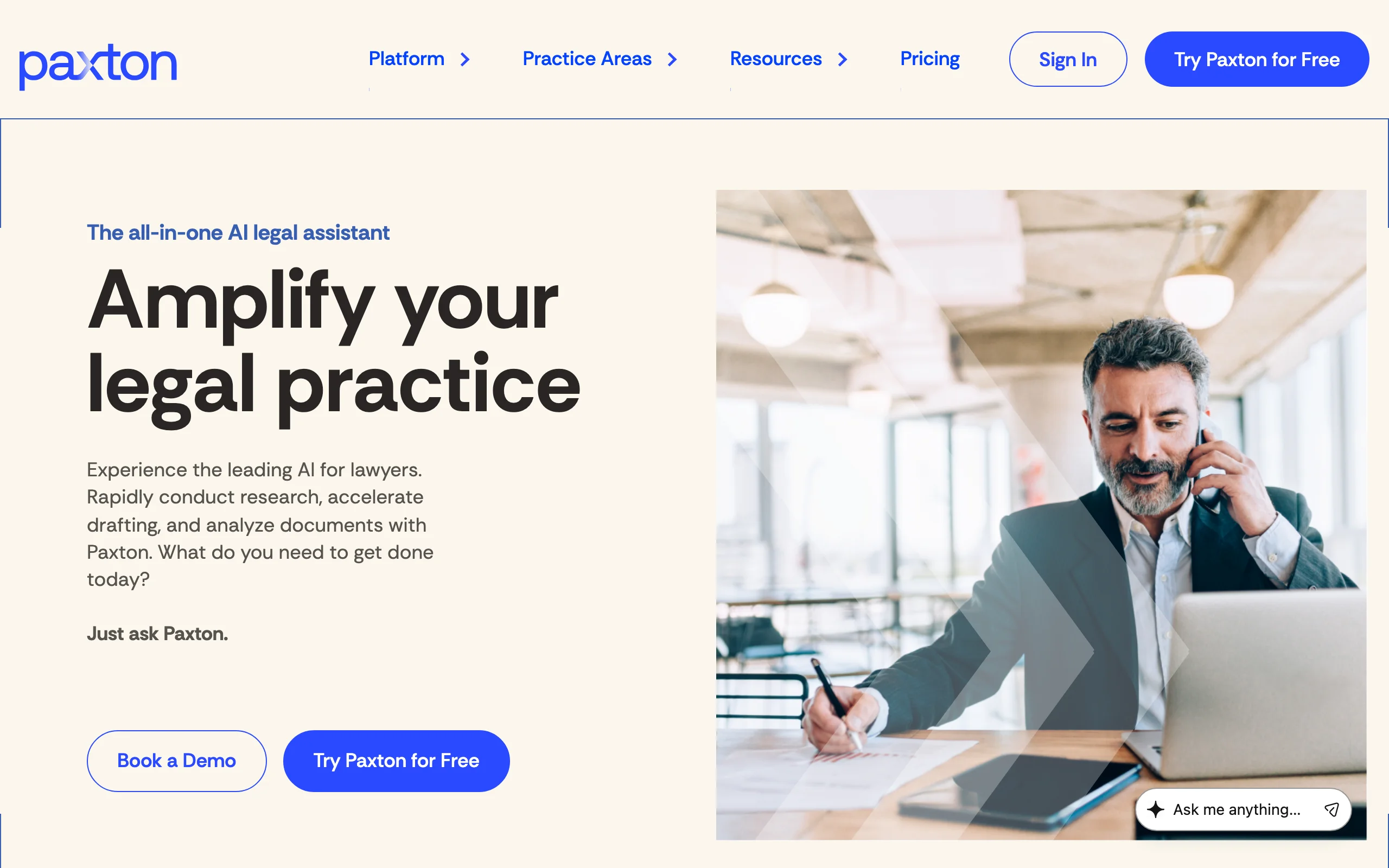
Paxton AI is the closest thing to a self-serve, published-price version of Harvey. It covers legal research across US federal regulations, all 50 states' statutes, and case law, plus AI drafting, document analysis, contract review, and specialized tools like medical chronologies and billing summaries. It carries SOC 2, ISO 27001, and HIPAA certifications, and it positions itself openly as an alternative to Harvey, Lexis, and CoCounsel.
The reason it lands here is transparency: Paxton publishes its price and offers a free trial, so a firm can evaluate an enterprise-grade research tool without a sales cycle. It sits above LegesGPT on price but below the fully sales-gated platforms on friction.
Key features:
- Legal research across federal regulations, all 50 states' statutes, and case law
- AI drafting and document analysis
- Contract review and clause analysis
- Medical chronologies and billing summaries for litigation
- SOC 2, ISO 27001, and HIPAA certifications
Best for:
- Small and midsize firms that want enterprise-grade research without enterprise sales
- Litigation practices that value the medical chronology and citation tooling
- Buyers who insist on a published price and a trial
Pricing:
- Individual $499 per user per month, or $2,999 per user per year
- Enterprise custom pricing for larger teams
- 7-day free trial on the Individual plan
Pros:
- Transparent, published pricing, rare among enterprise-grade legal AI
- Strong research coverage plus litigation-specific tools
- Self-serve with a free trial
Cons:
- At $499 per user per month, far pricier than LegesGPT for overlapping core features
- Fewer all-in-one conveniences like built-in e-signature
- Positioned around research more than end-to-end drafting and signing
5. Spellbook, best for contract drafting in Microsoft Word
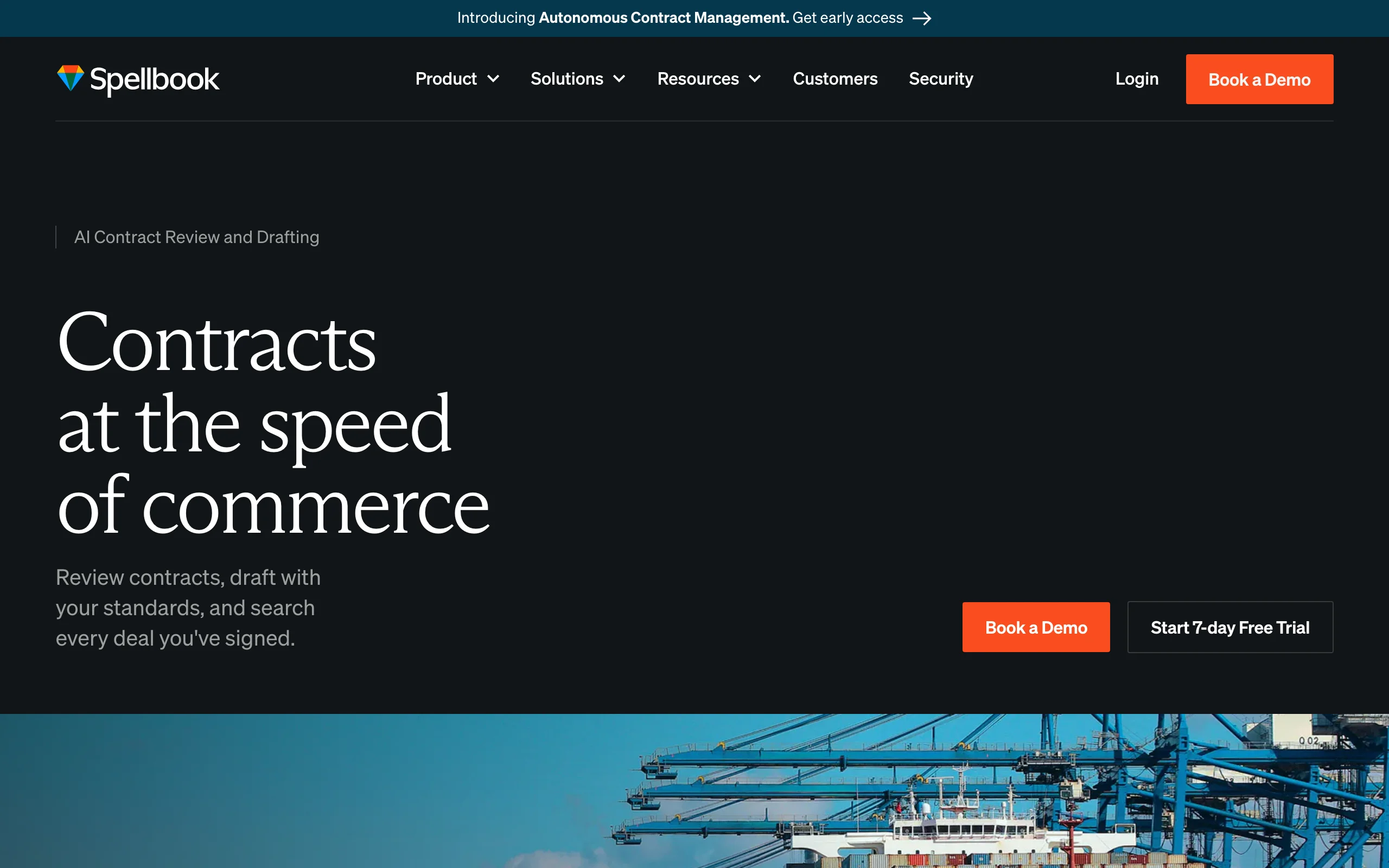
Spellbook takes a narrower path than Harvey. Instead of a full research platform, it lives inside Microsoft Word and focuses on contracts: reviewing and redlining agreements, drafting from clause libraries, benchmarking terms against market standards, and answering questions about a contract with citations to its language. For transactional lawyers who spend their day in Word, that focus is a feature, not a limitation.
Spellbook runs on frontier models from OpenAI and Anthropic, holds SOC 2 Type II, HIPAA, and GDPR compliance, and reported a $50 million Series B in late 2025 alongside more than 10 million contracts reviewed.
Key features:
- Contract review and redlining inside Microsoft Word
- Drafting from reusable clause libraries and playbooks
- Benchmarking of terms against market standards
- Contract Q&A with citations to the document
- Enterprise security and compliance certifications
Best for:
- Transactional and contract lawyers who work primarily in Word
- In-house teams standardizing contract review with playbooks
- Firms that want a focused drafting assistant rather than a research suite
Pricing:
- Not published; priced per license seat
- 7-day free trial, with no permanent free tier
Pros:
- Deep, Word-native contract drafting and review
- Playbooks and benchmarking speed up repetitive contract work
- Self-serve trial to evaluate the fit
Cons:
- Contract-focused, so it does not cover case law research or litigation
- No transparent published price
- Tied to the Microsoft Word workflow
If contracts are your main use case, compare it against our list of the best AI contract review tools before you decide.
6. Lexis+ with Protégé, best for citation-validated research
Lexis+ with Protégé is LexisNexis's AI assistant, rebranded from Lexis+ AI in early 2026. Its strength mirrors CoCounsel's: research grounded in an authoritative database, in this case Lexis's primary law and exclusive secondary sources, with Shepard's Citations to validate that an authority is still good law. It adds conversational research, transactional and litigation drafting, a secure Document Vault with DMS integration, and AI Agent Skills for multi-step workflows with approval gates.
For firms whose work turns on citation accuracy and authoritative sourcing, Lexis+ is a natural Harvey alternative, though it carries the same enterprise sales model.
Key features:
- Conversational research grounded in Lexis primary and secondary law
- Shepard's Citations to validate authorities
- Transactional and litigation drafting
- Secure Document Vault with iManage, SharePoint, and NetDocuments integration
- AI Agent Skills for multi-step workflows
Best for:
- Research- and litigation-heavy practices that need validated citations
- Firms already invested in the LexisNexis platform
- Larger teams that want authoritative sourcing over self-serve convenience
Pricing:
- Not published. Customized by organization size, capabilities, and content scope, typically on top of a Lexis+ subscription
- 2-day free trial
Pros:
- Authoritative sourcing with Shepard's citation validation
- Strong drafting and a secure, DMS-integrated document vault
- Established, trusted research brand
Cons:
- Quote-based pricing that usually requires an existing Lexis subscription
- Short two-day trial relative to competitors
- Enterprise sales model, not built for quick self-serve adoption
How to choose the best Harvey AI alternative for your practice
The right Harvey alternative depends less on raw capability and more on how you buy, what you do most, and what you can spend. Work through these questions before you commit.
1) How do you want to buy, self-serve or sales-led?
- If you want to start today without a sales cycle: LegesGPT, Paxton AI, and Spellbook are self-serve with published prices or trials.
- If you are comfortable with a demo and an annual contract: CoCounsel, Legora, and Lexis+ are sales-led but bring deep, authoritative platforms.
The single biggest reason firms leave Harvey is procurement friction, so be honest about whether your team will sit through an enterprise buying process.
2) What do you actually do most, research, drafting, or diligence?
- Broad, everyday mix of research, review, and drafting: LegesGPT covers the whole workflow in one subscription.
- Authoritative primary-law research: CoCounsel or Lexis+ with Protégé.
- High-volume document review and diligence: Legora's Tabular Review.
- Contract drafting in Word: Spellbook.
3) What is your budget and team size?
- Solo or small firm on a tight budget: LegesGPT from $13.99/month is the clear value pick.
- Small firm that wants enterprise-grade research with a published price: Paxton AI at $499/user/month.
- Large firm with an established database subscription: CoCounsel or Lexis+, where the AI layers onto content you already pay for.
4) Try before you commit
Whatever the shortlist, test three to five of your real documents and questions in each tool. LegesGPT, Paxton AI, Spellbook, and Lexis+ all offer trials, so you can compare answers, citations, and drafting quality on your own matters. Run the math on price-to-value: for many solos and small firms, an all-in-one tool like LegesGPT delivers most of Harvey's day-to-day usefulness at a fraction of the cost, and you can always add a specialized platform later as you scale.