Every legal answer starts with a database, and the market for legal research databases now runs from incumbents that bill per document to bar-association benefits you already pay for and AI-native platforms that answer in plain language with linked sources. The right choice depends on the depth of law you need, the jurisdictions you cover, and how much you can spend without overpaying for coverage you never touch.
This guide compares the 7 best legal research databases in 2026. We cover what each one holds, who it fits, real pricing, and the honest trade-offs, from the gold-standard incumbents to the free options, so you can match a database to your practice instead of defaulting to the most expensive name.
Best legal research databases: a brief overview
Here is a quick snapshot of the 7 databases and what each does best:
- LegesGPT: Best overall for solo and small-firm lawyers: a searchable case law and statute database with AI answers backed by verified citations, at the lowest entry price on this list.
- Westlaw: Best for comprehensive US case law: the long-standing gold standard for primary law and editorial tools.
- LexisNexis (Lexis+): Best for deep primary and secondary sources: the other incumbent, with vast secondary content and Shepard's.
- Bloomberg Law: Best for business and transactional law: dockets, analytics, and news under a predictable flat fee.
- vLex (with Fastcase): Best for value and international coverage: free through many bar associations, with 100+ jurisdictions.
- HeinOnline: Best for historical and secondary research: deep archives of law reviews, treaties, and government documents.
- Google Scholar: Best free option: searchable US case law for quick checks and budget-conscious research.
| Tool | Best for | Starting price | Free trial | Coverage |
|---|---|---|---|---|
| LegesGPT | AI research with verified citations | From $19.99/mo | 3-day for $1 | 38+ countries |
| Westlaw | Comprehensive US case law | From ~$133/user/mo (1 state) | Demo only | US primary + secondary |
| LexisNexis (Lexis+) | Deep primary + secondary | Custom quote | Demo only | US-focused, global |
| Bloomberg Law | Business law, dockets, analytics | Custom (flat-fee quote) | Demo only | US + business/global |
| vLex (with Fastcase) | Value and international | Free via 80+ bar assns | Free for bar members | 100+ jurisdictions |
| HeinOnline | Historical + secondary sources | Subscription (quote) | Limited free content | Global archives |
| Google Scholar | Free case law search | Free | Not needed (free) | US case law |
Pricing note: LegesGPT publishes standard prices, Westlaw lists new-customer flat rates, and vLex Fastcase is free through many bar memberships. LexisNexis, Bloomberg Law, and HeinOnline quote per organization, so those figures are estimates, not list prices. Confirm before budgeting.
1. LegesGPT, best overall for solo and small-firm lawyers
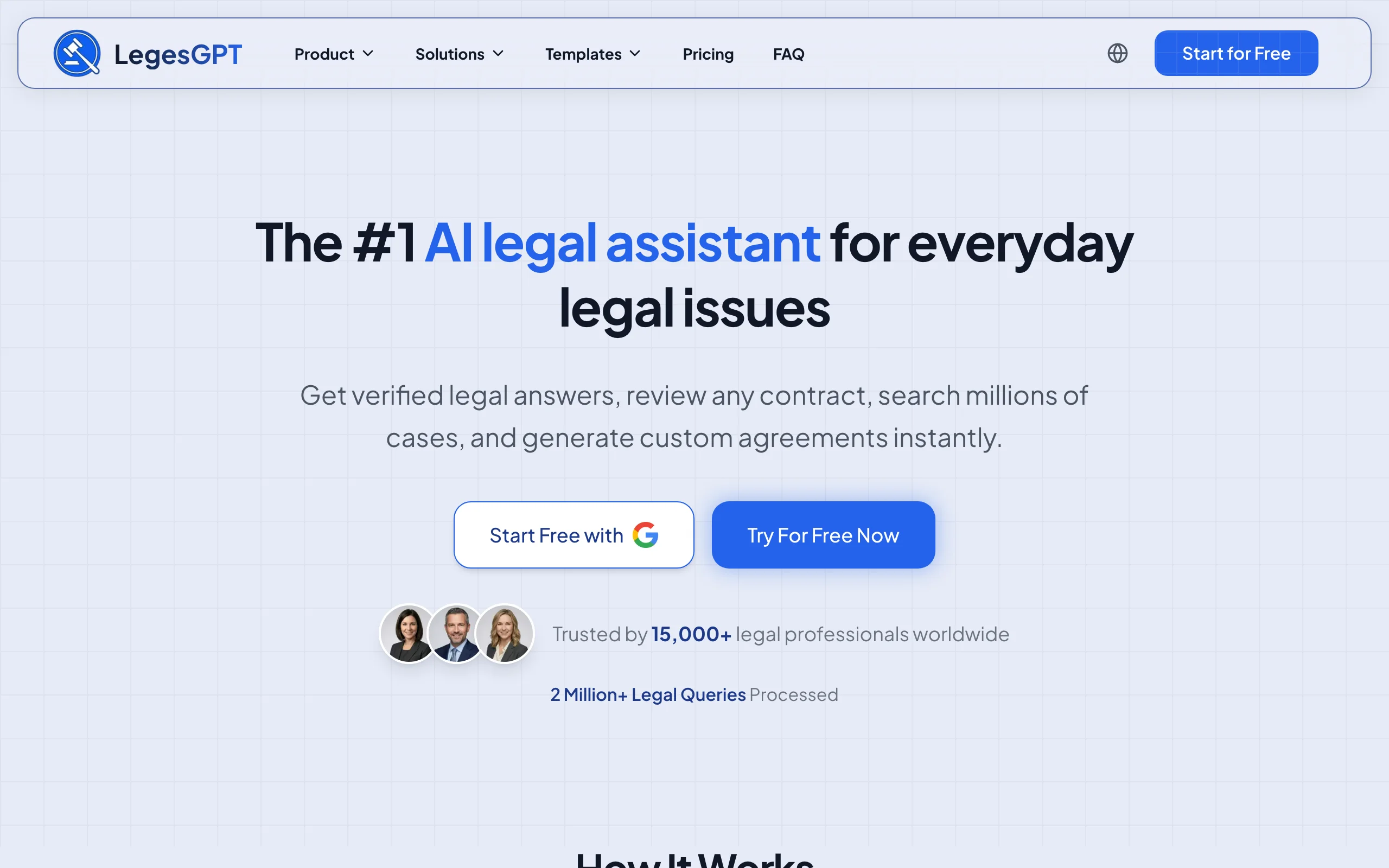
LegesGPT is the AI-native option on this list. Instead of returning a list of documents to read, it answers your question directly and shows the verified sources behind the answer with citations you can click and check. It searches case law and statutes across many jurisdictions, runs a Deep Research mode for multi-step questions, and pulls in web search for recent developments, all in one app that also reviews and drafts documents.
It earns the top spot on value and accessibility, not raw database size. The incumbents below hold deeper editorial archives, but they cost many times more and assume a US-only practice. LegesGPT gives you trustworthy, source-linked research without a per-document bill or an enterprise contract: you start a 3-day trial for $1 and run your first query in minutes. For most solo and small-firm lawyers who want fast, checkable answers at a sane price, it is the best place to start, and if you are weighing the wider AI field, our roundup of the best AI legal research tools compares it against the newer entrants.
Key features
- Answers research questions with verified sources and direct, clickable citations
- Searchable case law and statute database spanning US and international jurisdictions
- Deep Research mode for complex, multi-step legal questions
- Web search integration for recent legal developments
- Document review and AI drafting in the same platform
- Free tools including a citation generator
Best for
- Solo practitioners and small firms that want checkable research at an accessible price
- Lawyers handling multi-jurisdictional questions beyond the US
- Anyone who wants research, review, and drafting in one subscription
Pricing
- 3-day trial for $1 on all plans (no permanently free tier)
- Basic at $19.99/month, Plus at $49.99/month, Premium at $99.99/month (adds Deep Research and web search)
- Roughly 30% off with annual billing; no per-seat minimums
Pros
- Verified sources and direct citations make answers easy to check
- By far the lowest entry price on this list
- Multi-jurisdiction coverage, unlike the US-centric incumbents
- Research connects directly to drafting and review
Cons
- Smaller raw editorial archive than Westlaw or LexisNexis
- Web-only: no native mobile app or Word add-in
2. Westlaw, best for comprehensive US case law
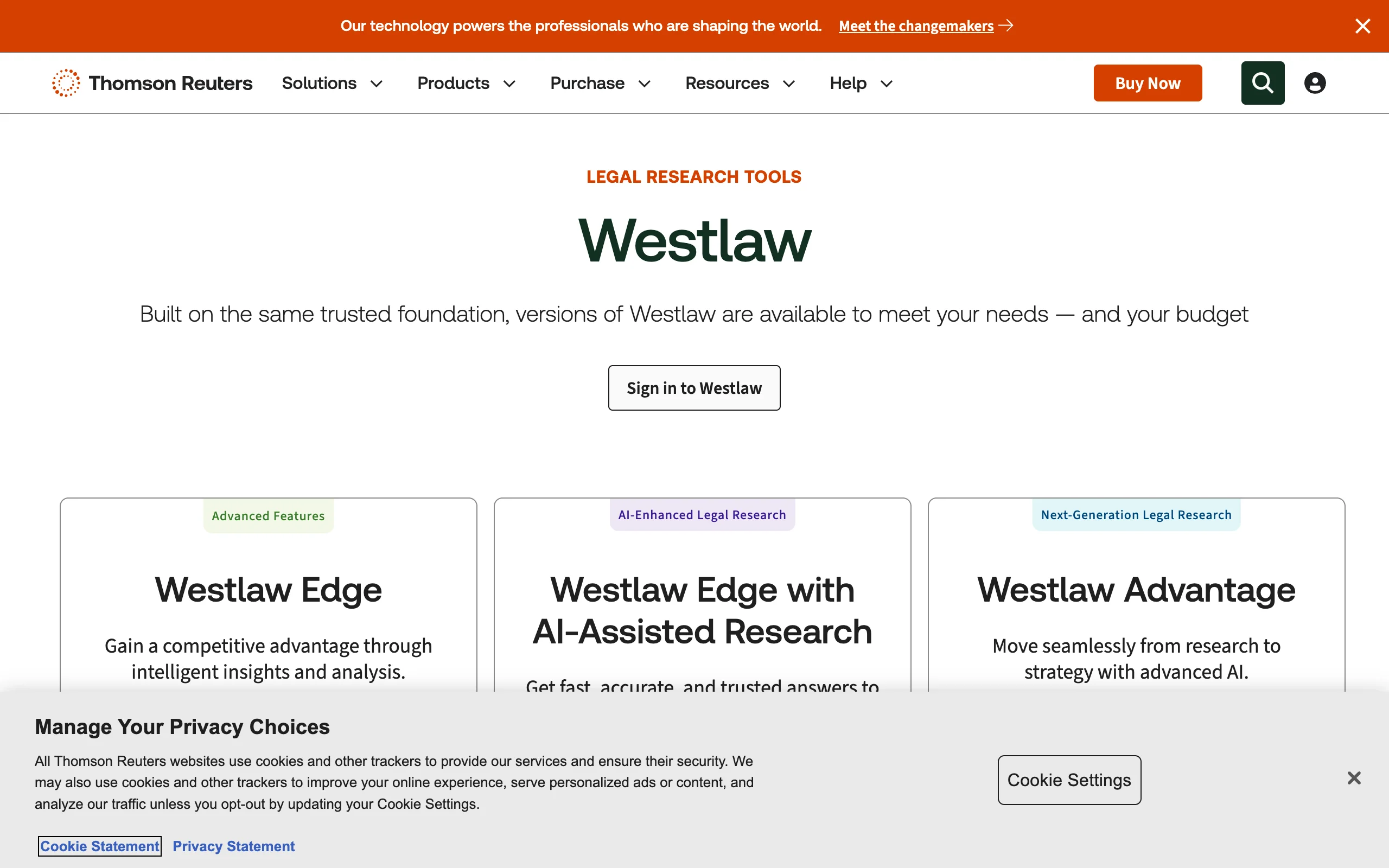
Westlaw, from Thomson Reuters, is the database many lawyers think of first. It pairs a vast collection of US primary law with editorial tools built over decades: the Key Number System for topical research, headnotes that summarize holdings, and KeyCite to check whether a case is still good law. For US litigation and research-intensive practices, its depth and editorial quality remain the benchmark.
That depth is the reason it sits at the premium end. Westlaw now publishes new-customer flat rates by coverage tier, which adds welcome transparency, but the cost climbs quickly as you add states, federal materials, and analytics, and document charges can apply outside your plan. For firms that need the deepest US database and will use the editorial layer, it is worth the price; for lighter research, it can be more than you need, and we compared the best Westlaw alternatives for exactly that case.
Key features
- Extensive US case law, statutes, regulations, and secondary sources
- KeyCite citation service to verify whether authority is still good law
- Key Number System and editorial headnotes for topical research
- AI-enhanced research on higher tiers (Westlaw Edge and Advantage)
- Court rules, briefs, and practice materials
Best for
- US litigation and research-intensive practices
- Firms that rely on editorial tools like the Key Number System and KeyCite
- Lawyers who need the deepest primary law coverage in a single state or nationally
Pricing
- New-customer flat rates roughly from $133/user/month for one state up to around $400/user/month for all states and federal
- Higher tiers (Edge, Advantage) add AI features at higher prices
- Existing customers and large firms are quoted directly; document fees can apply outside a plan
Pros
- Comprehensive US database with a long-trusted editorial layer
- KeyCite is a benchmark for citation validation
- Now offers published new-customer pricing tiers
Cons
- Premium pricing that scales quickly with coverage
- Potential extra document charges outside your plan
- US-centric, with less value for international work
3. LexisNexis (Lexis+), best for deep primary and secondary sources
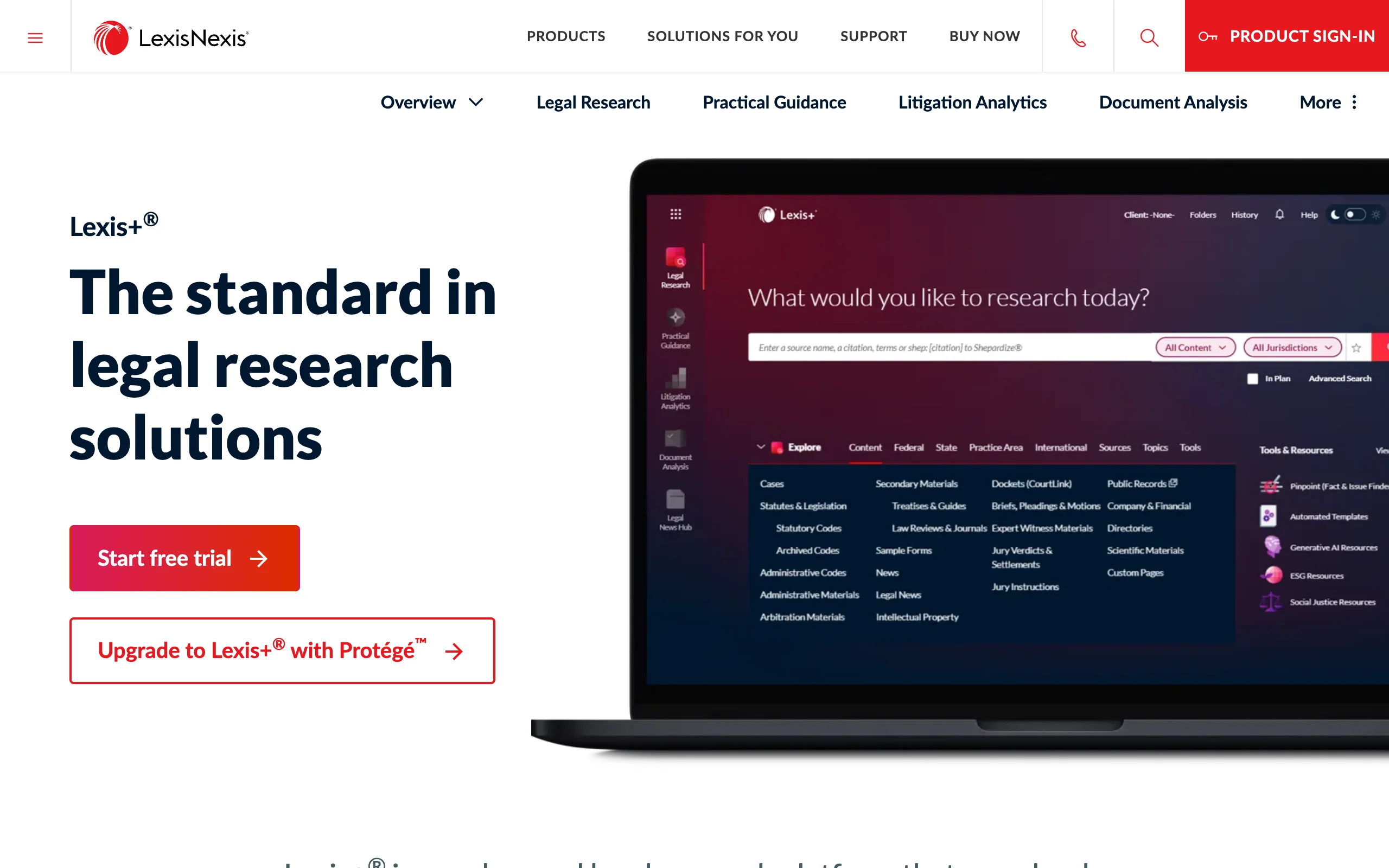
LexisNexis, through its Lexis+ platform, is the other incumbent and Westlaw's closest rival. It offers an enormous collection of primary law alongside one of the deepest libraries of secondary sources, treatises, and analytical materials, plus Shepard's Citations for validating authority. For practices that lean heavily on secondary content and treatises, Lexis is often the preferred database.
Like Westlaw, it is priced for firms rather than individuals, and pricing is quote-based rather than published. The two incumbents are close enough that the choice often comes down to which editorial ecosystem and secondary sources your practice already relies on. If your work depends on specific Lexis treatises or Shepard's, that pull is hard to replace; if it does not, our guide to the best LexisNexis alternatives covers lower-cost routes to the same everyday research.
Key features
- Vast US primary law plus a deep secondary source and treatise library
- Shepard's Citations for validating whether authority is still good
- Practical Guidance and analytical materials across practice areas
- Lexis+ AI layer for natural language research on higher tiers
- Integration with Microsoft 365 and the broader Lexis suite
Best for
- Firms that rely on Lexis treatises and secondary sources
- Research-intensive and appellate practices needing depth
- Lawyers who prefer Shepard's for citation validation
Pricing
- Custom, quote-based pricing; LexisNexis does not publish standard rates
- Generally comparable to Westlaw, varying by coverage and firm size
- Higher tiers add the Lexis+ AI assistant
Pros
- One of the deepest secondary source and treatise libraries available
- Shepard's is a trusted citation validation standard
- Strong analytical and practical guidance content
Cons
- Opaque, quote-only pricing aimed at firms
- Premium cost beyond most solo budgets
- US-focused, with depth that smaller practices may not use
4. Bloomberg Law, best for business and transactional law
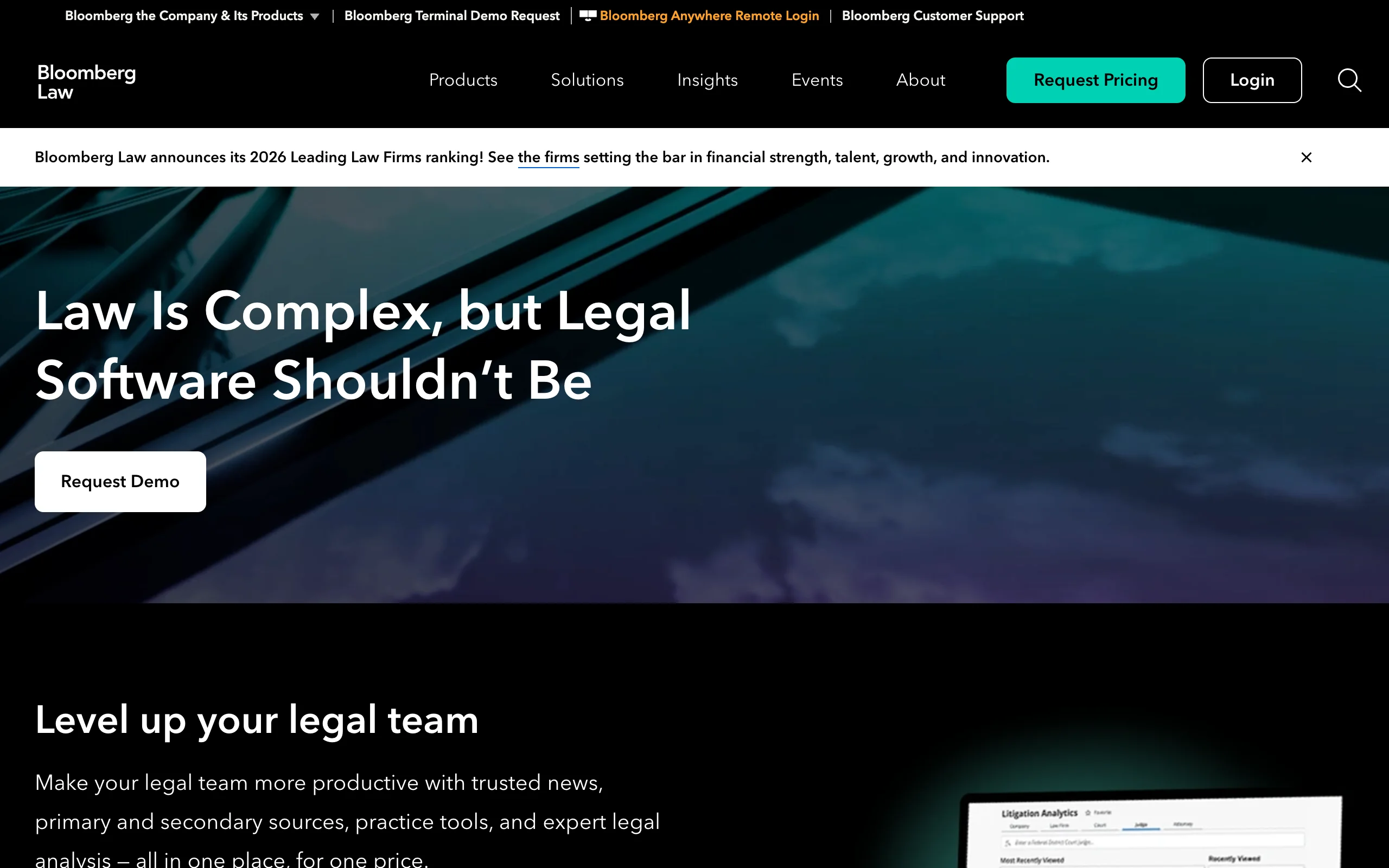
Bloomberg Law combines legal research with business intelligence, which is what sets it apart from the two pure-research incumbents. Alongside case law and statutes, it offers extensive dockets, transactional and corporate materials, regulatory content, and news from Bloomberg's broader operation, plus analytics on judges, companies, and trends. For transactional, corporate, and regulatory practices, that blend of law and business data is the draw.
It is sold on a flat-fee subscription, which makes budgeting more predictable than per-document billing, but pricing is quote-based rather than published. For litigation-only practices, the business layer may be more than necessary; for corporate and regulatory work, it is often exactly the right mix.
Key features
- Legal research combined with business and financial intelligence
- Extensive court dockets with tracking and alerts
- Transactional, corporate, and regulatory materials
- Litigation and company analytics, plus Bloomberg news
- Practical guidance and contract tools
Best for
- Transactional, corporate, and regulatory practices
- Teams that need dockets and business intelligence alongside case law
- Firms that prefer predictable flat-fee billing
Pricing
- Custom, flat-fee subscription; Bloomberg Law does not publish standard rates
- Flat pricing avoids per-document charges, aiding budgeting
- Request a quote based on firm size and needs
Pros
- Strong dockets, analytics, and business intelligence
- Predictable flat-fee model
- Useful blend of legal and business content for corporate work
Cons
- Quote-only pricing with no published rates
- Business features can be excess for litigation-only practices
- Premium positioning relative to budget tools
5. vLex (with Fastcase), best for value and international coverage
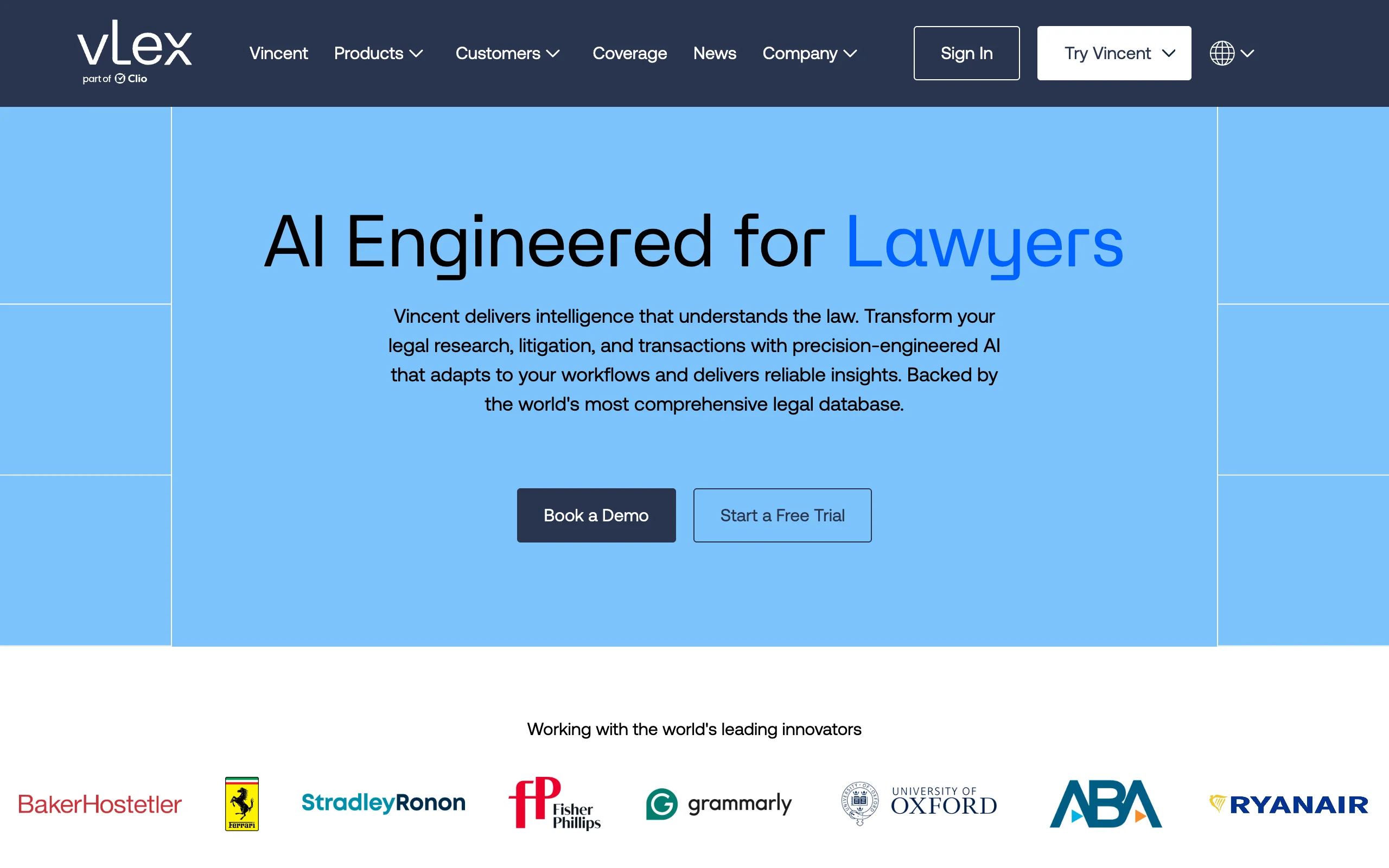
vLex, which merged with Fastcase, offers one of the best value propositions in legal research because the Fastcase Library is free to members of more than 80 state, county, and specialty bar associations. If your bar participates, you already have access to a large research database as a membership benefit, a resource that otherwise costs over a thousand dollars a year. On top of that, vLex's full platform spans 100+ jurisdictions, making it strong for international and cross-border work.
The merged platform adds the Cert citator for checking negative treatment and the Vincent AI research assistant on paid tiers. Following Clio's acquisition of vLex, the platform is increasingly available through Clio as well. For cost-conscious lawyers and those with international needs, it is hard to beat on value.
Key features
- Fastcase Library free through 80+ bar association memberships
- Coverage across 100+ jurisdictions for international research
- Cert citator to flag negative treatment of cases
- Vincent AI research assistant on paid tiers
- Large searchable document collection across primary and secondary law
Best for
- Cost-conscious solo and small firm lawyers with bar access
- Practices handling international or cross-border research
- Lawyers who want a capable database without a premium contract
Pricing
- Free Fastcase Library access through participating bar associations
- Non-member and full vLex/Vincent AI tiers are subscription or quote-based
- Increasingly available through Clio following the acquisition
Pros
- Free to a huge number of lawyers through bar memberships
- Broad international coverage across 100+ jurisdictions
- Citator and AI assistant included on appropriate tiers
Cons
- Free access depends on your bar association participating
- Editorial depth in US law is lighter than Westlaw or Lexis
- Full AI features require a paid tier or Clio subscription
6. HeinOnline, best for historical and secondary research
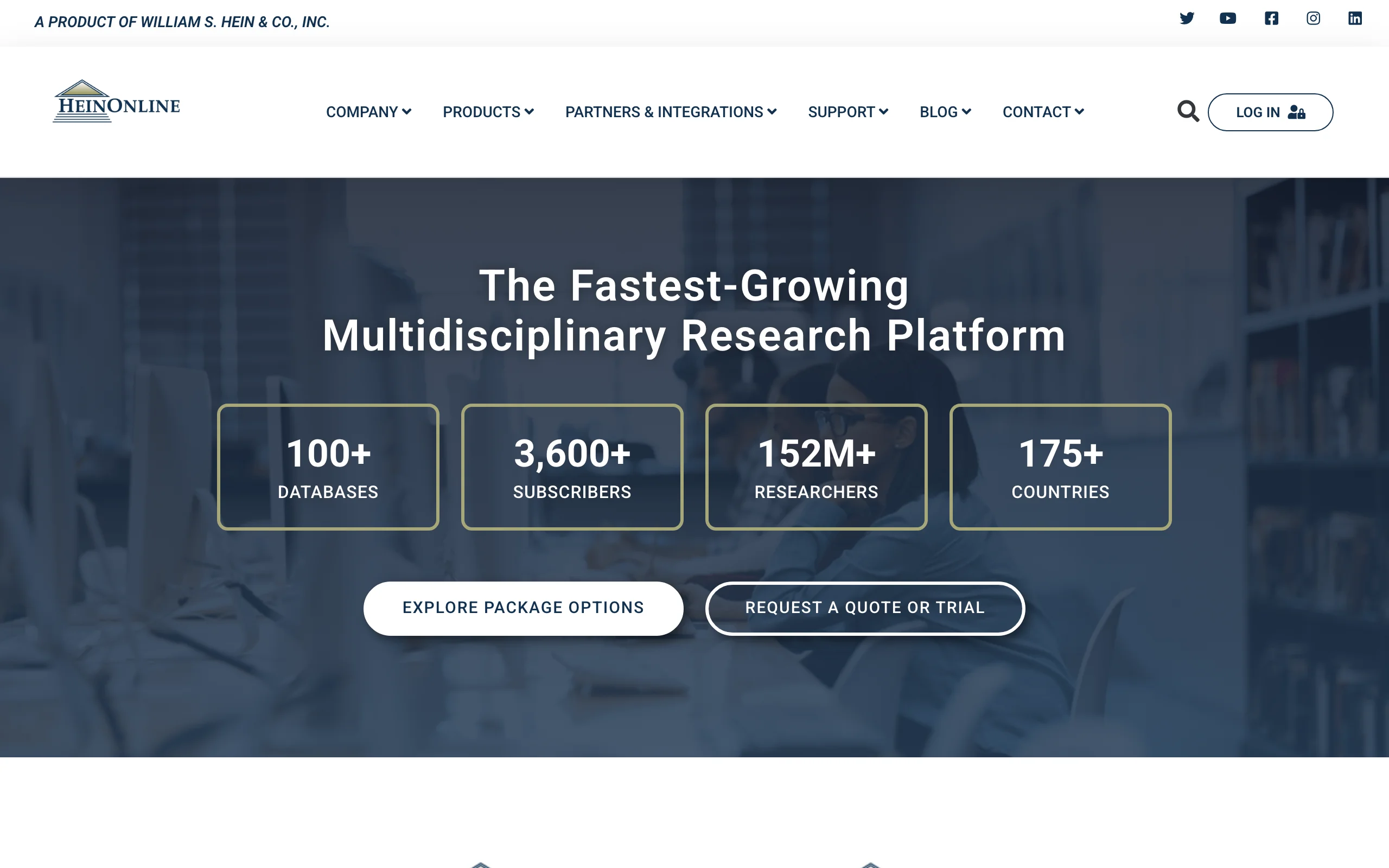
HeinOnline is the specialist's database for historical and secondary materials. It holds deep, image-based archives of law review articles, treaties, legislative histories, government documents, and historical statutes and case law that the general research platforms do not match for depth. For academic research, legislative history, and any work that reaches back through the historical record, it is the go-to source.
It is not built for fast, current case law checks the way Westlaw or LegesGPT are; its value is the archive. Many lawyers access it through a law library or institutional subscription rather than an individual plan, and pricing is quote-based by collection and institution. As a complement to a primary-law database, it fills gaps the others leave open.
Key features
- Deep, image-based archives of law review and journal articles
- Legislative histories, treaties, and government documents
- Historical statutes, case law, and legal periodicals
- Strong citation and full-text search across archival collections
- Widely available through law libraries and institutions
Best for
- Academic and scholarly legal research
- Legislative history and historical legal research
- Practices that need deep secondary and archival sources
Pricing
- Subscription, quote-based by collection and institution
- Often accessed through a law library or institutional plan
- Some limited free content; full archives require a subscription
Pros
- Unmatched depth in historical and secondary materials
- Excellent for legislative history and scholarly work
- Image-based archives preserve original documents
Cons
- Not designed for fast, current case law research
- Pricing and access usually run through institutions
- A complement to, not a replacement for, a primary-law database
7. Google Scholar, best free option
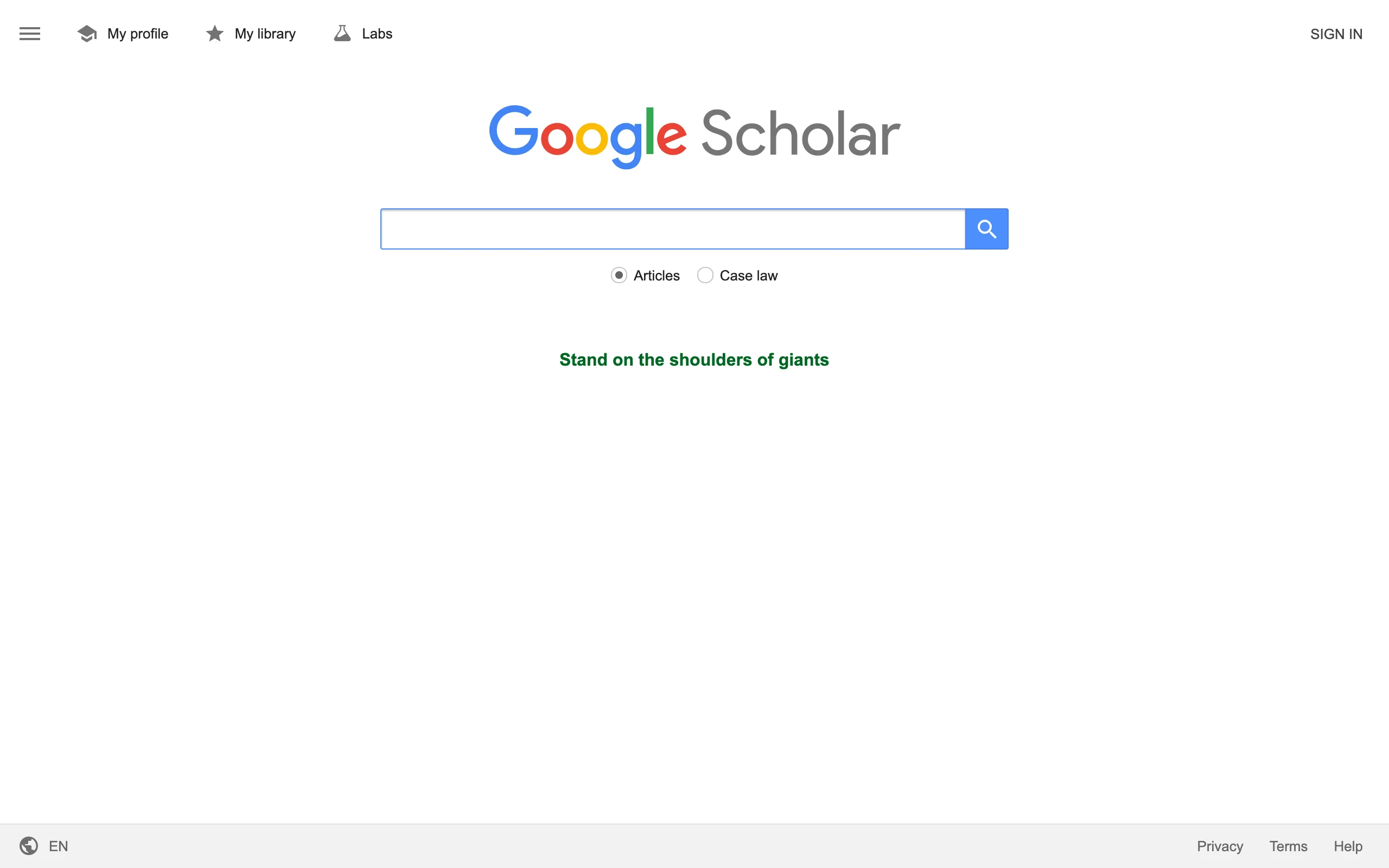
Google Scholar is the free starting point for legal research. Its case law search covers US federal and state opinions, and you can read full-text decisions and follow how later cases cite them, all at no cost. For quick checks, students, solos on a tight budget, or a fast look at a case before turning to a paid database, it is genuinely useful and widely used.
The trade-offs are what you would expect from a free tool. There is no editorial citator to reliably tell you whether a case is still good law, coverage of statutes and secondary sources is limited, and the search lacks the precision tools of the paid platforms. It is a strong free option for case law, but it is not a substitute for a full research database on serious matters.
Key features
- Free search of US federal and state case law
- Full-text access to many court opinions
- "How Cited" view to see later citing cases
- Simple, familiar search interface
- No subscription or login required
Best for
- Students and budget-conscious solo practitioners
- Quick case look-ups before using a paid database
- Anyone needing free access to US case law
Pricing
- Completely free
- No account or subscription required
- No paid tiers
Pros
- Free access to a large body of US case law
- Easy to use, with no setup
- Useful "How Cited" view for tracing case treatment
Cons
- No reliable editorial citator to confirm good law
- Limited statutes, secondary sources, and precision search
- Not suitable as the sole database for serious matters
How to choose among the best legal research databases for your practice
1) What law do you actually need?
Start with the type of law your work depends on. For comprehensive US primary law and editorial tools, Westlaw and LexisNexis lead. For business, dockets, and analytics, Bloomberg Law fits. For historical and secondary materials, HeinOnline is the specialist. For fast, AI-native answers across many jurisdictions, LegesGPT covers it, and for free case law, Google Scholar works.
- Deep US primary law: Westlaw or LexisNexis
- Business and dockets: Bloomberg Law
- Historical and secondary: HeinOnline
2) What is your budget, and what do you already get?
Budget separates this list sharply, and many lawyers already have free access they overlook. Check whether your bar association includes the vLex Fastcase Library before paying for anything. Google Scholar is free for case law. LegesGPT starts at $19.99/month, while Westlaw, LexisNexis, and Bloomberg Law run into the hundreds per user per month. Pay for an incumbent only if you will use its depth.
- Free or low cost: vLex Fastcase (via bar), Google Scholar, LegesGPT
- Premium depth: Westlaw, LexisNexis, or Bloomberg Law
3) Do you need editorial citation validation?
If your work depends on confirming whether a case is still good law, the editorial citators matter. KeyCite on Westlaw and Shepard's on Lexis are the trusted standards, and vLex's Cert covers negative treatment. LegesGPT links every answer to a verified source so you can check it directly, and Google Scholar's citing view helps but is not an editorial citator. For high-stakes filings, verify in a tool with a real citator.
4) Match the database to your jurisdictions
US-only practices are well served by any of the incumbents. If you handle international or cross-border matters, your strongest options narrow to vLex, with 100+ jurisdictions, and LegesGPT, which covers 38+ countries at a far lower price. Do not pay for global coverage you will not use, and do not assume a US-centric incumbent covers foreign law well.
Whichever direction you lean, do not buy from a demo alone. Take three to five real research questions from closed matters, run the same queries through each shortlisted database during a trial, and compare what each surfaces against the authorities you actually cited. A $1 trial or a free database makes that test nearly costless, and the price-to-value gap it reveals is usually decisive. For the wider research stack beyond databases, see our guide to the best legal research tools for lawyers.