
Westlaw is the default legal research platform for a reason: deep primary law, the KeyCite citator, and litigation analytics that big firms rely on. But it is also one of the most expensive tools in law, sold on quote-based, multi-year contracts with annual price increases and overlapping tiers that are hard to compare. For solos, small firms, and cost-conscious in-house teams, the value math often stops working.
You have more options than ever. Some alternatives match Westlaw's database depth, some replace the daily research grind with AI, and some are free. In this guide we compare the best Westlaw alternatives, with verified pricing where it exists, the features that matter, and who each one actually fits, so you can cut cost without cutting corners.
Best Westlaw alternatives: a quick overview
- LegesGPT: Best overall value for solos and small firms. AI answers with verified citations, case law and statute search, document review, and drafting in one subscription from $13.99/month.
- LexisNexis (Lexis+ with Protégé): Best full-database rival, with comparable primary law, Shepard's citations, and an integrated AI assistant.
- Bloomberg Law: Best for flat-fee predictability and firms that want legal research plus business and news intelligence in one bundle.
- vLex Fastcase: Best budget route, free through many bar memberships, with global coverage and Vincent AI.
- Thomson Reuters CoCounsel: Best AI research grounded in Westlaw and Practical Law content, for teams staying in the TR ecosystem.
- Paxton AI: Best transparent, self-serve research tool with a published price.
- Google Scholar: Best free option for basic case law lookups.
| Tool | Best for | Starting price | Free trial / tier | Type |
|---|---|---|---|---|
| LegesGPT | All-in-one for solo & small firms | From $13.99/mo | 3-day, $1 | AI assistant |
| Lexis+ with Protégé | Full-database Westlaw rival | Quote-based | 2-day free | Database + AI |
| Bloomberg Law | Flat-fee research + business intel | Quote-based | Demo only | Database + AI |
| vLex Fastcase | Budget / bar-membership access | Free via 40+ bars | Bar benefit | Database + AI |
| CoCounsel | AI grounded in Westlaw content | Quote-based | Trial on some tiers | AI assistant |
| Paxton AI | Transparent self-serve research | $499/user/mo | 7-day free | AI assistant |
| Google Scholar | Free basic case law search | Free | Free | Free database |
1. LegesGPT, best overall value alternative to Westlaw
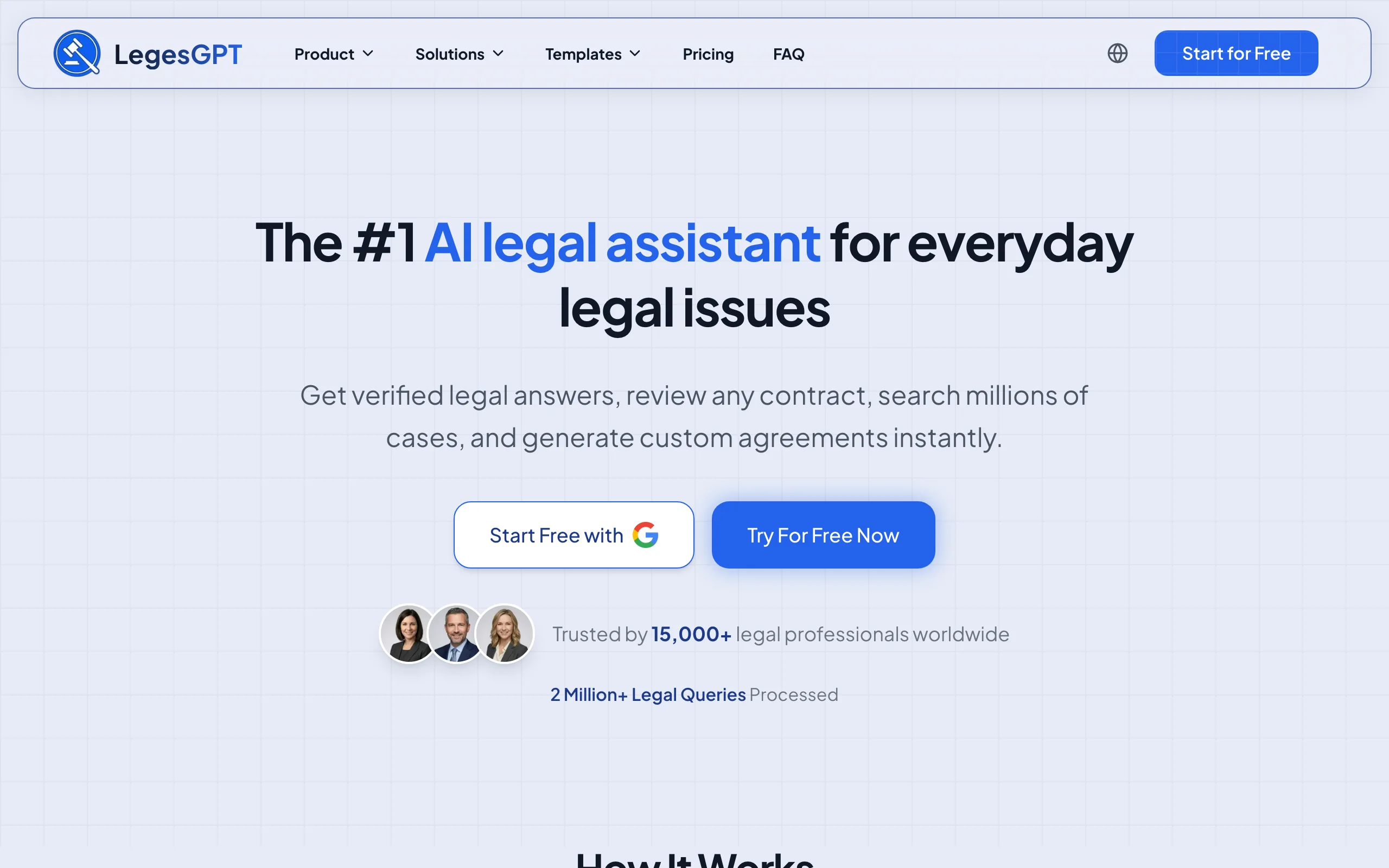
LegesGPT is the most accessible way to replace much of your daily Westlaw usage. It answers legal questions with verified citations and direct source links, searches case law and statutes across 38+ jurisdictions, reviews uploaded documents for risk, and drafts contracts and legal documents, all in one browser-based subscription. Where Westlaw is a premium research database sold through sales reps, LegesGPT is self-serve, transparently priced, and cheap enough for a solo to run month to month.
It is not a like-for-like database swap. LegesGPT is an AI assistant built for speed and affordability, not an exhaustive primary-law archive with a full citator. But for the questions most lawyers ask most days, getting a cited answer in seconds beats paying premium rates to search manually.
Key features:
- Verified-citation answers with links to the underlying authority
- Case law and statute search across 38+ jurisdictions
- AI document review that flags risks and proposes changes
- AI drafting of contracts and legal documents
- Deep Research mode and web search for multi-step and recent questions
- Built-in e-signature to finalize documents
Best for:
- Solo practitioners and 2-50 attorney firms priced out of Westlaw
- In-house counsel who want fast, cited answers without a database contract
- Anyone who wants research, review, and drafting in one affordable tool
Pricing:
- Basic $13.99/month: unlimited AI queries, case law and statute search, citation verification
- Plus $34.99/month: adds document upload and 50 document reviews per month
- Premium $69.99/month: adds unlimited document review, Deep Research, and web search
- 3-day trial for $1; about 30% off annual billing
Pros:
- A fraction of Westlaw's cost, with no multi-year contract
- Cited answers plus document review and drafting in one place
- Self-serve trial so you can test it on your own questions
Cons:
- Not a full primary-law database, so exhaustive archival research still needs one
- No dedicated citator like KeyCite or Shepard's for negative-treatment flagging
- Web-only, with no native mobile app or Word add-in
See how it compares more broadly in our roundup of the best AI legal research tools.
2. LexisNexis (Lexis+ with Protégé), best full-database rival
LexisNexis is Westlaw's closest peer and its longtime rival, with comparable primary-law coverage and its own respected citator, Shepard's Citations. Its AI is now consolidated into Lexis+ with Protégé, an agentic assistant that runs conversational research, drafts and redlines, and executes multi-step workflows grounded in Lexis content. If you want Westlaw-scale depth from a different vendor, this is the obvious switch.
The trade-off is that Lexis carries the same premium, quote-based pricing model as Westlaw, so it is an alternative in vendor and feature set more than in cost.
Key features:
- Comprehensive primary and secondary law
- Shepard's Citations for good-law validation
- Protégé conversational research, drafting, and redlining
- Secure Document Vault for grounded AI on your own files
- DMS integrations with iManage, SharePoint, and NetDocuments
Best for:
- Firms wanting a full Westlaw-class database from a different provider
- Litigation and research-heavy practices needing citator validation
- Teams already in the LexisNexis ecosystem
Pricing:
- Not published; customized quote-based pricing, typically premium
- 2-day free trial
Pros:
- Depth and authority comparable to Westlaw
- Strong AI assistant plus a mature citator
- Broad integrations and secure document tooling
Cons:
- Premium, quote-based pricing similar to Westlaw
- Very short two-day trial
- Overkill and overpriced for many solos and small firms
3. Bloomberg Law, best for flat-fee predictability
Bloomberg Law bundles legal research with business and news intelligence, and it is known for flat, all-inclusive pricing rather than per-library add-ons. That predictability appeals to firms tired of Westlaw's a la carte tiers. It includes comprehensive dockets, Litigation Analytics, Points of Law, Practical Guidance, and the Brief Analyzer AI tool with the BCite citator.
For litigators and corporate teams who value dockets, analytics, and business data alongside case law, Bloomberg Law is a genuine Westlaw competitor, though it sits at the premium end of the market.
Key features:
- Comprehensive dockets included in the subscription
- Litigation Analytics for judges, courts, and counsel
- Points of Law machine-learning precedent identification
- Brief Analyzer AI and the BCite citator
- Practical Guidance and integrated business and news intelligence
Best for:
- Litigation and corporate teams wanting dockets and analytics
- Firms that prefer flat-fee, all-inclusive billing
- Practices that use business and news data alongside legal research
Pricing:
- Not published; pricing by request. Widely cited flat-fee estimates put it in the premium range per attorney per month
- Demo by request, with no public free trial
Pros:
- Predictable flat-fee pricing with dockets included
- Strong analytics and business intelligence
- Modern generative-AI research tools with source attribution
Cons:
- Premium pricing, not a budget option
- No public free trial or bar-association free access
- More than a solo doing routine research usually needs
4. vLex Fastcase, best budget and bar-membership route
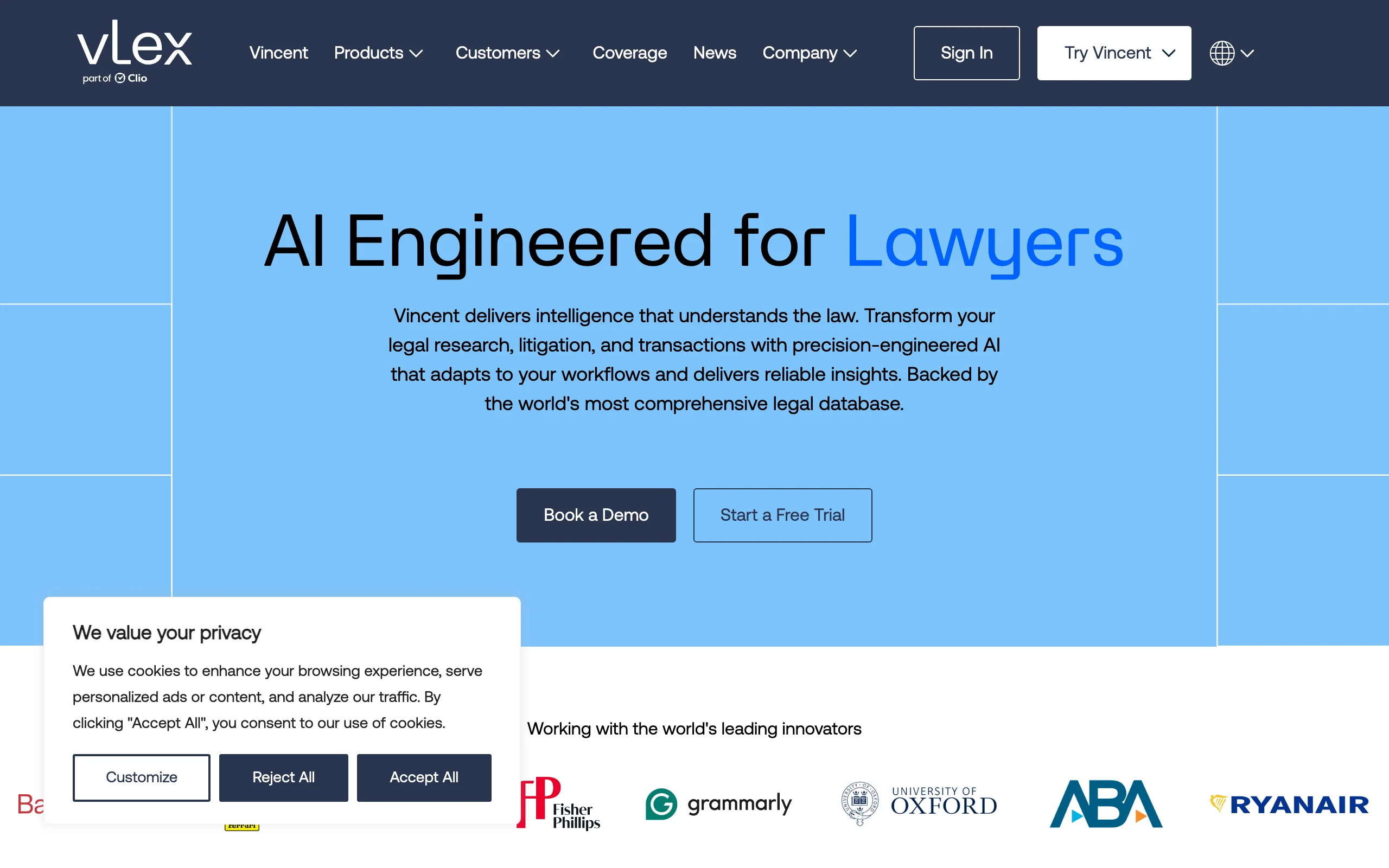
vLex Fastcase is the value champion of legal research. Fastcase merged with vLex in 2023, and the combined platform was acquired by Clio in a landmark billion-dollar deal that closed in late 2025. Its signature advantage survives: free access for members of 40 or more state and local bar associations. On top of primary law, it offers Vincent AI for cross-jurisdictional research and drafting, plus genuinely global coverage spanning the law of many countries.
For a solo whose bar membership includes it, vLex Fastcase is effectively a free or low-cost Westlaw alternative for core research.
Key features:
- Full US case law, statutes, regulations, and court rules
- Free access through 40+ bar associations
- Vincent AI for research and drafting
- Global coverage across many jurisdictions
- Cert citator for bad-law flagging, plus Word and Chrome integrations
Best for:
- Solos and small firms whose bar membership includes it
- Cost-conscious lawyers wanting solid primary law without a premium contract
- International or multi-jurisdiction research
Pricing:
- Free to members of 40+ state and local bar associations
- Full platform and premium Vincent AI features are quote-based outside the bar benefit
Pros:
- Free or very low cost through bar memberships
- Strong global coverage and modern AI features
- Now backed by Clio's practice-management ecosystem
Cons:
- Full Vincent AI is often a limited or paid add-on within the bar benefit
- Branding and interface are in transition after the merger
- Depth of US analytics trails Westlaw and Bloomberg
5. Thomson Reuters CoCounsel, best AI grounded in Westlaw content
CoCounsel is Thomson Reuters' agentic AI assistant, rebuilt from the Casetext technology TR acquired in 2023. Relaunched as CoCounsel Legal in 2025, it grounds Deep Research and drafting in Westlaw and Practical Law content, so you get AI answers tied to the same authoritative sources Westlaw uses. If you want to modernize into AI without leaving the Thomson Reuters world, CoCounsel is the natural path.
Note the standalone, low-cost Casetext plan is gone; CoCounsel is now sold through the same quote-based TR model, often bundled with Westlaw.
Key features:
- Deep Research grounded in Westlaw and Practical Law
- Agentic drafting workflows for complaints, discovery, and policies
- Deposition transcript review
- Document review and contract analysis in Word
- Knowledge Search over uploaded documents
Best for:
- Firms already invested in Westlaw and Thomson Reuters
- Litigation and research teams wanting AI on authoritative content
- Mid-to-large practices with the budget for premium tooling
Pricing:
- Not published; quote-based through the Thomson Reuters configurator, often bundled with Westlaw
- Free trial on some tiers, demo on others
Pros:
- AI answers grounded in respected Westlaw content
- Strong agentic drafting and litigation workflows
- Deep integration with the TR ecosystem
Cons:
- No cheap standalone tier since Casetext was retired
- Quote-based pricing with the same complexity as Westlaw
- Best value requires an existing Westlaw subscription
6. Paxton AI, best transparent self-serve research
Paxton AI stands out for publishing its price, a rarity in legal research. It covers research across US federal regulations, all 50 states, and case law, and adds an AI citator with a confidence indicator, AI drafting, file analysis, and litigation-specific tools like medical chronologies. It is SOC 2, ISO 27001, and HIPAA certified, and it markets itself directly as a Westlaw, Lexis, and CoCounsel alternative.
For a small firm that wants an enterprise-grade research assistant without a sales cycle, Paxton is a clean, self-serve option, though it costs more than an all-in-one tool like LegesGPT.
Key features:
- Research across federal regulations, all 50 states, and case law
- AI citator with a confidence indicator
- AI document drafting and file analysis
- Medical chronologies and billing summaries for litigation
- SOC 2, ISO 27001, and HIPAA compliance
Best for:
- Small and midsize firms wanting transparent, self-serve pricing
- Litigation practices that value the citator and medical tooling
- Buyers who insist on a published price and a trial
Pricing:
- Individual $499 per user per month, or $2,999 per user per year
- Enterprise custom pricing
- 7-day free trial
Pros:
- Transparent published pricing and a self-serve trial
- Strong research coverage plus a citator with confidence scoring
- Litigation-specific tools built in
Cons:
- Far pricier than LegesGPT for overlapping core research
- Narrower all-in-one workflow than a full platform
- Some performance metrics are vendor-reported
7. Google Scholar, best free option
Google Scholar is the free starting point millions of lawyers and students already use. It covers US Supreme Court, federal, and state appellate case law, and its How Cited feature gives a rough sense of how a case has been referenced. For quick lookups, background reading, and confirming a citation, it costs nothing.
The catch matters: Google Scholar has no true citator, so it will not tell you whether a case is still good law, and it lacks headnotes and analytics. Treat it as a free first pass, then validate anything you rely on in a platform with a real citator.
Key features:
- Free access to a large body of US case law
- Coverage of Supreme Court, federal, and state appellate decisions
- How Cited references as a rough citator-like starting point
- Familiar Google search interface
- No subscription or account required
Best for:
- Solos, students, and cost-conscious practitioners
- Quick citation lookups and background research
- Anyone needing a free first pass before validating elsewhere
Pricing:
- Free
Pros:
- Completely free with broad case law coverage
- No login or contract
- Fine for quick lookups and secondary research
Cons:
- No true citator, so good-law status must be checked elsewhere
- No headnotes, analytics, or drafting tools
- Coverage gaps and no support
How to choose the best Westlaw alternative for your practice
The right replacement depends on how much database depth you truly use, how you like to buy, and your budget. Work through these questions.
1) Do you need a full database, or fast cited answers?
- If you mostly ask day-to-day legal questions and draft: an AI assistant like LegesGPT, CoCounsel, or Paxton AI answers faster and cheaper.
- If you do exhaustive primary-law research with citator validation: a full database like Lexis+ or Bloomberg Law is closer to Westlaw.
Be honest about how often you actually run deep archival searches. Many lawyers pay for a premium database and use a fraction of it.
2) What is your budget?
- Tight budget or solo: LegesGPT from $13.99/month, or vLex Fastcase free through your bar, or Google Scholar for free lookups.
- Mid-market with a research focus and a published-price requirement: Paxton AI.
- Firm with the budget for a full database: Lexis+ or Bloomberg Law.
3) How important is a citator?
- Critical (litigation, appeals): choose a tool with a real citator, Shepard's on Lexis+, BCite on Bloomberg, or the Cert citator on vLex Fastcase.
- Helpful but not essential: LegesGPT's verified citations with source links let you read and confirm authorities, and Google Scholar's How Cited gives a rough starting point.
4) Try before you switch
Run three to five of your real research questions through your shortlist and compare the answers, citations, and cost. LegesGPT, Lexis+, and Paxton AI all offer trials, and vLex Fastcase and Google Scholar are free to test. For most solos and small firms, the smartest setup is an affordable AI assistant like LegesGPT for daily work, plus a free or low-cost database for deeper research, at a fraction of a full Westlaw contract.