
Most of a practicing lawyer's week breaks down into three repeating tasks: researching a question of law, drafting a document, and reviewing something another party drafted. The best AI tools for lawyers now handle meaningful portions of all three, turning hours of research into minutes and first drafts into a review exercise instead of a blank page.
The hard part is choosing. Some tools do one job exceptionally well and nothing else. Others bundle several jobs but only sell through enterprise contracts you cannot test first. If you are picking your first legal AI subscription, or consolidating a patchwork of point tools into one main platform, those differences decide whether the tool actually earns a place in your day.
This guide measures seven tools against a general-practice lawyer's daily workflow: what each covers, what it costs, and where it stops.
Best AI tools for lawyers: a brief overview
- LegesGPT: Best overall for practicing lawyers: cited legal research, document review, AI drafting, and e-signature in one subscription from $19.99/month.
- Spellbook: Best for drafting inside Word: clause suggestions and redlines that appear in the document you are already editing.
- Paxton AI: Best for verification-first research: benchmark-tested citation accuracy for lawyers who check every source.
- CoCounsel: Best for Westlaw firms: Thomson Reuters' AI assistant grounded in the Westlaw database, with deposition prep.
- Lexis+ with Protégé: Best for deep US primary law: an agentic research assistant layered on the LexisNexis library.
- Harvey AI: Best for large firms: enterprise-grade legal reasoning and custom agents for complex, high-stakes matters.
- Everlaw: Best for litigation document review: predictive coding and corpus-wide AI Q&A built for eDiscovery.
| Tool | Best for | Starting price | Free trial | Jurisdictions |
|---|---|---|---|---|
| LegesGPT | All-in-one daily workflow | From $19.99/mo | 3-day for $1 | 38+ countries |
| Spellbook | Contract drafting in Word | Custom (contact sales) | 7-day | Primarily US |
| Paxton AI | Citation-verified research | $499/user/mo | 7-day | US federal and state |
| CoCounsel | Firms already on Westlaw | ~$225/user/mo (estimate) | Demo only | Primarily US |
| Lexis+ with Protégé | Deep primary law research | Custom (five figures/yr) | Demo only | US, some international |
| Harvey AI | Enterprise legal teams | Custom (enterprise) | Demo only | Multi-jurisdiction |
| Everlaw | eDiscovery and litigation | Per-GB (custom) | Demo only | US and international matters |
Only LegesGPT and Paxton AI publish list prices. The CoCounsel and Lexis figures are widely cited estimates, not official rates, so confirm with sales before you budget.
1. LegesGPT, best overall AI tool for lawyers
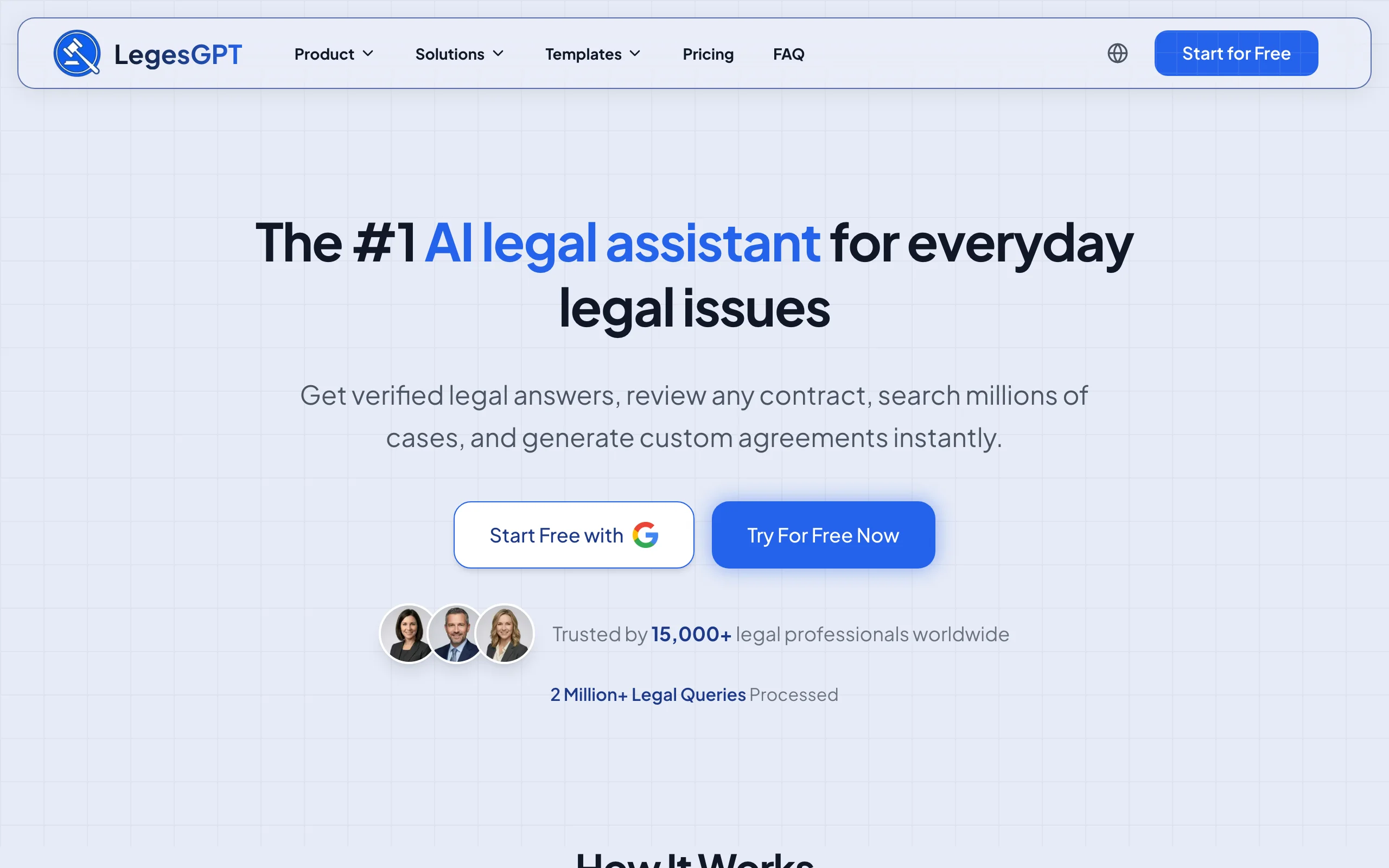
LegesGPT is built around the loop most lawyers repeat every day. You ask a legal question and get an answer with verified citations and links to the underlying cases and statutes. You upload a contract or pleading (PDF, DOCX, PPTX, or even an image) and it flags risky clauses and proposes specific changes. You draft a new agreement with AI or start from one of 100+ attorney-drafted templates, then send it for e-signature without leaving the platform.
That loop, research to review to drafting to signature, is what usually takes three separate subscriptions. Because it runs in the browser with no IT setup and starts with a 3-day trial for $1, you can test it on live matters this week rather than after a procurement cycle.
Key features
- Answers legal questions with verified citations and direct links to sources you can check yourself
- Case law and statute search, plus a Deep Research mode for multi-step questions
- AI document review that flags risks and proposes changes across PDF, DOCX, PPTX, TXT, and image files
- AI drafting of contracts and legal documents, backed by 100+ attorney-drafted templates
- Built-in e-signature to execute what you draft
- Free extras: contract generator, deadline and support calculators, citation generator
Best for
- Solo and small-firm lawyers who want one subscription covering research, review, and drafting
- General practitioners whose matters span several practice areas and, sometimes, several jurisdictions
- Lawyers who want to trial legal AI on real work without a sales call
Pricing
- 3-day trial for $1 (paid trial, not a free plan)
- Basic $19.99/mo; Plus $49.99/mo adds document upload and 50 reviews/month; Premium $99.99/mo adds unlimited review, Deep Research, and web search
- Roughly 30% off with annual billing
Pros
- Replaces separate research, review, drafting, and e-signature tools with one workflow
- Every answer carries checkable citations, which shortens your own verification step
- The lowest entry price of any full-featured tool on this list
Cons
- Newer brand without the decades-long track record of Lexis or Westlaw
- Web-only: no Microsoft Word add-in, public API, or native mobile app
2. Spellbook, best for contract drafting inside Microsoft Word
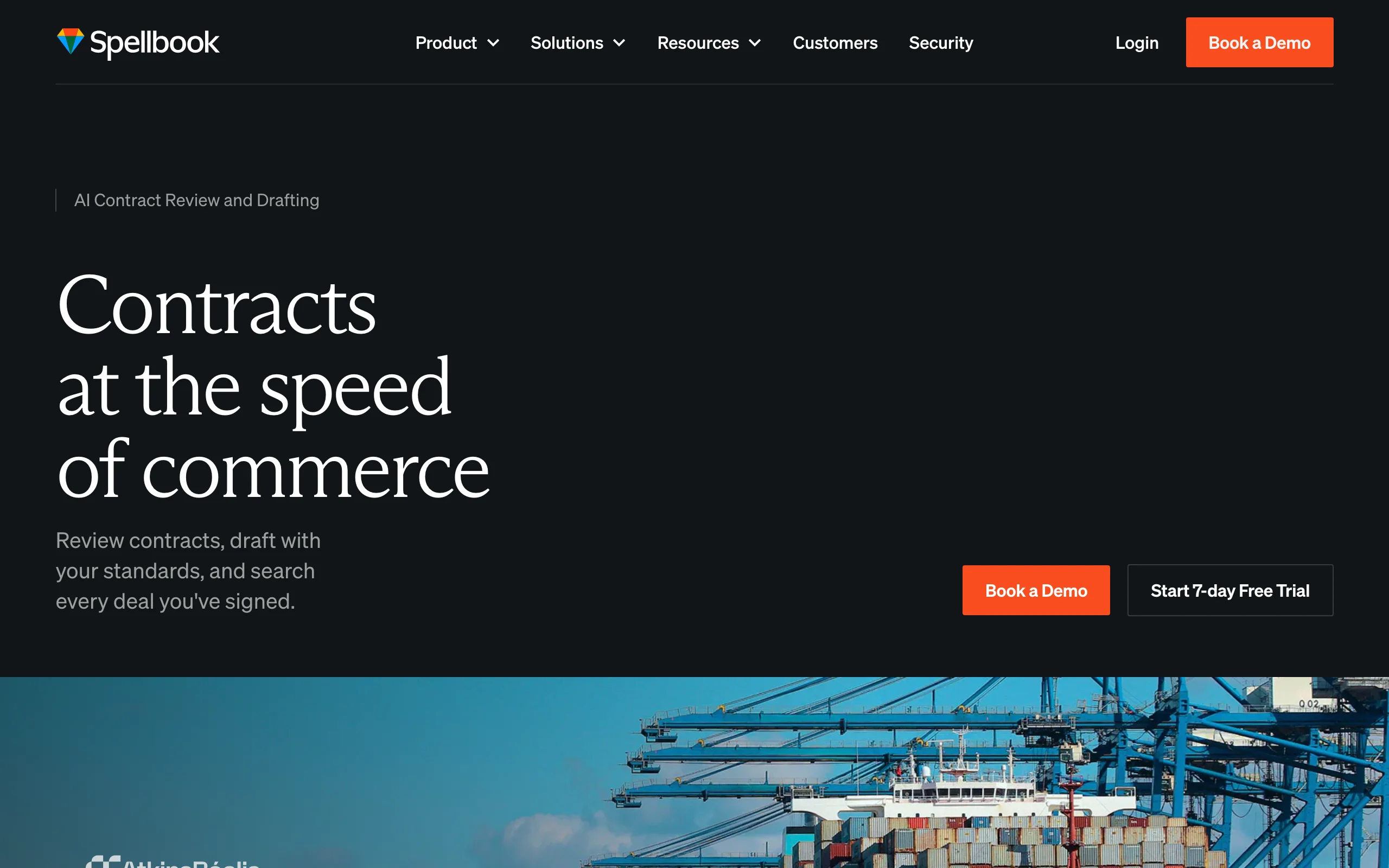
Spellbook takes the opposite approach to a standalone platform: it lives inside Microsoft Word, where transactional lawyers already spend their day. As you work through an agreement, it suggests clause language, spots missing or unusual provisions, and generates redlines that reflect which side you represent. Its Associate agent extends that beyond a single document, handling multi-step transactional tasks across related files.
If your practice is mostly NDAs, MSAs, leases, and vendor agreements, the appeal is zero context-switching. The limit is scope: Spellbook does not do case law research or litigation work, so it is a strong second tool rather than a complete stack. Our roundup of the best AI contract drafting tools compares it against other drafting-first options.
Key features
- Clause drafting and suggestions delivered directly in Microsoft Word
- Detection of missing, unusual, or off-market provisions
- Position-aware redlining based on whether you act for buyer or seller
- Market Comparison for benchmarking terms against common standards
- Spellbook Associate agent for multi-document transactional workflows
Best for
- Transactional lawyers who draft and negotiate contracts as their core workload
- In-house counsel processing steady volumes of routine commercial agreements
Pricing
- Quote-based licensing by team size; no published tiers
- 7-day free trial available before committing
Pros
- No new interface to learn: the AI meets you inside Word
- Contract-specific training reads legal provisions better than general-purpose chatbots
- The Associate agent turns clause help into full transactional support
Cons
- No legal research capability, so litigators get little from it
- Requires Word; there is no web-only or Google Docs version
- Pricing is opaque until you talk to sales
3. Paxton AI, best for citation-verified legal research
Paxton AI is a research tool for lawyers who have read the sanctions stories about fabricated citations and want a defense against them. Its pitch is accuracy: on a Stanford-designed benchmark, Paxton reported 93.82% accuracy with a 94.7% non-hallucination rate, and every answer links directly to the cited case or statute so you can confirm it in seconds.
Coverage spans US federal and state case law and statutes across a corpus of more than 60 million documents, with contract analysis alongside research. Paxton deliberately stays narrow: it is not trying to draft your agreements or run your eDiscovery, just to make research answers you can rely on.

Key features
- Research answers with source verification and direct links to cited authorities
- Benchmark-reported accuracy above 93% on a Stanford-designed test
- US federal and state coverage across 60M+ documents
- Contract analysis in addition to case law and statutory research
- Saved queries and research history for ongoing matters
Best for
- Brief writers and appellate lawyers who verify every citation before filing
- US-focused practices willing to pay a premium for research confidence
Pricing
- $499/user/month, or $2,999/user/year
- 7-day free trial; enterprise plans on request
Pros
- Published benchmark results, which few legal AI vendors offer
- Transparent public pricing, rare in this market
- Focused interface keeps research fast and uncluttered
Cons
- Little drafting support and no eDiscovery, so you still need other tools
- US-centric coverage limits cross-border work
- At $499/user/month, it costs more than most all-in-one options while covering a narrower slice
4. CoCounsel, best for firms already using Westlaw
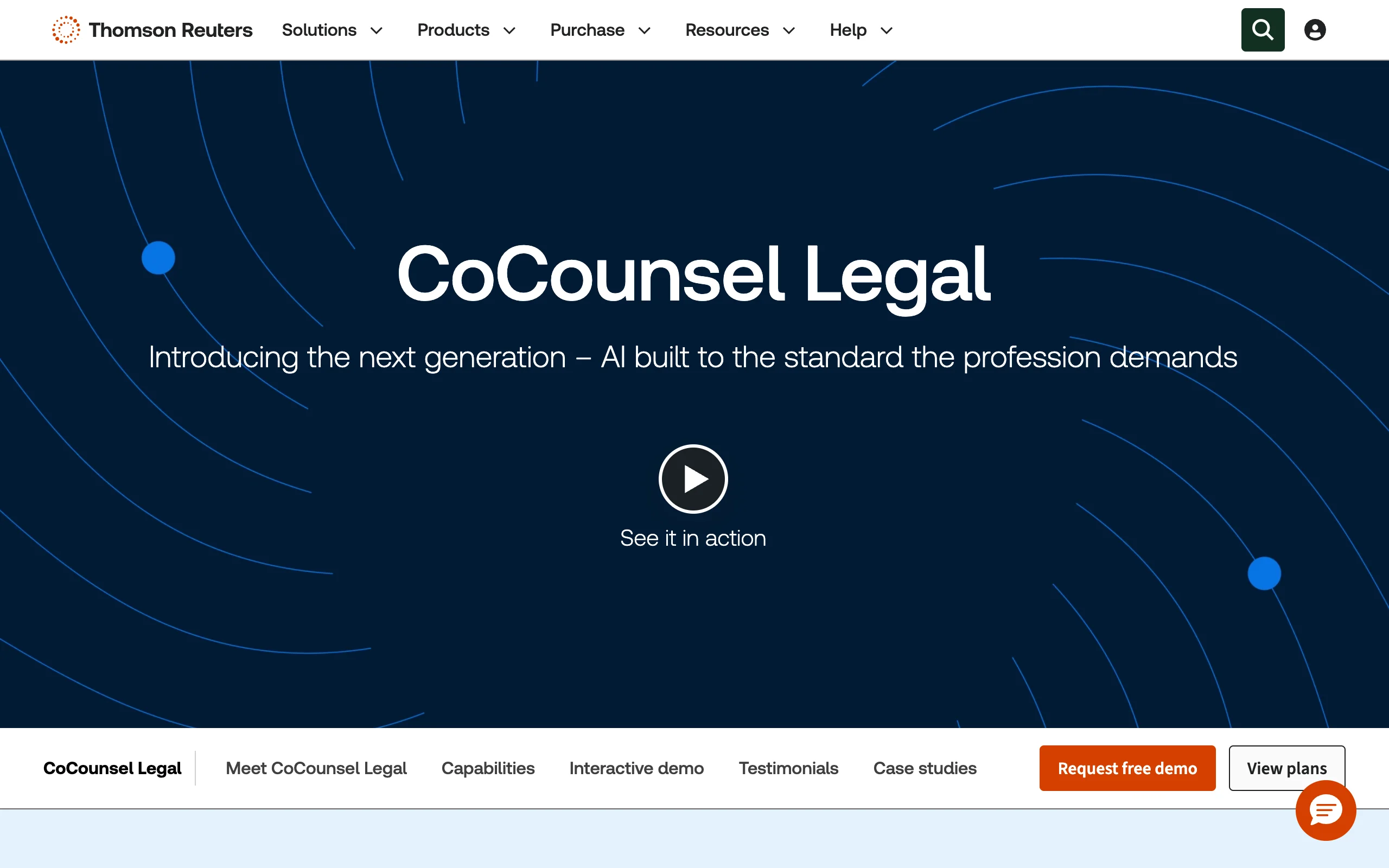
CoCounsel is Thomson Reuters' AI legal assistant, born from the $650 million Casetext acquisition and now used by more than 20,000 firms and legal departments. Its answers are grounded in Westlaw's primary law database, and it stretches beyond research into document review, bulk analysis, and deposition preparation, a capability few rivals match.
Thomson Reuters has pushed hard into agentic features: a Deep Research agent, guided workflows, and, as of May 2026, a rebuild on Anthropic's Claude Agent SDK. The economics work best if you already pay for Westlaw. As a standalone purchase it is harder to justify against cheaper self-serve tools.
Key features
- Research answers grounded in Westlaw's primary law database
- Deep Research agent and a builder for custom multi-step workflows
- Document review and bulk analysis across large sets
- Automated deposition preparation with generated question lines
- Tight integration across the Thomson Reuters product suite
Best for
- Firms with existing Westlaw subscriptions that want AI inside that ecosystem
- Litigation teams that value deposition prep alongside research
Pricing
- No published standalone pricing; CoCounsel Core is commonly estimated around $225/user/month
- Cost varies with your Westlaw subscription level; larger deployments are quote-only
Pros
- Westlaw grounding gives answers depth that generic models cannot match
- Deposition preparation is a genuine differentiator for litigators
- Thomson Reuters backing means sustained investment and support
Cons
- Standalone value is weak if you are not already a Thomson Reuters customer
- Per-seat cost climbs quickly for multi-lawyer firms
- Budgeting requires a sales conversation; there is no self-serve price
5. Lexis+ with Protégé, best for deep US primary law research
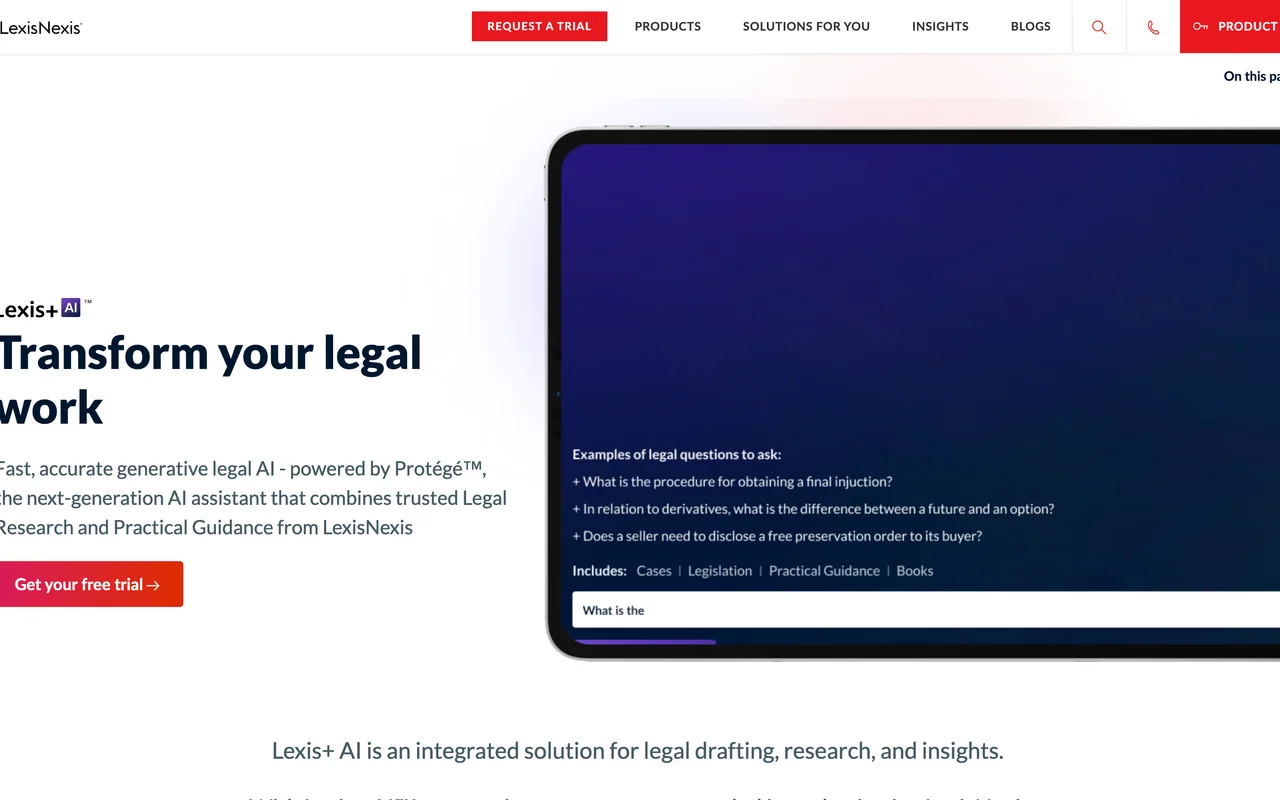
Lexis+ with Protégé puts an agentic assistant on top of the deepest legal content library in the market. Protégé, which reached general availability in February 2026, takes natural-language questions, grounds answers in Lexis' case law, statutes, and secondary sources, and chains them into drafting and review tasks. Shepard's Verify adds trust markers that validate citations inside the AI workflow, and its Vault handles document sets up to 100,000 files.
For research-heavy practices, the underlying data is the draw: decades of indexed primary and secondary law that newer entrants cannot replicate. The catch is cost and commitment, since pricing typically runs to five figures per year on top of a Lexis relationship.
Key features
- Natural-language research across the full LexisNexis primary law database
- Protégé agent with specialized sub-agents and automatic model selection
- Agentic drafting plus a Vault for document sets up to 100K files
- Shepard's Citations and Shepard's Verify for citation validation
- Microsoft 365 Copilot integration
Best for
- Firms already invested in LexisNexis that want agentic AI on top
- Appellate and research-intensive practices needing maximum primary law depth
Pricing
- Custom enterprise pricing, typically five figures annually
- Strongest value bundled with an existing Lexis subscription; no public standalone rate
Pros
- Unmatched depth of indexed US primary and secondary law
- Shepard's Verify brings established citation trust signals into AI answers
- Extends past search into drafting and large-scale document work
Cons
- Priced out of reach for most solo and small-firm budgets
- Opaque, package-dependent pricing makes cost comparison difficult
6. Harvey AI, best for large firms and enterprise legal teams
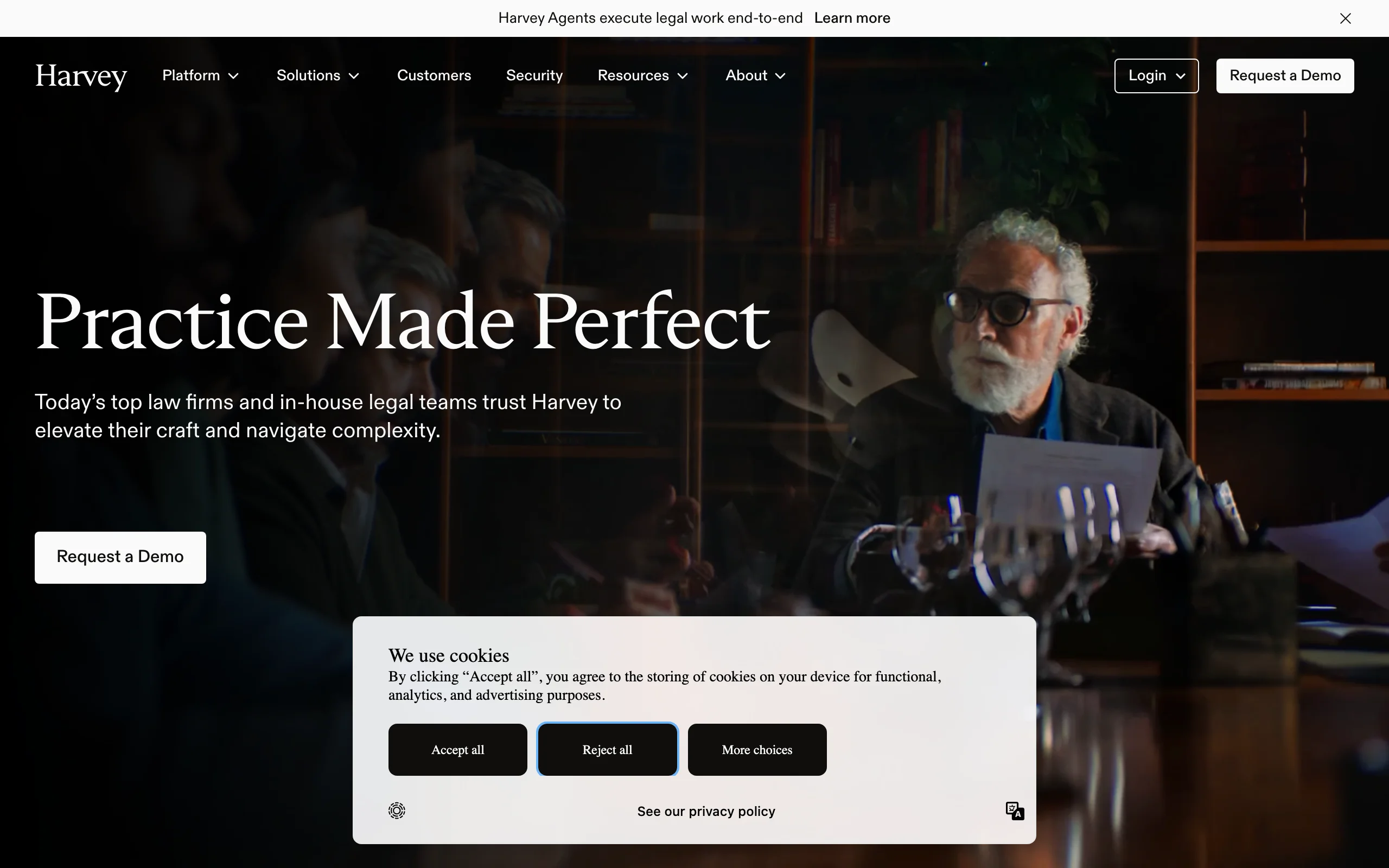
Harvey AI targets the top of the market: Am Law-scale firms and Fortune 500 legal departments. It applies advanced legal reasoning to contract analysis, regulatory research, and due diligence, and in 2026 added a library of pre-built agents plus an Agent Builder so firms can encode their own workflows. Harvey reports over 1,500 customers and 142,000+ lawyers on the platform, and its March 2026 fundraise valued the company at $11 billion.
For an individual lawyer choosing a first AI stack, the practical issue is access: Harvey sells only through enterprise contracts, with no self-serve signup or trial. If you want Harvey-class capability without the procurement cycle, see the best Harvey AI alternatives.
Key features
- Advanced reasoning for complex contract, regulatory, and diligence questions
- Pre-built agent library plus an Agent Builder for firm-specific workflows
- Due diligence acceleration across very large document sets
- Vault document sync and shared team workspaces
- Model selector spanning current frontier AI models
Best for
- Large firms and corporate legal departments running high-stakes, high-volume matters
- Teams with the budget and IT support for a custom AI deployment
Pricing
- Enterprise contracts only; no public pricing published
- No self-serve tier or trial; third-party estimates vary too widely to rely on
Pros
- Among the most capable legal reasoning engines available
- Agent Builder tailors workflows to a firm's specific practice mix
- Heavy adoption at elite firms signals sustained development
Cons
- Inaccessible to solo and small-firm lawyers by design
- No way to test the product before a sales-led commitment
7. Everlaw, best for litigation and eDiscovery review
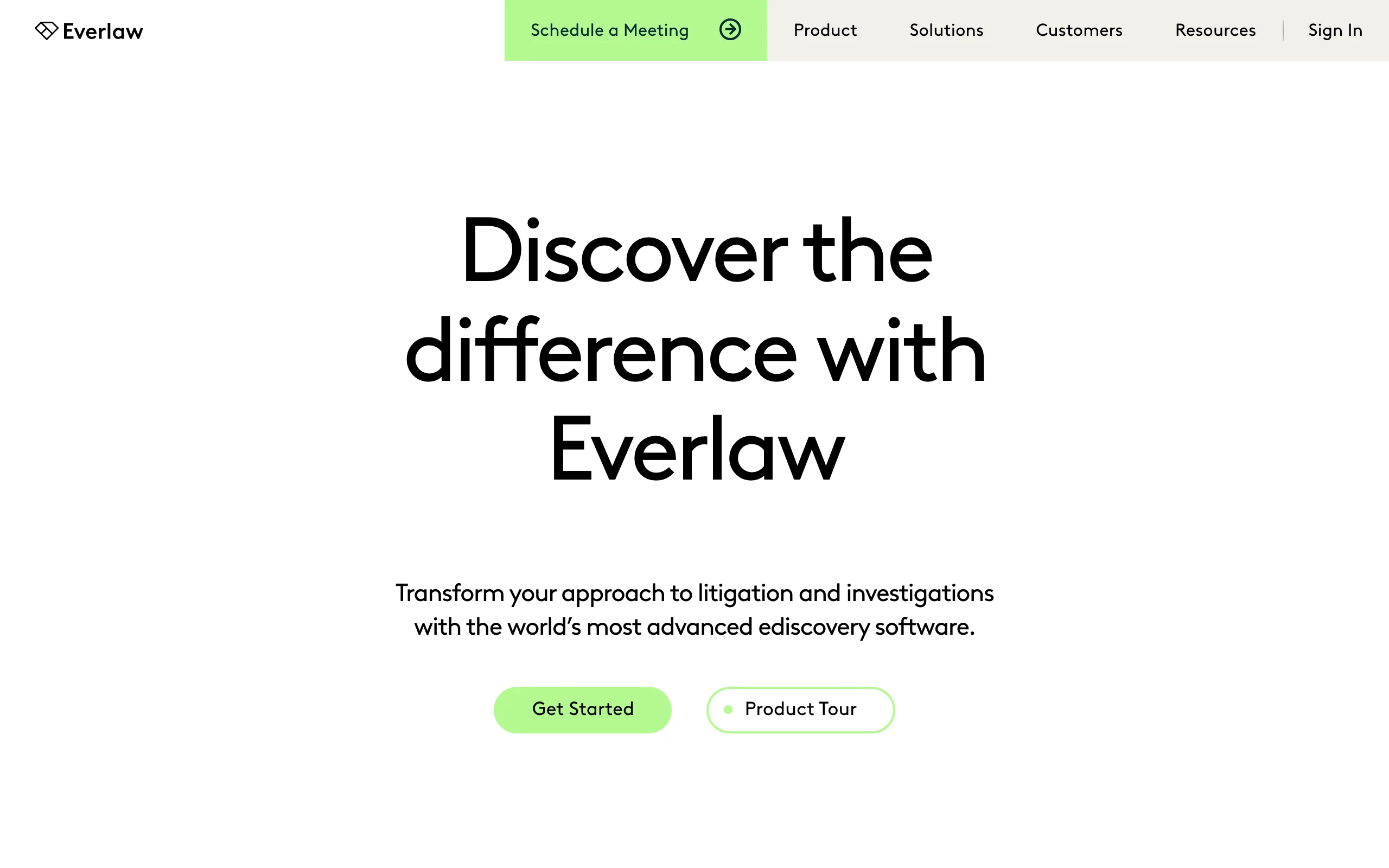
Everlaw is the specialist pick for litigators drowning in documents. Its cloud platform applies predictive coding to surface the most relevant files from massive productions, and the EverlawAI Assistant's Deep Dive feature (generally available since late 2025) answers natural-language questions across an entire document corpus with citations back to the source files. Teams review collaboratively with role-based access and produce court-ready output.
In October 2025 Everlaw folded its AI features into the core per-GB rate, ending separate credit metering and simplifying budgets. It is litigation infrastructure, not a daily research or drafting assistant, so most lawyers pair it with a general-purpose tool.
Key features
- Predictive coding to prioritize relevant documents in large reviews
- Deep Dive: citation-backed Q&A across a full document corpus
- Real-time collaborative review with role-based permissions
- Visual analytics, advanced search, and filtering across productions
- Court-ready production tools with FedRAMP-authorized generative AI
Best for
- Litigation teams handling eDiscovery on large document volumes
- Firms working class actions, investigations, or complex commercial disputes
Pricing
- Per-GB hosting plus a platform fee; users typically included rather than per-seat
- AI features bundled into the core rate since late 2025; quotes via sales only
Pros
- Predictive coding materially cuts review hours on big matters
- Bundled AI pricing removes unpredictable per-use charges
- FedRAMP authorization suits government and regulated work
Cons
- Covers litigation review only; research and drafting need separate tools
- Enterprise sales model excludes most solo practitioners
How to choose the best AI tools for lawyers in your practice
1) Match the tool to where your hours actually go
Track a normal week before you buy anything. Whichever task consumes the most time should drive the choice.
- If your time splits across research, drafting, and review: start with LegesGPT, which covers all three plus e-signature in one plan
- If you live in Word negotiating contracts: add Spellbook
- If research accuracy is the whole game (appellate work, brief writing): evaluate Paxton AI, or compare the wider field of best AI legal research tools
- If document-heavy litigation dominates: Everlaw is the specialist
2) Be honest about budget and procurement tolerance
Price-to-value math matters more than feature lists. Harvey and Lexis+ with Protégé deliver depth, but at custom enterprise rates most individual lawyers cannot justify. Paxton's $499/user/month buys excellent research and nothing else. LegesGPT's $19.99 to $99.99 monthly range is less than one billable hour, and the $1 trial means the evaluation costs almost nothing.
- If you can spend under $100/month: LegesGPT is the only full-stack option at that level
- If you already pay for Westlaw: CoCounsel is the incremental upgrade that fits your stack
- If your firm has an enterprise budget and IT team: shortlist Harvey and Lexis+ with Protégé, and see our guide to the best AI tools for law firms for firm-wide rollouts
3) Check jurisdiction coverage before features
Most tools on this list are US-first. Paxton, CoCounsel, and Spellbook are built primarily around US law; Lexis extends internationally through the broader LexisNexis network. If your clients bring cross-border questions, LegesGPT's coverage across 38+ countries is the practical differentiator at a self-serve price.
- If you practice only US law: any tool here fits
- If you touch international matters even occasionally: prioritize LegesGPT or Lexis
4) Run a real-work test before subscribing
Never judge legal AI on a demo. Take 3 to 5 documents from closed matters, a contract you negotiated, a research question you already answered, a pleading you reviewed, and run them through each candidate. Check whether the citations are real, whether flagged risks match what you caught, and whether the draft would have saved you time. LegesGPT ($1 for 3 days), Paxton, and Spellbook (7-day trials each) all let you do this cheaply; the enterprise tools require a demo request. Thirty minutes with your own files tells you more than any comparison article, including this one.