
Corporate practice runs on documents: share purchase agreements, disclosure schedules, board resolutions, and the hundreds of contracts sitting in a data room before a deal closes. The best AI tools for corporate lawyers now take the first pass at most of that work, extracting clauses, flagging risks, checking cross-references, and drafting the documents that follow, so you spend your hours on structure, negotiation, and judgment.
This guide ranks 7 AI tools for corporate and transactional lawyers, whether you practice at a firm or in-house. For each one you get what it actually does, current pricing, and honest pros and cons, plus a short framework for choosing. If your day is more about supporting a business than closing deals, our companion guide to the best AI tools for in-house legal teams covers that side.
AI tools for corporate lawyers: a brief overview
- LegesGPT: Best overall for corporate lawyers: covers the daily transactional loop, contract review with risk flags, cited research, drafting, and e-signature, in one subscription from $19.99/month.
- Spellbook: Best for drafting and negotiating deals in Word: clause suggestions, playbook review, and market-term benchmarking without leaving your document.
- Harvey AI: Best for large firms and enterprise deal teams: agentic workflows and Vault document analysis, adopted by roughly half the AmLaw 100.
- Kira (Litera): Best for high-volume M&A contract analysis: 1,400+ pre-trained smart fields extracting provisions at 90%+ accuracy.
- Luminance: Best for due diligence and cross-border review: anomaly detection across large deal rooms plus autonomous NDA negotiation.
- Definely: Best for accuracy in complex transaction documents: automated checks on defined terms, cross-references, and the downstream impact of edits.
- Diligen: Best for trainable due diligence: teach its ML engine your own clause types on top of 250+ pre-built provision models.
| Tool | Best for | Starting price | Free trial | Jurisdictions |
|---|---|---|---|---|
| LegesGPT | All-round corporate practice | From $19.99/mo | 3-day for $1 | 38+ countries |
| Spellbook | Deal drafting in Word | Quote-based | 7-day free trial | Common law focus (US, UK) |
| Harvey AI | BigLaw and enterprise teams | Custom (enterprise) | Demo only | 60+ countries |
| Kira (Litera) | High-volume M&A analysis | Quote-based | Demo only | Smart fields in 40+ languages |
| Luminance | Due diligence, cross-border deals | Custom (enterprise) | Demo only | 70+ countries |
| Definely | Document accuracy in Word | Custom (demo-based) | Demo only | Common law focus (UK, US) |
| Diligen | Trainable diligence review | Tiered, custom quotes | Demo only | Not published |
1. LegesGPT, best overall for corporate lawyers
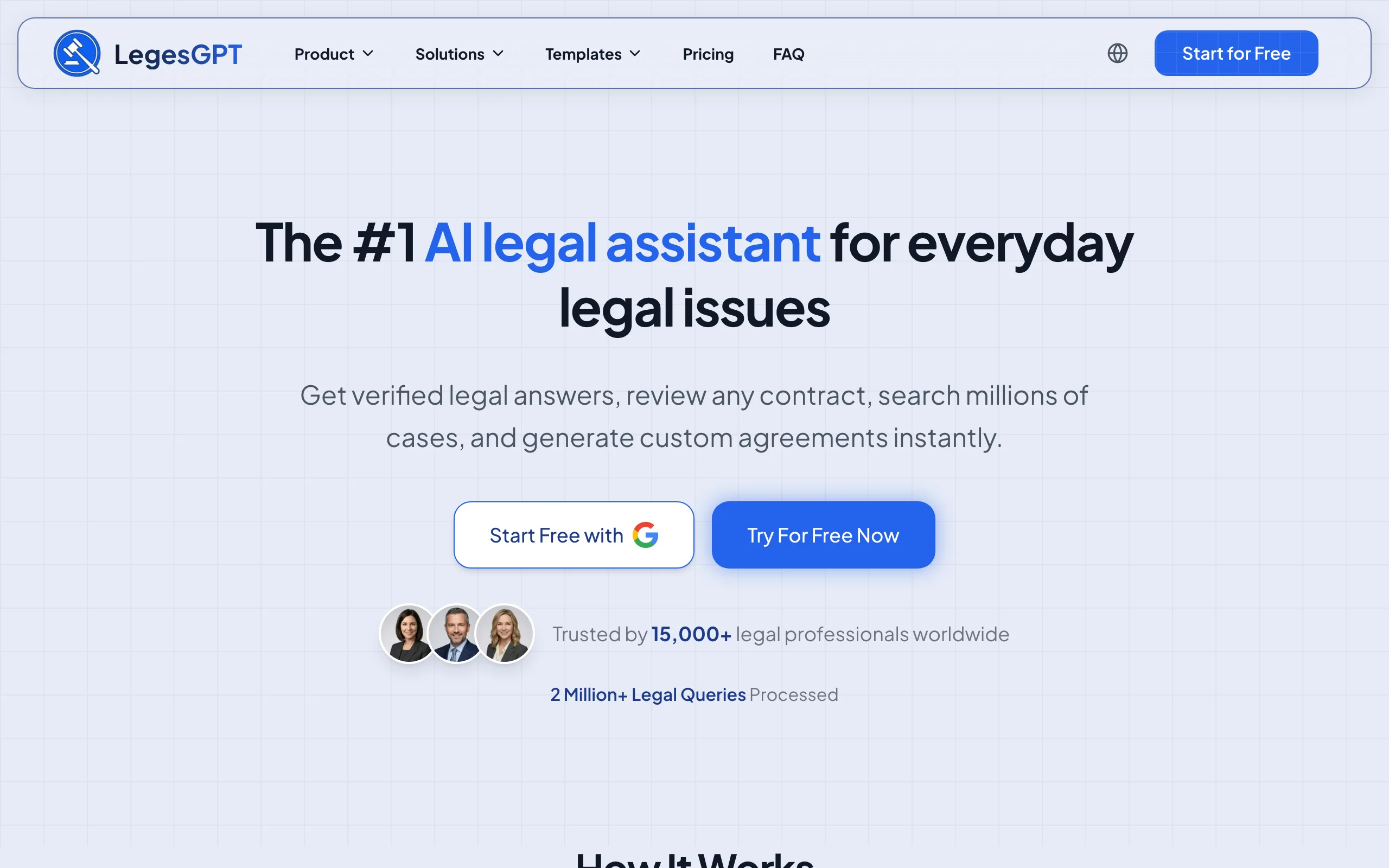
LegesGPT fits the rhythm of corporate work because it covers the whole loop on one screen. Upload a shareholders' agreement or an SPA (PDF, Word, PowerPoint, even scanned images) and it flags risky clauses and proposes concrete changes. Ask a governance or securities question and it answers with verified citations and links to the underlying case law and statutes, so you can check the authority before you rely on it. When the deal moves forward, it drafts the follow-on documents, and you can e-sign and send them without opening another tool.
That range matters most for cross-border work. Deep Research mode handles multi-step questions that span jurisdictions, and 100+ attorney-drafted templates cover common corporate documents. It runs in the browser with no IT setup, which means a solo corporate practitioner gets started the same afternoon an enterprise team would still be scheduling a demo.
Key features
- Contract and document review that flags risks and proposes edits (PDF, DOCX, PPTX, images)
- Legal questions answered with verified citations and source links, backed by case law and statute search
- AI drafting of contracts and corporate documents, plus built-in e-signature
- Deep Research mode for multi-jurisdictional and multi-step questions
- 100+ attorney-drafted templates and free tools (contract generator, citation generator)
Best for
- Corporate lawyers who review, research, and draft in the same matter and want one tool for all three
- Small and mid-size firms handling cross-border transactions without an enterprise budget
- Practitioners who need to verify AI output against real sources before advising
Pricing
- 3-day trial for $1 (there is no free plan)
- Basic $19.99/mo; Plus $49.99/mo adds document upload and 50 reviews/month; Premium $99.99/mo adds unlimited review, Deep Research, and web search
- Annual billing saves around 30%
Pros
- The daily transactional loop (review, research, draft, sign) lives in one affordable subscription
- Every answer links to checkable sources, which shortens verification
- Self-serve pricing with no sales cycle or minimum seat count
Cons
- Newer brand without the decade-long track record of Kira or Luminance
- Web-only: no Microsoft Word add-in, API, or native mobile app
- Document review starts on the Plus plan, not Basic
2. Spellbook, best for drafting and negotiating deals in Word
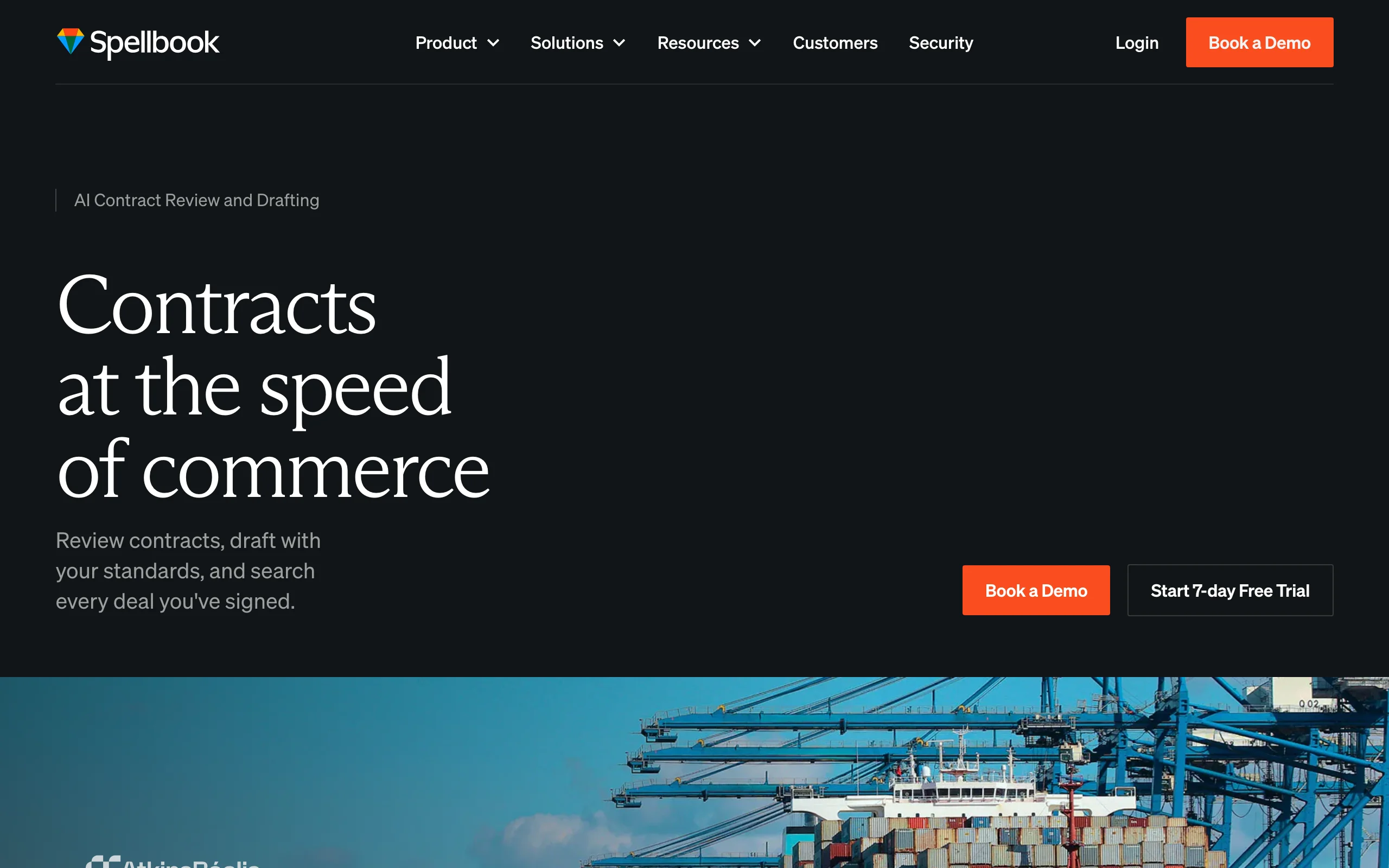
Spellbook lives where most corporate drafting happens: inside Microsoft Word. It reviews contracts against your playbooks, suggests clause language, and redlines directly in the document, drawing on frontier models including GPT-5 and Claude. For negotiation, the Market Comparison feature (generally available since January 2026) benchmarks your terms against market standards for common contract types, which gives you data to support a position instead of instinct.
Two additions round it out for deal work: Spellbook Library learns from your firm's own precedents, and Spellbook Associate runs multi-document tasks like checking reps, warranties, and indemnities across a deal set. A zero data retention policy (SOC 2 Type II) addresses the confidentiality question that sensitive transactions raise. If you want to compare it against similar Word-native tools, see our roundup of Spellbook alternatives.
Key features
- Contract review, drafting, and clause suggestions natively in Microsoft Word
- Market Comparison benchmarking of deal terms against market standards
- Spellbook Library trained on your firm's precedent documents
- Spellbook Associate agent for multi-document diligence tasks
- Zero data retention policy, SOC 2 Type II, GDPR and CCPA compliant
Best for
- Transactional lawyers who draft and mark up contracts in Word all day
- Deal teams that want market benchmarking data during negotiations
Pricing
- Quote-based per-license pricing, no public list price
- 7-day free trial
Pros
- Deal-term benchmarking is rare and genuinely useful in negotiations
- Fits an existing Word workflow with almost no learning curve
- Free trial lets you test on real deal documents before committing
Cons
- Tied to Microsoft Word; no browser or mobile option
- No legal research or case law capability, drafting and review only
- Quote-based pricing makes budgeting harder for small teams
3. Harvey AI, best for large firms and enterprise deal teams
Harvey is the enterprise heavyweight, used by roughly half of the AmLaw 100 and a long list of Fortune 500 legal departments. Its edge is agentic architecture: the Workflow Builder and Agent Builder chain AI steps into repeatable processes, and clients have built more than 25,000 custom workflows and agents. A library of 500+ prebuilt agents shipped in May 2026, and the platform now serves 1,500+ customers and over 142,000 lawyers across 60+ countries.
For corporate matters specifically, Harvey Vault analyzes and extracts data from up to 10,000 documents per vault, and the Agentic Word integration brings drafting and review reasoning into Word. The catch is access: pricing is enterprise-only, and smaller practices are effectively priced out. Mid-market teams often start with the Harvey AI alternatives instead.
Key features
- Workflow Builder and Agent Builder for custom multi-step agentic processes
- Harvey Vault for document analysis and extraction at scale (10,000 documents per vault)
- 500+ prebuilt agents plus guest accounts for client collaboration
- Agentic Word integration and coverage across 60+ countries
Best for
- AmLaw 100 and Magic Circle firms running complex M&A at scale
- Enterprise in-house departments with dedicated legal tech budgets
Pricing
- Enterprise seat-based pricing, not publicly listed
- No free trial; pilots require user-count commitments
Pros
- Deep customizability, proven by 25,000+ client-built workflows
- Enterprise security including ISO 27001 certification
- Strongest brand adoption at the top of the market
Cons
- Out of reach for solo, small, and most mid-market practices
- Steep learning curve to get real value from workflow building
- Some users report manual copy-pasting between workflow steps
4. Kira (Litera), best for high-volume M&A contract analysis
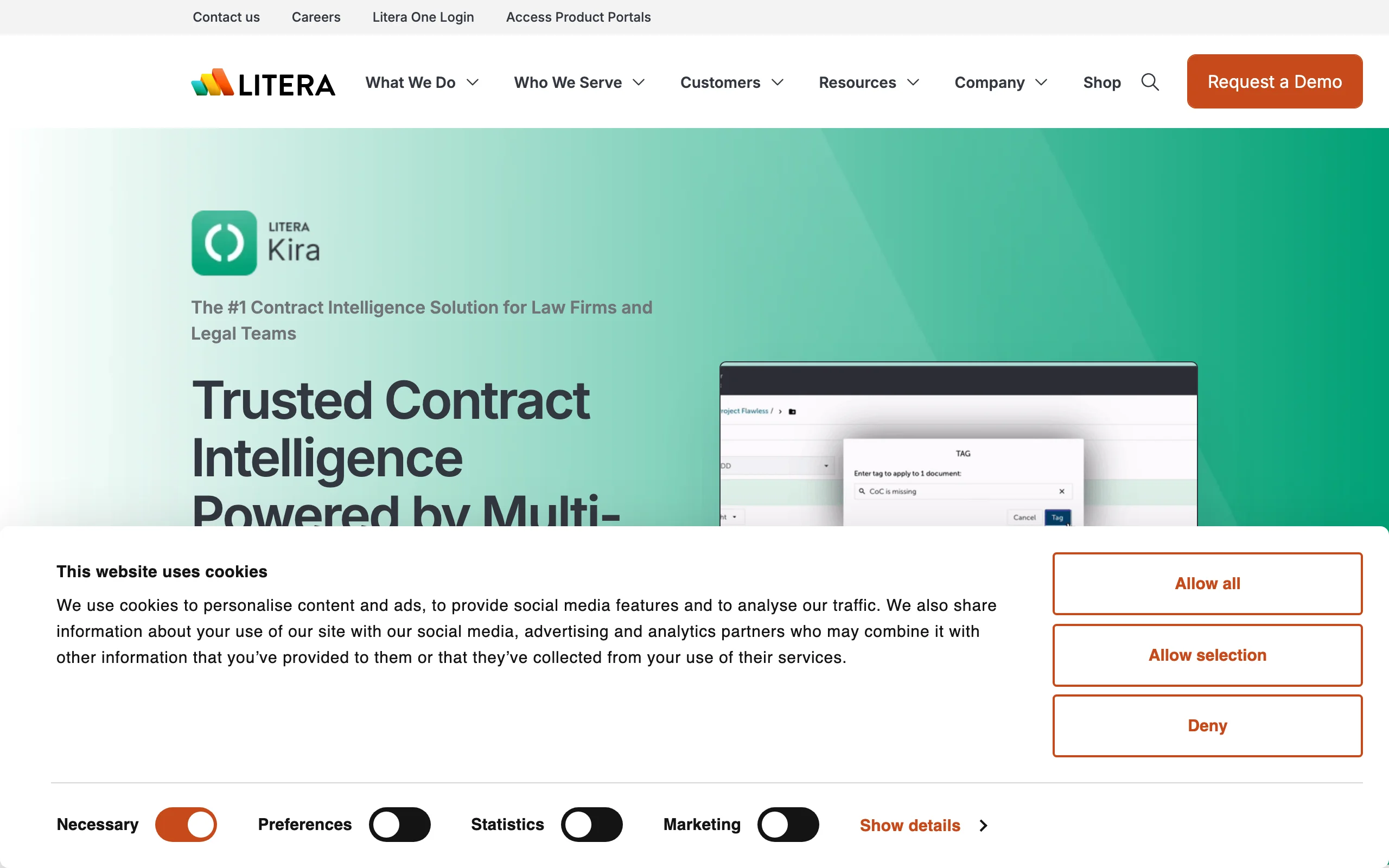
Kira remains the reference point for machine-learning contract analysis in M&A. Its library of 1,400+ pre-trained smart fields identifies provisions across 40+ substantive areas of law, refined over a decade and more than 45,000 lawyer hours of training, with extraction accuracy consistently above 90%. Around 70% of the top 50 global law firms use it, which tells you where it sits in serious due diligence work.
Litera folded Kira into its Litera AI+ framework in July 2025, adding generative summarization and analysis (including the Lito agent) on top of the extraction engine at no extra cost to existing customers. If clause extraction is your bottleneck, this is the deepest pre-trained library available; our guide to the best AI contract review tools compares the wider field.
Key features
- 1,400+ pre-trained smart fields across 40+ areas of law
- Generative summarization and analysis via Litera AI+ (added July 2025)
- Custom training for deal-specific or unusual clause types
- Smart fields in 40+ languages and collaborative review worksheets
Best for
- Large firms running due diligence over thousands of contracts per deal
- Cross-border transactions needing multi-language extraction
Pricing
- Quote-based; no published price list
- Third-party estimates put firm deployments in the five- to six-figure annual range (unofficial)
Pros
- Largest pre-trained provision library on the market
- 90%+ extraction accuracy with a decade of refinement behind it
- GenAI features added without extra charges for existing customers
Cons
- Firm-level pricing excludes small teams and solo practitioners
- Limited export and integration options with some document automation platforms
- Interface takes time for new reviewers to learn
5. Luminance, best for due diligence and cross-border document review
Luminance built its Legal-Grade AI on more than a decade of training over millions of verified legal documents, and it shows in due diligence: the platform spots anomalies and patterns across deal rooms of thousands of contracts, with Traffic Light Analysis giving a visual first-pass risk rating. Luminance Diligence reads across 1,000+ legal concepts for M&A, lease reviews, and compliance audits.
Its most distinctive capability is autonomous negotiation of routine contracts: for an inbound NDA, Luminance reviews it, remediates issues against your playbook, and responds to the counterparty end to end. A January 2026 update added institutional memory across negotiation and contract intelligence. Over 1,000 organizations in 70+ countries use it, including AMD, Hitachi, and Rolls-Royce.
Key features
- Anomaly detection and pattern recognition across large deal rooms
- Autonomous end-to-end negotiation of routine NDAs
- Traffic Light Analysis for visual first-pass risk review
- Ask Lumi redrafting and negotiation suggestions inside Word
- Integrations with Word, Outlook, Salesforce, and data rooms
Best for
- M&A teams reviewing hundreds or thousands of contracts per transaction
- Legal departments that want routine NDA flow handled autonomously
Pricing
- Custom, quote-based pricing scaled to organization and contract volume
- Onboarding, training, and data upload included in the upfront price
Pros
- Excellent anomaly detection for diligence at scale
- Autonomous NDA negotiation is a real differentiator
- No hidden fees; implementation is bundled into the price
Cons
- Cannot draft contracts from scratch without existing templates
- Works primarily with Word; other formats need conversion
- Enterprise pricing shuts out smaller firms
6. Definely, best for accuracy in complex transaction documents
Definely attacks a narrow but expensive problem: errors in long-form transaction documents. Working inside Microsoft Word, its proofreading engine runs hundreds of automated checks on defined terms, cross-references, punctuation, formatting, and leftover drafting notes, the exact things that consume associate hours before an M&A closing or a securities filing.
The Cascade feature (August 2025) maps up to three levels of downstream impact from a single edit, which is the difference between changing a definition confidently and hoping nothing broke in the disclosure schedules. Definely Enhance adds an agentic drafting layer the vendor estimates speeds workflows by 40-70%. Users include A&O Shearman, Slaughter and May, DLA Piper, Barclays, and Samsung, and the company raised a $30M Series B in June 2025.
Key features
- Automated proofreading of definitions, cross-references, formatting, and drafting notes
- Cascade change-impact analysis showing up to three levels of downstream effects
- Definely Draft for editing defined terms without leaving the current clause
- Definely Enhance agentic layer for faster drafting
- Native Microsoft Word integration
Best for
- Lawyers producing multi-party agreements, disclosure schedules, and securities documents
- Firms where a broken cross-reference at closing is an unacceptable risk
Pricing
- Custom, demo-based pricing by product suite and user count
- No public self-serve tier or free plan
Pros
- Saves roughly 45 minutes per lawyer per day on accuracy checks
- Cascade is unique for understanding the ripple effects of edits
- Proven at Magic Circle firms and major corporates
Cons
- Narrow scope: drafting accuracy only, no research or lifecycle features
- No public pricing or self-serve signup
7. Diligen, best for trainable due diligence review
Diligen's pitch is adaptability. It ships with 250+ pre-trained provision models spanning M&A, lease review, tax, finance, and confidentiality, but its Prodigy training tool lets you teach the system entirely new clause types. For teams that see the same industry-specific or unusual provisions deal after deal, building custom extraction models beats waiting for a vendor to add them.
Output fits existing workflows: contract summaries export to Word or Excel, and filtering by parties, dates, and provision types keeps large deal rooms manageable. One caution: Diligen has shown little public product development in recent years compared to better-funded rivals, so weigh momentum against the trainability advantage.
Key features
- 250+ pre-trained provision models across M&A, leases, tax, and finance
- Prodigy tool for training custom clause-recognition models
- Contract summaries exported to Word or Excel
- Filtering and collaborative review across large document sets
Best for
- Teams with recurring, industry-specific diligence that justifies custom models
- Mid-market firms wanting trainable review without enterprise CLM overhead
Pricing
- Tiered plans with custom enterprise quotes; aggregators cite roughly $350-$1,600/month by tier (unofficial)
- Enterprise pricing on request
Pros
- User-trainable engine adapts to any clause type or industry
- Word and Excel summaries drop straight into diligence reports
- Company data suggests review time cut roughly in half
Cons
- Smaller pre-trained library than Kira (250+ vs 1,400+)
- Sparse public product news in recent years
- Less pricing transparency than most tools here
How to choose among AI tools for corporate lawyers
Match the tool to the work that fills your week
Corporate practice splits into distinct workflows, and most tools only cover one.
- If your matters mix contract review, research, and drafting: use LegesGPT, it covers all three from $19.99/month
- If you live in Word negotiating deal documents: use Spellbook (benchmarking) or Definely (accuracy)
- If due diligence over large document sets dominates: use Kira, Luminance, or Diligen
Be honest about budget and firm size
The price spread in this category is enormous, from $19.99/month to six figures a year.
- Solo and small firm: LegesGPT is the only self-serve option under $100/month with review, research, and drafting
- Mid-market: Spellbook, Definely, and Diligen offer focused value on quotes
- Enterprise: Harvey, Luminance, and Kira justify their cost only at serious deal volume
Check jurisdictional coverage before you commit
Cross-border deals expose the limits of tools trained on one legal system.
- Broad coverage at a low price: LegesGPT (38+ countries)
- Enterprise-scale global reach: Harvey (60+ countries), Luminance (70+ countries), Kira (40+ languages)
- Primarily US and UK work: Spellbook and Definely are strongest in common law drafting
Test before you buy
Vendor demos use clean documents. Your deals do not.
- Run 3-5 real documents from recent matters through any trial or pilot
- Check accuracy on your unusual clauses, not just standard NDA terms
- Price the tool against the associate hours it actually replaces, not the sticker number